Clean Arctic Alliance reacts to COP30 outcomes now is time reduce black carbon from Arctic Shipping
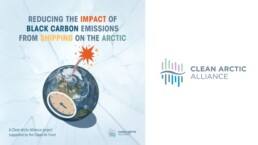

Following the closing of the COP30 climate summit this weekend, the Clean Arctic Alliance criticised the lack of action on fossil fuels, and failure to harness potential quick victories from cutting black carbon and other short-lived climate forcers.
“COP30 promised so much – it’s disappointing that it delivered so little”, said Dr Sian Prior, Lead Advisor, of the Clean Arctic Alliance. “There was a clear lack of urgency amongst governments, in the face of the climate crisis, with a complete dearth of official COP30 attention to easy wins on short-lived climate forcers – like black carbon.”
“However, with less than a fortnight to go for governments to submit a plan for cutting a plan for cutting black carbon emissions from shipping in the Arctic, International Maritime Organization member states – led by Arctic governments – must now respond to the high-level announcement made by several governments – including Canada – at COP30 on sectoral action to tackle black carbon emissions from commercial and residential energy and transport sources”, added Prior.
“These countries clearly recognise the need for urgent action on a potent, short-lived superpollutant where action now could make a real difference in mitigating the impact of climate change and also improve air quality and public health for communities in the Arctic”, said Prior.
See also: Clean Air Fund: Countries make first-of-its-kind announcement to cut black carbon
“Addressing black carbon offers a unique opportunity to advance climate change
mitigation, build climate resilience, improve air quality, safeguard public health, and deliver
sustainable development co-benefits”, said the statement by Canada, Chile, Colombia, Costa Rica, Dominican Republic, Madagascar, Nigeria, Sri Lanka, Uganda.
Governments need to urgently act ahead of the December 5th deadline for proposals on polar fuels, ahead of a meeting of the IMO’s Pollution Prevention and Response committee (PPR 13) in February 2026 in London that will set rules on what fuels can be used in the immediate future by shipping in the Arctic.
Momentum towards these polar fuels is building: the Nordic Council of Ministers recently recommended that Nordic governments work towards the recognition of polar fuels by the IMO and the MARPOL Convention. Now, during COP30, governments have again recognised the need for urgent action on a potent, short-lived superpollutant where action now could make a real difference in mitigating the impact of climate change and also improve air quality and public health for communities in the Arctic.
“As this announcement from COP30 shows, the world is starting to take urgent action on black carbon emissions – we need Arctic governments to take action ahead of the IMO’s December 5th deadline, in order to dramatically reduce black carbon emissions from Arctic shipping”, said Dr Sian Prior, Lead Advisor, of the Clean Arctic Alliance. “By making cleaner fuels (polar fuels) mandatory for shipping in this unique region that is already being dramatically affected by climate change, Arctic governments – and other IMO member states – have a unique opportunity to demonstrate joint leadership on this issue”.
“Black carbon is one of the longest, unresolved issues running at the IMO, and must now be dealt with without delay”, said Prior. “The International Maritime Organization (IMO) has spent more than a decade on scientific analysis and discussions, but black carbon emissions from Arctic shipping remain unregulated. The next opportunity comes in February 2026, when the IMO’s Sub-Committee on Pollution Prevention and Response will meet (PPR 13) to discuss polar fuels.”
“A strong agreement on polar fuels to set rules which will reduce black carbon emission levels from shipping in the Arctic region is essential”, added Prior. “The deadline for submitting proposals is December 5th – and we want to see a concrete proposal led by Arctic states, including Canada, Norway, Iceland, Denmark/Greenland, on polar fuels that will ensure a rapid reduction in Arctic black carbon emissions, ahead of longer-term decarbonisation efforts.”
A regulation requiring the use of polar fuels in the Arctic must set the foundation in MARPOL Annex VI (International Convention for the Prevention of Pollution from Ships) for reductions in emissions which reduce the impact of black carbon on the Arctic.
A recent report by NGO Pacific Environment lays out the case for why the International Maritime Organization (IMO) should immediately act on reducing black carbon pollution — a climate super-pollutant. On Thin Ice: Why Black Carbon Demands Urgent Action, explores how the expansion of Arctic shipping is causing an increase in the release of black carbon into the air, which then settles on snow and ice, accelerating dangerous melting. Switching to readily available and cleaner “polar fuels” — such as marine distillates DMA and DMZ or new fuels with comparable black carbon emissions levels — will rapidly cut emissions, protect vulnerable ecosystems and safeguard communities.



Related News.
Hong Kong Global Maritime Trade Summit to return for third edition
The International Chamber of Shipping, in collaboration with the Transport and Logistics Bureau of the Government of Hong Kong and the Hong Kong…

Appetite for US crude oil exports climbs despite high freight
South Korea tops US crude destinations at 568,600 b/d VLCC rates to Asia double, closing arbitrage window European refining margins…
Shipping stocks Rally as Hormuz Traffic plunges 75%
Ship traffic through the Strait of Hormuz — a critical chokepoint handling about 20% of global crude oil and liquefied natural gas shipments — has…
Diana Shipping announces Time Charter Contract for m/v G P Zafirakis with Classic Maritime
Diana Shipping, a global shipping company specializing in the ownership and bareboat charter-in of dry bulk vessels, announced that, through a…
New IMO ESP Code framework for Remote Inspection Techniques
The International Maritime Organisation, through Resolution MSC.584(111) , has adopted amendments to the International Code on the Enhanced…

ABS opens Offshore & Marine Support Center in Bergen
ABS has expanded its capabilities in the Norwegian maritime market with the opening of a cutting-edge support center in Bergen, bringing advanced…
MOL holds giant step memorial ceremony and beach cleanup at Kashima Coast
Memorial and Reflection 20 Years After the Accident: Learning from the Past to Foster an Even Stronger Safety Culture Mitsui O.S.K. Lines, announced…

KEZAD-based Arabian Gulf Steel Industries achieves lowest verified Carbon Footprint for Rebar
CARES UK verified Environmental Product Declaration confirms 139 kg CO₂e per tonne for rebar produced at AGSI’s KEZAD Abu Dhabi facility Arabian…

Indian Register of Shipping announces launch of first fleet support ship INS Surya
Indian Register of Shipping continues to strengthen its role in supporting the Indian Navy and India’s naval shipbuilding capabilities through the…

VLCCs Climbing the Record Charts
LR2 The TC1 75kt MEG/Japan index decreased by only a single point this week to WS928. The corresponding Baltic round-trip TCE fell by $2,000 to…
Subscribe to our newsletter!
if you dont want to swim alone in the ocean of news, sign up for the newsletter, and you will receive daily all the important news of world shipping!
