

Bridge Resource Management (BRM) has been central to navigational safety for a quarter of a century. Over that time, new bridge systems and equipment, advancing automatic and digitisation have transformed the nature of work, but one factor remains constant: the interface of people and technology and the role of the human element.
Accident investigation reports from around the world continue to show that, when things go wrong, weaknesses in BRM are often a key contributing factor. Common themes include unclear task allocation, ineffective communication, a lack of challenge and response, distraction at critical moments and the absence of a shared mental model on the bridge.
The Australian Transport Safety Bureau’s report into the 2024 allision between the Maersk Shekou and the tall ship STS Leeuwin II in Fremantle is one recent example. The investigation highlighted issues such as incomplete information-sharing on the bridge, limited monitoring of wheel-over points and the impact of competing tasks and communications during a demanding manoeuvre in heavy weather.
For The Nautical Institute, cases like this underscore the importance of BRM becoming a culture of practice where proper planning, alignment and execution of a voyage plan, from berth to berth, is supported by strong leadership, teamwork and sound decision-making, especially under pressure. In this environment, incidents can usually be avoided but if they do occur, they provide an opportunity for learning and continuous improvement for all.
Captain Trevor Bailey FNI, President of The Nautical Institute notes “Harbour approaches in challenging conditions are some of the most demanding evolution we face at sea. When something goes wrong, it is rarely a single-person failure – it is how the entire bridge team functions under pressure. Our focus must always be on learning, reinforcing good practice and supporting seafarers, not on apportioning blame.”
Effective BRM goes beyond mere passage planning. It requires:
- a shared mental model of the ship’s intended track with clearly defined margins of safety that allow for timely interventions by all members of the bridge team
- clear allocation of roles and responsibilities, including how pilots can best serve and be served on the bridge
- open communication where speaking up is expected, not avoided
- active monitoring of the vessel and the factors influencing its progress
- recognition and management of workload, distraction and fatigue
“Despite all the technological advances we’ve heard about in recent months — from AI to autonomous vessels, digital navigation to drone-based surveys — we know that it is human decisions, human intervention and human capability that ultimately drive good safety, performance and practice at sea,” Captain Bailey added. “Let us invest in the human element, respect it, and never underestimate it.”
The Nautical Institute continues to work with seagoing officers , pilots, trainers and human factors specialists worldwide to share lessons learned and promote effective BRM. This includes guidance on working with pilots, running realistic drills and simulations, and embedding non-technical skills such as closed-loop communication, leadership and assertiveness into everyday operations, not just formal training courses.
Supporting bridge teams with practical guidance
For Masters, officers, pilots and trainers seeking structured guidance on good BRM practice, The Nautical Institute’s new Bridge Resource Management series brings together the experience of experts serving at sea and ashore. The two-volume series takes a holistic view of human and technical resources on the modern bridge, with practical chapters on situational awareness, team dynamics, communication, cultural diversity, workload management and voyage planning.
As one contributor, Capt Mert Dağgeçen, notes, the aim is to “share knowledge and experience that will be of particular benefit to younger colleagues, building synergies on the bridge and making the best use of human, machine, internal and external resources.”



Related News.

Navigating the Multi-Orbit Era: In Conversation with Intellian’s Jon Harrison at SMM 2026
At SMM 2026 in Hamburg, the rapid evolution of maritime satellite communications took centre stage. Across the exhibition halls, discussions among…
Cyprus ports need joint energy and investment strategy, shipping agents chief says
Cyprus needs a coordinated strategy for shipping, energy and environmental protection to support port investment and modernisation, Cyprus shipping…

MASO Public Affairs introduces MASO Regulatory Intelligence
A new subscription service helping businesses understand what is changing and what it means for them MASO Public Affairs introduces MASO Regulatory…
Anglo-Eastern helps turn CMBTECH’s ammonia ambition into an operational reality
From early feasibility study and risk-based design to newbuilding supervision, crew readiness and technical management, Anglo-Eastern drew on its…

Escalation of attacks threatens to derail recovery in Middle East oil exports
World oil demand is forecast to fall by 2.5 mb/d y-o-y in 4Q26 and 2.6 mb/d on average in 2026. As the Iran war manifests itself through restricted…
New study finds shipping pays twice its share to EU ETS earmarked revenues should triple to help build market for sustainable fuels and technologies
Shipping is responsible for around 10% of EU ETS emissions but pays almost 20% of the ETS bill. Unlike other sectors, it has never received free…
MSARC strengthens maritime mass rescue readiness through training and national live exercise off Dakar, Senegal
Joint MSARC–FHAS programme combines three days of SAR training with a national multi-agency live exercise The Maritime Search and Rescue Council ,…
Sogese report deliveries are still being delayed as container freight rates fluctuate
FOR IMPORTERS Spot rates into the Mediterranean are back at January levels, Far East to Europe reliability sits at pandemic lows, and nearly…

Glencore begins trading on Australian Securities Exchange
Glencore has begun trading on the Australian Securities Exchange under the ASX code GLC. Gary Nagle, Glencore’s CEO, said it was an exciting day for…
BIMCO Shipping Number of the Week
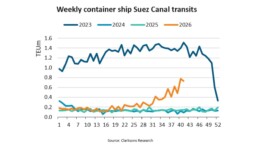
Suez Canal container ship transits exceed 50% of pre-disruption levels "During the first two weeks of October, weekly container ship capacity…
Subscribe to our newsletter!
if you dont want to swim alone in the ocean of news, sign up for the newsletter, and you will receive daily all the important news of world shipping!
