Norway and Arctic nations Must Lead on Cleaner Fuels for Arctic Shipping

Norway has a unique opportunity to stamp its influence on the clean up of Arctic shipping, ahead of an upcoming International Maritime Organization meeting in February 2026 in London that will set rules on what fuels can be used in the immediate future by shipping in the Arctic, according to non-profit organisations Bellona and the Clean Arctic Alliance.
The momentum for this important decision is building: the Nordic Council of Ministers has just made a recommendation for the Nordic governments to work towards the recognition of polar fuels by the IMO and the MARPOL Convention.
“The International Maritime Organization (IMO) has spent more than a decade on scientific analysis and discussions, but black carbon emissions from Arctic shipping remain unregulated”, said Sigurd Enge, Senior Advisor, Shipping at Bellona, a member of the Clean Arctic Alliance. “Now Arctic nations, including Norway, need to act without further delay, to make cleaner fuels (polar fuels) mandatory for shipping in this unique region that is already being affected by climate change. Norway has a unique opportunity to demonstrate joint leadership on this issue, as it has many vessels operating in polar waters.”
“Black carbon is one of the longest, unresolved issues running at the IMO, and must now be dealt with without delay”, said Dr Sian Prior, Lead Advisor, of the Clean Arctic Alliance. “The next opportunity comes in February 2026, when the IMO’s Sub-Committee on Pollution Prevention and Response will meet (PPR 13) to discuss polar fuels.”
“A strong agreement on polar fuels to set rules which will reduce black carbon emission levels from shipping in the Arctic region is essential”, added Prior. “The deadline for submitting proposals is December 5th – and we want to see a concrete proposal led by Arctic states on polar fuels that will ensure a rapid reduction in Arctic black carbon emissions, ahead of longer-term decarbonisation efforts.”
A regulation requiring the use of polar fuels in the Arctic must set the foundation in MARPOL Annex VI (International Convention for the Prevention of Pollution from Ships) for reductions in emissions which reduce the impact of black carbon on the Arctic.
“Norway has been a leader in the past on action to reduce atmospheric emissions from shipping leading to improvements in air quality both domestically in Norway’s fjords, and in the Norwegian Exclusive Economic Zone (EEZ) through an emission control area for the Norwegian sea which takes effect in 2026”, said Enge. A PPR 13 submission, supported by Norway, would showcase Norwegian leadership, place Norway at the centre of mitigating climate impacts from black carbon emissions from shipping across the whole Arctic, and set the global shipping community on the right pathway”.
A recent report by NGO Pacific Environment lays out the case for why the International Maritime Organization (IMO) should immediately act on reducing black carbon pollution — a climate super-pollutant. On Thin Ice: Why Black Carbon Demands Urgent Action, explores how the expansion of Arctic shipping is causing an increase in the release of black carbon into the air, which then settles on snow and ice, accelerating dangerous melting.
From the report: “one major cause of the accelerated Arctic warming is black carbon, a super-pollutant characterized mainly by its high degree of warming potential as a powerful “short-lived climate forcer” — small particles with a relatively brief lifespan in the atmosphere compared to long- lived greenhouse gases like carbon dioxide (CO2). Cutting black carbon emissions will result in immediate climate benefits that slow warming in the Arctic and improve public health”.
Despite over a decade of scientific analysis and discussions at the International Maritime Organization (IMO), black carbon emissions from Arctic shipping remain unregulated, with only non-binding guidance in place. On thin ice: Why black carbon demands urgent action, presents a clear and urgent call for IMO member states to require vessels operating in and near the Arctic to switch to readily available and cleaner “polar fuels” — such as marine distillates DMA and DMZ or new fuels with comparable black carbon emissions levels — to rapidly cut emissions, protect vulnerable ecosystems and safeguard communities.



Related News.

Navigating the Multi-Orbit Era: In Conversation with Intellian’s Jon Harrison at SMM 2026
At SMM 2026 in Hamburg, the rapid evolution of maritime satellite communications took centre stage. Across the exhibition halls, discussions among…
Cyprus ports need joint energy and investment strategy, shipping agents chief says
Cyprus needs a coordinated strategy for shipping, energy and environmental protection to support port investment and modernisation, Cyprus shipping…

MASO Public Affairs introduces MASO Regulatory Intelligence
A new subscription service helping businesses understand what is changing and what it means for them MASO Public Affairs introduces MASO Regulatory…
Anglo-Eastern helps turn CMBTECH’s ammonia ambition into an operational reality
From early feasibility study and risk-based design to newbuilding supervision, crew readiness and technical management, Anglo-Eastern drew on its…

Escalation of attacks threatens to derail recovery in Middle East oil exports
World oil demand is forecast to fall by 2.5 mb/d y-o-y in 4Q26 and 2.6 mb/d on average in 2026. As the Iran war manifests itself through restricted…
New study finds shipping pays twice its share to EU ETS earmarked revenues should triple to help build market for sustainable fuels and technologies
Shipping is responsible for around 10% of EU ETS emissions but pays almost 20% of the ETS bill. Unlike other sectors, it has never received free…

MSARC strengthens maritime mass rescue readiness through training and national live exercise off Dakar, Senegal
Joint MSARC–FHAS programme combines three days of SAR training with a national multi-agency live exercise The Maritime Search and Rescue Council ,…
Sogese report deliveries are still being delayed as container freight rates fluctuate
FOR IMPORTERS Spot rates into the Mediterranean are back at January levels, Far East to Europe reliability sits at pandemic lows, and nearly…
Glencore begins trading on Australian Securities Exchange
Glencore has begun trading on the Australian Securities Exchange under the ASX code GLC. Gary Nagle, Glencore’s CEO, said it was an exciting day for…
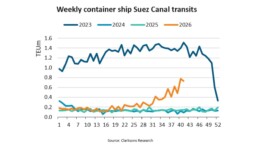
BIMCO Shipping Number of the Week
Suez Canal container ship transits exceed 50% of pre-disruption levels "During the first two weeks of October, weekly container ship capacity…
Subscribe to our newsletter!
if you dont want to swim alone in the ocean of news, sign up for the newsletter, and you will receive daily all the important news of world shipping!
