Red Hat delivers evolving Foundation for Modern IT with latest version of Red Hat Enterprise Linux

Red Hat Enterprise Linux 10.1 and 9.7 bring AI-enhanced capabilities to address IT skills gaps, expanded resistance to quantum threats, and improved operational efficiency across the hybrid cloud.
Red Hat, the world’s leading provider of open source solutions, today introduced the general availability of Red Hat Enterprise Linux 10.1 and 9.7, building on the innovations of Red Hat Enterprise Linux 10 for a more intelligent and future-ready computing foundation. The latest versions of the world’s leading enterprise Linux platform help bridge IT skills gaps with AI-powered, offline Linux management, quantum threat mitigation, and greater control over operational consistency.
Red Hat Enterprise Linux 10.1 and 9.7 provide a strategic and durable operating system platform to address the growing complexities of hybrid cloud computing, compounded by demand for AI workloads. According to a Red Hat-sponsored IDC study1, “IT infrastructure teams are an average of 32% more efficient with Red Hat solutions than non-paid open source alternatives. This opens up significant amounts of staff time to accommodate growth or focus on other business-impacting initiatives.” In addition, “development teams working on their organizations’ Red Hat Enterprise Linux infrastructure see an average productivity gain of 20% compared with using non-paid open source alternatives.” The operating system empowers teams to be more adaptable to dynamic business needs, with modern tooling and simplified management intended to help bring order and efficiency to fragmented business IT estates.
Bridging AI and Linux skills gaps
AI-powered Linux management is foundational to Red Hat Enterprise Linux, with the Red Hat Enterprise Linux command-line assistant greatly lowering the skills barriers to help manage and troubleshoot connected systems. The command-line assistant now has an expanded context limit, so customers can attach more data, making it easier to analyze very large log files and data streams for effective troubleshooting. Additionally, the offline version of the Red Hat Enterprise Linux command-line assistant (in developer preview) is a self-contained tool that runs locally, enabling users to receive AI-powered guidance for Linux tasks in disconnected environments, key for organizations in highly sensitive and regulated industries where cloud services are restricted.
As IT teams rapidly deploy AI solutions, the need to frequently update AI accelerator drivers can cause software conflicts and disrupt production. Red Hat Enterprise Linux customers can now more easily access and install validated drivers for leading AI accelerators from AMD, Intel, and NVIDIA. With these components at the ready, Red Hat Enterprise Linux delivers validated and signed drivers to provide a secure foundation for emerging and mission-critical AI workloads, helping reduce bottlenecks and accelerate the AI/ML lifecycle.
Simplified management and operational efficiency
Red Hat Enterprise Linux continues to smooth IT operations with features that help reduce downtime and provide greater consistency. Red Hat Enterprise Linux 10.1 includes soft-reboots, a new capability in image mode that enables administrators to change system states without needing a full kernel reboot. This provides for faster updates and patching with minimal disruption to business operations, keeping crucial production applications online even during maintenance.
Red Hat Enterprise Linux also supports reproducible builds for container tools in image mode, so container images built with the same content are identical. This enhances security and improves the efficiency of cloud-native application pipelines without limiting time to market for new applications. Additionally, the Automatic Certificate Management Environment (ACME) is now generally available, automating the manual and error-prone task of security certificate updates for production applications and helping to maintain appropriate levels of security and reliability.
Enhanced safeguards against future threats
Building on the post-quantum cryptography capabilities introduced in Red Hat Enterprise Linux 10, Red Hat Enterprise Linux 9.7 now incorporates these same post-quantum cryptography algorithms to help address potential threats posed by future quantum computing. Red Hat Enterprise Linux 10.1 adds enhanced support for post-quantum cryptography in Transport Layer Security (TLS), offering protection for crucial data in transit. Additionally, the OpenTelemetry Collector in Red Hat Enterprise Linux 9 and 10 Cloud Images now supports Trusted Platform Module (TPM) on AWS, Microsoft Azure, and Google Cloud Platform, allowing sensitive operations to be performed within tamper-resistant hardware.
Gaining more control over content and data
Available alongside Red Hat Enterprise Linux 10.1 and Red Hat Enterprise Linux 9.7, Red Hat Satellite 6.18 provides customers with more control over critical data and system components through a centralized management platform for Red Hat Enterprise Linux workloads.
The latest version expands on-premises analytic capabilities, including the general availability of the advisor service and a technology preview for the vulnerability service. The advisor service proactively identifies issues and known configuration risks across your operating system and workloads, with prioritized, automated recommendations. Additionally, the vulnerability service enables on-premises integration to assess, monitor, report, and remediate CVEs that affect your Red Hat Enterprise Linux deployments. For data-sensitive customers, this release provides greater control over the data sent to Red Hat, enabling them to submit only the minimal data required for subscription reporting. Satellite also introduces enhanced reporting options and rolling content views, helping administrators to restrict repository access while still receiving ongoing updates.
Availability
Red Hat Enterprise Linux 10.1 and 9.7 and Satellite 6.18 are now generally available through the Red Hat Customer Portal. The AI accelerator drivers are now available via the extensions and supplementary repositories.
Supporting Quotes
Gunnar Hellekson, vice president and general manager, Red Hat Enterprise Linux, Red Hat
“The latest versions of the world’s leading enterprise platform extend our commitment to delivering a flexible, future-ready foundation for the hybrid cloud needs of today as well as an AI-driven tomorrow. Red Hat Enterprise Linux 10.1 and 9.7 offer IT organizations the tools and capabilities necessary to be more efficient, bridge skills gaps and maintain more consistent systems and management practices, no matter where their workloads run or whatever those workloads are.”
Additional Resources
- Learn more about AI Accelerators
- Read more about the offline RHEL command-line assistant
- See the 10.1 release notes and documentation and 9.7 release notes and documentation
- Visit the Red Hat newsroom for KubeCon North America 2025
Connect with Red Hat
- Learn more about Red Hat
- Get more news in the Red Hat newsroom
- Read the Red Hat blog
- Follow Red Hat on X
- Follow Red Hat on Instagram
- Follow Red Hat on LinkedIn
- Watch Red Hat videos on YouTube
Source: BUSINESS WIRE



Related News.

Navigating the Multi-Orbit Era: In Conversation with Intellian’s Jon Harrison at SMM 2026
At SMM 2026 in Hamburg, the rapid evolution of maritime satellite communications took centre stage. Across the exhibition halls, discussions among…

Cyprus ports need joint energy and investment strategy, shipping agents chief says
Cyprus needs a coordinated strategy for shipping, energy and environmental protection to support port investment and modernisation, Cyprus shipping…

MASO Public Affairs introduces MASO Regulatory Intelligence
A new subscription service helping businesses understand what is changing and what it means for them MASO Public Affairs introduces MASO Regulatory…

Anglo-Eastern helps turn CMBTECH’s ammonia ambition into an operational reality
From early feasibility study and risk-based design to newbuilding supervision, crew readiness and technical management, Anglo-Eastern drew on its…

Escalation of attacks threatens to derail recovery in Middle East oil exports
World oil demand is forecast to fall by 2.5 mb/d y-o-y in 4Q26 and 2.6 mb/d on average in 2026. As the Iran war manifests itself through restricted…

New study finds shipping pays twice its share to EU ETS earmarked revenues should triple to help build market for sustainable fuels and technologies
Shipping is responsible for around 10% of EU ETS emissions but pays almost 20% of the ETS bill. Unlike other sectors, it has never received free…

MSARC strengthens maritime mass rescue readiness through training and national live exercise off Dakar, Senegal
Joint MSARC–FHAS programme combines three days of SAR training with a national multi-agency live exercise The Maritime Search and Rescue Council ,…
Sogese report deliveries are still being delayed as container freight rates fluctuate
FOR IMPORTERS Spot rates into the Mediterranean are back at January levels, Far East to Europe reliability sits at pandemic lows, and nearly…

Glencore begins trading on Australian Securities Exchange
Glencore has begun trading on the Australian Securities Exchange under the ASX code GLC. Gary Nagle, Glencore’s CEO, said it was an exciting day for…
BIMCO Shipping Number of the Week
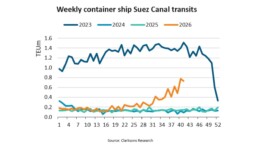
Suez Canal container ship transits exceed 50% of pre-disruption levels "During the first two weeks of October, weekly container ship capacity…
Subscribe to our newsletter!
if you dont want to swim alone in the ocean of news, sign up for the newsletter, and you will receive daily all the important news of world shipping!
