Danish Example shows Canadian Ships can sail without ocean-polluting scrubbers
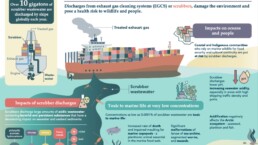

Canada has the opportunity to follow Denmark’s decision to ban the discharge of waste from scrubbers – devices installed on board ships to cut air pollution, and from which toxic effluent is dumped into the marine environment.
“Now that Denmark, along with Sweden and Finland have taken a decisive step to protect marine ecosystems and public health by banning the discharge of scrubber waste from all open-loop scrubbers in their territorial seas, Canada should follow suit to protect fisheries, coastal areas, people, and wildlife at risk”, says Andrew Dumbrille, Director of Equal Routes and Advisor to the Clean Arctic Alliance. “Now is the time to take advantage of the global momentum behind getting rid of this toxic technology that trades one form of pollution for another.”
The Danish ban on scrubbers — also known as Exhaust Gas Cleaning Systems (EGCS) — which came into effect on July 1st, 2025, and extends to the 12 nautical mile (22 km) limit, is designed to reduce both waterborne and airborne pollution from shipping without slowing down maritime trade.
“Almost all political parties in the Danish Parliament supported the scrubber water discharge ban to protect nature and public health,” said Dr. Kaare Press-Kristensen, senior advisor to the NGO Green Global Future. “The impact assessment showed very little costs due to the ban, so it was really a no-brainer for politicians.” Press-Kristensen initiated the political push to regulate scrubber water in Denmark in 2023 and is regarded as the architect behind the national ban. He is now helping Denmark share its experiences with scrubber water discharge restrictions in the Scrubber Water Action Group for flag states at the IMO.
“Waste from open and closed-loop scrubbers is a significant source of environmentally hazardous substances in our marine environment. Once the substances have entered the marine environment, they break down very slowly, and they accumulate on the seabed and in the ocean’s food chains,” said Magnus Heunicke, Danish Minister of the Environment. “This is serious for both marine life and can also be serious for us humans. The regulation is a crucial step towards a better marine environment.”
In Emission Control Areas (ECAs) — sensitive sea regions with stringent environmental rules, which will include the Canadian Arctic in 2027 — ships must either use cleaner fuels that limit sulphur and particle/soot emissions or install scrubbers that “wash” the exhaust with seawater to remove some pollutants. This contaminated water is then dumped directly back into the sea.
“Scrubbers produce nearly 99 per cent of all polluting waste released by ships in Canada. To protect species at risk, communities, and industries that depend on healthy oceans, Canada’s next logical step is to exercise its sovereign authority and ban scrubbers in its internal waters and territorial sea,” says Dr. Sam Davin, Lead Specialist at WWF-Canada. “Internationally, IMO’s Pollution Prevention and Response sub-committee meeting this February is Canada’s opportunity to get the ball rolling by supporting a proposal to launch a global phase-out.”
Studies have clearly documented that the discharge of scrubber waste causes adverse effects in aquatic ecosystems. Furthermore, Canadian studiespresented at the International Maritime Organization show that scrubbers increase air pollution by releasing more toxic particles and climate-damaging black carbon (soot) compared to the cleaner fuels typically used in ECAs — exacerbating public health risks in the places the ECAs are designed to protect. Scrubbers are thereby a nature- and health-damaging loophole used by shipowners to avoid the cleaner and more expensive fuels that should be used to protect nature and people in ECAs.
Contrary to concerns raised by a few opponents, the ban has not reduced shipping activities to or from Denmark. Beginning in 2027, the fifteen contracting parties of the OSPAR Convention, including the UK, France, Spain, and Portugal, will also begin phasing in scrubber discharge bans.
“We see just as much shipping and just as many cruise liners after the ban entered into force. In fact, the industry is expected to grow at least as much as expected before the ban”, added Kaare Press-Kristensen. “The only difference is that ships use cleaner fuels, leading to less damaging water and air pollution.”



Related News.
Hong Kong Global Maritime Trade Summit to return for third edition
The International Chamber of Shipping, in collaboration with the Transport and Logistics Bureau of the Government of Hong Kong and the Hong Kong…

Appetite for US crude oil exports climbs despite high freight
South Korea tops US crude destinations at 568,600 b/d VLCC rates to Asia double, closing arbitrage window European refining margins…
Shipping stocks Rally as Hormuz Traffic plunges 75%
Ship traffic through the Strait of Hormuz — a critical chokepoint handling about 20% of global crude oil and liquefied natural gas shipments — has…
Diana Shipping announces Time Charter Contract for m/v G P Zafirakis with Classic Maritime
Diana Shipping, a global shipping company specializing in the ownership and bareboat charter-in of dry bulk vessels, announced that, through a…
New IMO ESP Code framework for Remote Inspection Techniques
The International Maritime Organisation, through Resolution MSC.584(111) , has adopted amendments to the International Code on the Enhanced…

ABS opens Offshore & Marine Support Center in Bergen
ABS has expanded its capabilities in the Norwegian maritime market with the opening of a cutting-edge support center in Bergen, bringing advanced…

MOL holds giant step memorial ceremony and beach cleanup at Kashima Coast
Memorial and Reflection 20 Years After the Accident: Learning from the Past to Foster an Even Stronger Safety Culture Mitsui O.S.K. Lines, announced…

KEZAD-based Arabian Gulf Steel Industries achieves lowest verified Carbon Footprint for Rebar
CARES UK verified Environmental Product Declaration confirms 139 kg CO₂e per tonne for rebar produced at AGSI’s KEZAD Abu Dhabi facility Arabian…
Indian Register of Shipping announces launch of first fleet support ship INS Surya
Indian Register of Shipping continues to strengthen its role in supporting the Indian Navy and India’s naval shipbuilding capabilities through the…

VLCCs Climbing the Record Charts
LR2 The TC1 75kt MEG/Japan index decreased by only a single point this week to WS928. The corresponding Baltic round-trip TCE fell by $2,000 to…
Subscribe to our newsletter!
if you dont want to swim alone in the ocean of news, sign up for the newsletter, and you will receive daily all the important news of world shipping!
