KIMM AI-based system suppresses shipboard oil fires autonomously
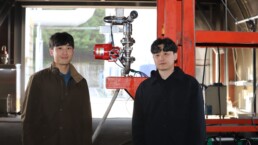

A next-generation fire suppression system capable of autonomously detecting oil fires aboard naval vessels and precisely targeting and extinguishing them even in maritime environments has been developed domestically for the first time. The system uses AI to independently determine the authenticity of a fire, activating only when an actual fire occurs. It concentrates its discharge solely on the fire source, much like a firefighter extinguishing flames.
A research team led by Senior Researcher Hyuk Lee at the AX Convergence Research Center, Virtual Engineering Platform Research Division, Korea Institute of Machinery and Materials (KIMM, President Seog-Hyeon Ryu), under the National Research Council of Science & Technology (NST, Chairman Young-Shik Kim), has developed an autonomous initial suppression firefighting system specialized for shipboard oil fires and successfully completed real-ship trials on an actual vessel.
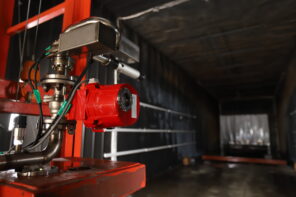
This newly developed initial suppression firefighting system for shipboard oil fires represents an advanced iteration of the research team’s autonomous firefighting technology, specifically engineered for the most common oil fires occurring on naval vessels. Its key feature is the ability to autonomously detect oil fires caused by equipment or aircraft leaks in engine rooms, hangars, decks, etc., and accurately target and extinguish the fire source even under complex environmental conditions such as sea waves and ship motion.
Existing shipboard firefighting systems release extinguishing agents throughout the entire affected area upon fire detection. This approach caused unnecessary damage during false alarms and made precise targeting difficult in maritime environments. In contrast, the technology developed by the KIMM research team combines AI-based precision fire detection with reinforcement learning algorithms for maritime condition adaptation, dramatically overcoming these limitations.
The developed fire suppression system consists of fire detection sensors, fire monitors, and an analysis and control unit equipped with AI-based fire authenticity determination and location estimation capabilities. The system maintains a fire detection accuracy of over 98%, with a foam discharge range reaching approximately 24 meters. It has also been verified to operate stably even in sea states of 3 or higher.
The research team conducted systematic performance verification using a large-scale land-based simulation facility (25m×5m×5m) that perfectly replicates the actual ship environment. Within the simulation facility, which replicated the color and illumination of actual ship compartments, various oil fire conditions and non-fire situations that could be mistaken for fires (lighters, welding, electric heaters, etc.) were reproduced to perform pre-training and accuracy testing of the AI system.
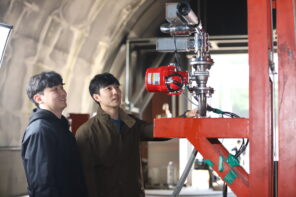
Notably, successful suppression tests were completed for open-area oil fires (maximum 4.5㎡ oil tray) and shielded fires (helicopter-sized shield installed 50cm above a 3.0㎡ oil tray) that could occur from leaks in aircraft carriers, proving the system’s capability to respond to all types of oil fires possible on actual vessels.
Subsequently, the research team conducted real-ship tests aboard the LST-II class amphibious assault ship (ROKS Ilchulbong) and successfully achieved precise targeting of extinguishing water onto a fire source 18m away in actual sea conditions with 1m waves. To accomplish this, they developed and pre-trained a reinforcement learning-based algorithm that recalculates the aiming angle in real-time by reflecting wave and hull motion using only 6-degree-of-freedom acceleration data.
Senior Researcher Hyuk Lee of KIMM stated, “This newly developed initial suppression firefighting system for shipboard oil fires is the world’s first technology to complete step-by-step verification from land-based simulation facilities to actual shipboard environments.” He added, “It can autonomously respond to the most dangerous oil fires on ships in both open and shielded conditions, marking a groundbreaking turning point for crew safety and preserving the ship’s combat effectiveness.” He further noted, “This technology is applicable not only to various naval vessels but also to ammunition depots, military supply warehouses, aircraft hangars, and offshore plants. Its future expansion to civilian ships and petrochemical facilities will significantly enhance fire safety at sea and in industrial settings.”
This research was conducted as part of the ‘Civilian-Military Practical Application Linkage Project’ implemented by the Institute of Civil Military Technology Cooperation. Participants included the Korea Institute of Civil Engineering and Building Technology, Chungnam National University, Super Century Co., Ltd., and the Korea Military Academy.



Related News.

Navigating the Multi-Orbit Era: In Conversation with Intellian’s Jon Harrison at SMM 2026
At SMM 2026 in Hamburg, the rapid evolution of maritime satellite communications took centre stage. Across the exhibition halls, discussions among…
Cyprus ports need joint energy and investment strategy, shipping agents chief says
Cyprus needs a coordinated strategy for shipping, energy and environmental protection to support port investment and modernisation, Cyprus shipping…

MASO Public Affairs introduces MASO Regulatory Intelligence
A new subscription service helping businesses understand what is changing and what it means for them MASO Public Affairs introduces MASO Regulatory…
Anglo-Eastern helps turn CMBTECH’s ammonia ambition into an operational reality
From early feasibility study and risk-based design to newbuilding supervision, crew readiness and technical management, Anglo-Eastern drew on its…
Escalation of attacks threatens to derail recovery in Middle East oil exports
World oil demand is forecast to fall by 2.5 mb/d y-o-y in 4Q26 and 2.6 mb/d on average in 2026. As the Iran war manifests itself through restricted…
New study finds shipping pays twice its share to EU ETS earmarked revenues should triple to help build market for sustainable fuels and technologies
Shipping is responsible for around 10% of EU ETS emissions but pays almost 20% of the ETS bill. Unlike other sectors, it has never received free…
MSARC strengthens maritime mass rescue readiness through training and national live exercise off Dakar, Senegal
Joint MSARC–FHAS programme combines three days of SAR training with a national multi-agency live exercise The Maritime Search and Rescue Council ,…
Sogese report deliveries are still being delayed as container freight rates fluctuate
FOR IMPORTERS Spot rates into the Mediterranean are back at January levels, Far East to Europe reliability sits at pandemic lows, and nearly…
Glencore begins trading on Australian Securities Exchange
Glencore has begun trading on the Australian Securities Exchange under the ASX code GLC. Gary Nagle, Glencore’s CEO, said it was an exciting day for…
BIMCO Shipping Number of the Week
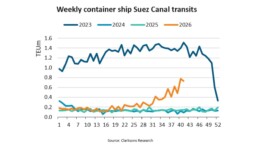
Suez Canal container ship transits exceed 50% of pre-disruption levels "During the first two weeks of October, weekly container ship capacity…
Subscribe to our newsletter!
if you dont want to swim alone in the ocean of news, sign up for the newsletter, and you will receive daily all the important news of world shipping!
