Bluetech Finland’s fully wind-optimized ‘SeaWasp’ tanker concept boosts vessel performance by up to 13.5%
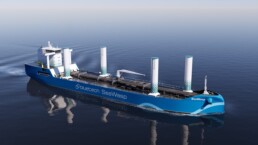

Bluetech’s wind-optimized tanker design models demonstrate significant gains in propulsion power and fuel savings on representative trade routes, based on a joint research project with tanker owner International Seaways.
Bluetech partnered with NYSE-listed INSW to explore a critical question: Can wind propulsion deliver more power in our ships of the future? Advanced simulations using Bluetech’s new ‘SeaWasp’ vessel design showed the answer to be a resounding yes.
PURPOSE-BUILT FOR WIND PERFORMANCE
With the support of wind-propulsion specialist Norsepower, Bluetech modified its BT50 design to extract maximum forward thrust from two 35-metre Rotor SailsTM. This resulted in a total savings of up to 876 kW of propulsion power on one representative INSW MR tanker route from San Francisco to South Korea – equating to around 597.2 MT of fuel per annum. The design modifications alone are estimated to contribute 104 kW or 71.5 MT of the savings, effectively improving the vessel’s overall performance by around 13.5% in certain conditions.
Wind-assisted ship propulsion (WASP or sometimes WAPS) technologies have traditionally been used to add propulsion power to existing ship types that were not originally designed to accommodate such forces. Even newbuild projects that integrate WASP from the planning phase make little or no changes to the ship’s overall design beyond what is necessary to install the units and comply with regulations. However, Bluetech’s designers went back to the drawing board with SeaWasp, creating a vessel that is purpose-designed for wind, but still practical for INSW MR fleet operations.
STRONG FOCUS ON OPERATING PROFILE
“We set out to develop a ship that is entirely WASP-optimized, but maintains every essential operational feature and meets all trade-specific terminal and port restrictions,” said Sam Robin, Director of Energy Savings Solutions at Bluetech.
Michael LaGrassa, Director of Performance and New Construction at INSW, added: “We focused on more than just energy savings and emissions reduction — our goal was a concept design that works in the real-world conditions of the MR trade. That meant ensuring reasonable build costs, equivalent cargo capacity and a design fit for purpose. Our approach was to test a wide range of scenarios across the MR trade, rather than rely on selectively favorable assumptions.”
For this reason, the project also carefully examined the lower end of the savings potential. For example, on a route from South Korea to Singapore, the SeaWasp saves 185.9 MT or 275 kW per annum versus a conventionally powered BT50, due to the prevailing wind directions. Keeping such a baseline allowed for a range in the data analysis and ensured that any commercial projections were realistic.
EFFICIENCY BY DESIGN – ABOVE AND BELOW THE WATERLINE
“On routes where wind propulsion offers limited advantage, the inherent efficiency of the vessel’s core design becomes paramount. The BT50 design is itself approximately 12% more efficient than the typical tanker performance profiles in the sample fleet. Our design modifications enhance that efficiency even further,” said Robin.
One ground-breaking feature beneath the waterline is a unique new fin design dubbed ‘blueSURF’ that computational fluid dynamics (CFD) analysis shows has significant power saving potential. “We were genuinely surprised to see such pronounced benefits in power demand, making the fins an additional powerful design modification that improves the case for WASP deployment,” said Juha Hanhinen, Head of Hydrodynamics at Bluetech. Modifications above the waterline include an aero upper deck and superstructure, as well as semi-enclosed mooring stations to reduce wind disturbance.
COMPARING CONFIGURATIONS
The project also examined which Rotor SailsTM configuration – four smaller 24-metre devices instead of the two 35-metre devices – had the best combination of cost versus thrust. “Each configuration had slightly better performance profiles in different conditions of apparent wind,” said Severi Sarsila, Sales Engineer at Norsepower. Ultimately, the larger pair had a higher potential at the upper end of the savings spectrum and lower overall quoted cost.
“The SeaWasp project has generated some truly innovative naval architecture that can meaningfully improve WASP performance on newbuild vessels,” concluded Robin. William Nugent, Chief Technical and Sustainability Officer at INSW*, added: “The future certainly looks brighter for our next generation of tanker shipping. Creative problem solving following a thorough design process will be one of the keys to success.”



Related News.
Navigating the Multi-Orbit Era: In Conversation with Intellian’s Jon Harrison at SMM 2026
At SMM 2026 in Hamburg, the rapid evolution of maritime satellite communications took centre stage. Across the exhibition halls, discussions among…
Cyprus ports need joint energy and investment strategy, shipping agents chief says
Cyprus needs a coordinated strategy for shipping, energy and environmental protection to support port investment and modernisation, Cyprus shipping…

MASO Public Affairs introduces MASO Regulatory Intelligence
A new subscription service helping businesses understand what is changing and what it means for them MASO Public Affairs introduces MASO Regulatory…
Anglo-Eastern helps turn CMBTECH’s ammonia ambition into an operational reality
From early feasibility study and risk-based design to newbuilding supervision, crew readiness and technical management, Anglo-Eastern drew on its…

Escalation of attacks threatens to derail recovery in Middle East oil exports
World oil demand is forecast to fall by 2.5 mb/d y-o-y in 4Q26 and 2.6 mb/d on average in 2026. As the Iran war manifests itself through restricted…
New study finds shipping pays twice its share to EU ETS earmarked revenues should triple to help build market for sustainable fuels and technologies
Shipping is responsible for around 10% of EU ETS emissions but pays almost 20% of the ETS bill. Unlike other sectors, it has never received free…
MSARC strengthens maritime mass rescue readiness through training and national live exercise off Dakar, Senegal
Joint MSARC–FHAS programme combines three days of SAR training with a national multi-agency live exercise The Maritime Search and Rescue Council ,…
Sogese report deliveries are still being delayed as container freight rates fluctuate
FOR IMPORTERS Spot rates into the Mediterranean are back at January levels, Far East to Europe reliability sits at pandemic lows, and nearly…

Glencore begins trading on Australian Securities Exchange
Glencore has begun trading on the Australian Securities Exchange under the ASX code GLC. Gary Nagle, Glencore’s CEO, said it was an exciting day for…
BIMCO Shipping Number of the Week
Suez Canal container ship transits exceed 50% of pre-disruption levels "During the first two weeks of October, weekly container ship capacity…
Subscribe to our newsletter!
if you dont want to swim alone in the ocean of news, sign up for the newsletter, and you will receive daily all the important news of world shipping!
