Nordic Council backs polar fuels action by governments to cut Arctic Black Carbon Emissions at UN shipping body
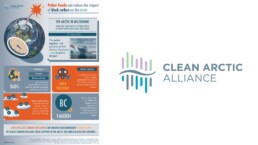

The Clean Arctic Alliance today welcomed adoption by the Nordic Council of a resolution on polar fuels which calls on Nordic governments to create and implement a regulation by the UN shipping body, the International Maritime Organization , that would require the use of cleaner maritime fuels, resulting in lower emissions of black carbon by ships when operating in the Arctic.
During this week’s session in Stockholm, the Nordic Council adopted a Member proposal on polar fuels for a prosperous Arctic: “The Committee for a Sustainable Nordic Region proposes that the Nordic Council recommends that the Nordic governments work to ensure that the International Maritime Organisation (IMO) recognises polar fuels in the MARPOL Convention and to implement regulations that require increased use of polar fuels for ships sailing in the Arctic waters of the Nordic countries.”
The Nordic Council is an official body for inter-parliamentary co-operation comprising 87 MPs elected by Nordic parliaments, from the Aland Islands, Denmark, Faroe Islands,Finland, Greenland, Iceland, Norway, and Sweden.
“The resolution on polar fuels adopted by the Nordic Council this week should spur nordic governments to take the lead on action with IMO Member States to urgently protect the Arctic from the impacts of shipping emissions – in particular black carbon, which has a disproportionate impact on Arctic ice”, said Dr Sian Prior, Lead Advisor to the Clean Arctic Alliance. “The clock is ticking – IMO Member States, led by Nordic governments and other Arctic countries, must urgently develop and adopt a mandatory IMO regulation which would require that only polar fuels can be used by shipping in the Arctic”.
The deadline for submission of concrete proposals for such a regulation isDecember 5th, in order to be accepted to the thirteenth session of an IMO technical committee in February 2026, which addresses pollution prevention and response (PPR13).
“Black carbon is a climate superpollutant produced when fossil fuels are burned”, continued Prior. “It has a disproportionate impact because it both heats the atmosphere – and when released from ship exhausts near to the Arctic settles onto snow and ice, speeding up the melting and exposing darker land and sea beneath, which in turn absorbs more heat. This loss of the planet’s reflectivity – or albedo – is contributing to the fast pace of warming seen in the Arctic.”
“Black carbon emissions from ships burning oil-based fuels have more than doubled in the last decade, yet a simple and easy solution is to require shipping to use widely available distillate fuels with lower black carbon emissions and new zero-emission fuels when operating in and near to the Arctic”, said Prior. “This is why action by the IMO this coming February is crucial, and why Arctic countries must be a driving force in ensuring this action takes place”.



Related News.

Navigating the Multi-Orbit Era: In Conversation with Intellian’s Jon Harrison at SMM 2026
At SMM 2026 in Hamburg, the rapid evolution of maritime satellite communications took centre stage. Across the exhibition halls, discussions among…
Cyprus ports need joint energy and investment strategy, shipping agents chief says
Cyprus needs a coordinated strategy for shipping, energy and environmental protection to support port investment and modernisation, Cyprus shipping…

MASO Public Affairs introduces MASO Regulatory Intelligence
A new subscription service helping businesses understand what is changing and what it means for them MASO Public Affairs introduces MASO Regulatory…
Anglo-Eastern helps turn CMBTECH’s ammonia ambition into an operational reality
From early feasibility study and risk-based design to newbuilding supervision, crew readiness and technical management, Anglo-Eastern drew on its…

Escalation of attacks threatens to derail recovery in Middle East oil exports
World oil demand is forecast to fall by 2.5 mb/d y-o-y in 4Q26 and 2.6 mb/d on average in 2026. As the Iran war manifests itself through restricted…
New study finds shipping pays twice its share to EU ETS earmarked revenues should triple to help build market for sustainable fuels and technologies
Shipping is responsible for around 10% of EU ETS emissions but pays almost 20% of the ETS bill. Unlike other sectors, it has never received free…

MSARC strengthens maritime mass rescue readiness through training and national live exercise off Dakar, Senegal
Joint MSARC–FHAS programme combines three days of SAR training with a national multi-agency live exercise The Maritime Search and Rescue Council ,…
Sogese report deliveries are still being delayed as container freight rates fluctuate
FOR IMPORTERS Spot rates into the Mediterranean are back at January levels, Far East to Europe reliability sits at pandemic lows, and nearly…
Glencore begins trading on Australian Securities Exchange
Glencore has begun trading on the Australian Securities Exchange under the ASX code GLC. Gary Nagle, Glencore’s CEO, said it was an exciting day for…
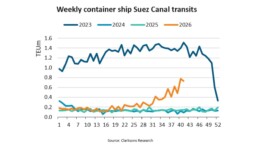
BIMCO Shipping Number of the Week
Suez Canal container ship transits exceed 50% of pre-disruption levels "During the first two weeks of October, weekly container ship capacity…
Subscribe to our newsletter!
if you dont want to swim alone in the ocean of news, sign up for the newsletter, and you will receive daily all the important news of world shipping!
