Mixed picture for Port of Antwerp-Bruges in volatile trade climate
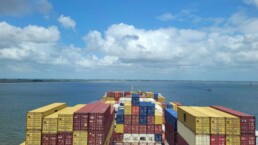

In the first nine months of 2025, Port of Antwerp-Bruges handled 202.6 million tonnes of maritime goods, a decrease of 3.8% compared with the same period last year. The throughput of general cargo, including containers, conventional general cargo and RoRo, increased by 1.3%, while dry and liquid bulk together declined by 12.8%. Following a solid first half of the year, container volumes eased from August onwards, partly as a result of the phase-out of former shipping alliances. Trade with the United States continues to be affected by ongoing uncertainty surrounding US import tariffs.
Key highlights
- Total goods transhipment falls by 3.8% in the first nine months of 2025.
- Container traffic has slowed since August, resulting in less congestion.
- Trade with the US is still growing, but American import duties are putting pressure on exports.
Slowdown in container traffic and declining congestion
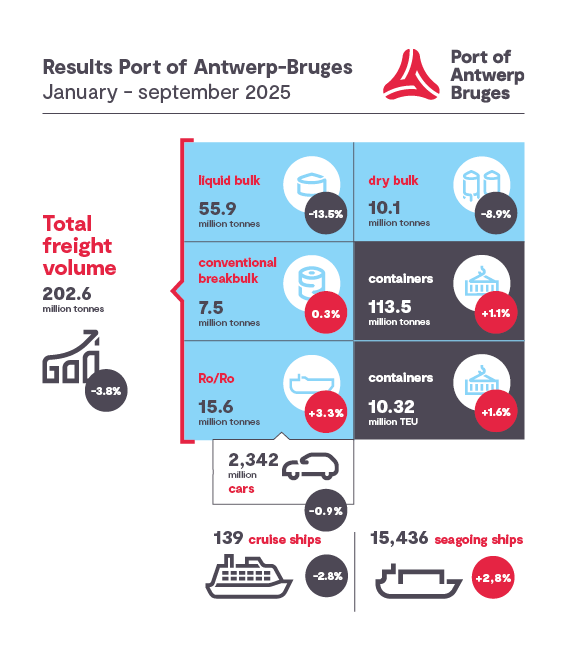
After a solid first half-year, container throughput declined 2.4% in the third quarter year on year. The first nine months saw modest growth, with tonnage rising 1.1% and TEU up 1.6%.
This slowdown is linked to the normalisation of container shipping alliances, which brought an end to the temporary overlap between calls in old and new alliances. This led to a clear reduction in congestion, with quicker turnarounds and smoother traffic to the hinterland.
Port of Antwerp-Bruges’ market share in the Hamburg–Le Havre range dropped 0.7 percentage points to 29.8% in the first half of 2025, largely because of lack of terminal capacity. The bottleneck will be tackled through the ECA project (Extra Container Capacity Antwerp). Low container shipping schedule reliability and a series of strikes however continue to affect operational reliability.
Mixed trends in other segments
Conventional general cargo trade remained status quo after nine months, thanks to a recovery in steel imports, although exports remained under pressure from weaker shipments to a.o. the US and Mexico. Meanwhile, the European Commission unveiled stricter rules to curb foreign steel dumping. Liquid bulk declined 13.5%, hit by weaker petroleum derivatives exports to West Africa and persistent weakness in the European chemical sector. Volumes of biofuels and energy gases continued their growth. The decline in LNG traffic, resulting from the European ban on the transshipment of Russian gas, was partially offset by higher imports from the US. Recent announcements in the European chemicals industry underline the continued pressure on the sector.
Dry bulk (-8.9%) was primarily impacted by weaker fertiliser shipments, partly offset by increased imports from Russia and Morocco, the former ahead of the introduction of new EU duties. The RoRo segment grew by 3.3%, supported by rising imports of new cars from China – despite European import duties introduced at the end of 2024 – as well as higher volumes of trucks and used vehicles. China has now become the leading country of origin for new car imports.
Increasing impact of American trade measures
Shipments to and from the US –Port of Antwerp-Bruges’ second-largest trading partner – grew by 15% in the first nine months of 2025. This growth was primarily driven by containers and liquid bulk. However, since the summer, the impact of US import tariffs has become apparent: exports fell in the third quarter, particularly for steel, which declined by more than a third compared to the second quarter.
Imports remained stable for the time being, supported by a sharp increase in liquid bulk and a threefold rise in LNG volumes. This reinforces Port of Antwerp-Bruges’ role as a gateway for alternative energy flows replacing Russian gas. Container imports from the US also increased by 8%, although growth has slowed slightly since August.
Balance between resilience and uncertainty
The results for the first three quarters of 2025 present a balanced yet challenging picture. After a strong start to the year, container flows are stabilising and pressure on terminals is easing, while traffic with the US remains stable. At the same time, declining exports and the challenging position of the European chemical sector illustrate the port’s sensitivity to geopolitical and economic fluctuations.
Jacques Vandermeiren, CEO Port of Antwerp-Bruges: “The slight decline in our market share is largely explained by congestion in the first half of the year. Volumes were sufficient, but available terminal capacity was inadequate. Rearrangements within shipping alliances also had a temporary impact on the distribution of traffic between ports. We anticipate that our market share will recover as soon as additional capacity becomes available. The quarterly figures also highlight the resilience of Port of Antwerp-Bruges in a particularly volatile economic climate.
Related News.
October 16, 2026
Navigating the Multi-Orbit Era: In Conversation with Intellian’s Jon Harrison at SMM 2026
At SMM 2026 in Hamburg, the rapid evolution of maritime satellite communications took centre stage. Across the exhibition halls, discussions among…

October 16, 2026
Cyprus ports need joint energy and investment strategy, shipping agents chief says
Cyprus needs a coordinated strategy for shipping, energy and environmental protection to support port investment and modernisation, Cyprus shipping…

October 16, 2026
MASO Public Affairs introduces MASO Regulatory Intelligence
A new subscription service helping businesses understand what is changing and what it means for them MASO Public Affairs introduces MASO Regulatory…

October 16, 2026
Anglo-Eastern helps turn CMBTECH’s ammonia ambition into an operational reality
From early feasibility study and risk-based design to newbuilding supervision, crew readiness and technical management, Anglo-Eastern drew on its…

October 16, 2026
Escalation of attacks threatens to derail recovery in Middle East oil exports
World oil demand is forecast to fall by 2.5 mb/d y-o-y in 4Q26 and 2.6 mb/d on average in 2026. As the Iran war manifests itself through restricted…

October 16, 2026
New study finds shipping pays twice its share to EU ETS earmarked revenues should triple to help build market for sustainable fuels and technologies
Shipping is responsible for around 10% of EU ETS emissions but pays almost 20% of the ETS bill. Unlike other sectors, it has never received free…

October 16, 2026
MSARC strengthens maritime mass rescue readiness through training and national live exercise off Dakar, Senegal
Joint MSARC–FHAS programme combines three days of SAR training with a national multi-agency live exercise The Maritime Search and Rescue Council ,…

October 16, 2026
Sogese report deliveries are still being delayed as container freight rates fluctuate
FOR IMPORTERS Spot rates into the Mediterranean are back at January levels, Far East to Europe reliability sits at pandemic lows, and nearly…

October 16, 2026
Glencore begins trading on Australian Securities Exchange
Glencore has begun trading on the Australian Securities Exchange under the ASX code GLC. Gary Nagle, Glencore’s CEO, said it was an exciting day for…

October 16, 2026
BIMCO Shipping Number of the Week
Suez Canal container ship transits exceed 50% of pre-disruption levels "During the first two weeks of October, weekly container ship capacity…
Subscribe to our newsletter!
if you dont want to swim alone in the ocean of news, sign up for the newsletter, and you will receive daily all the important news of world shipping!
Design & Development by P.KAN.DESIGNER
© 2026 Cyprus Shipping News. All rights reserved
Design & Development by P.KAN.DESIGNER
© 2026 Cyprus Shipping News. All rights reserved



