Google Aims for Quantum Computing Breakthrough in 10 Years
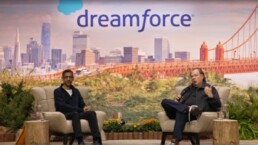

During a conversation with Salesforce CEO Marc Benioff at Salesforce’s annual developer conference Dreamforce 2025 in San Francisco on Oct. 16 (local time), Pichai stated, “Google plans to have a commercially viable quantum computer within a few years,” adding, “I am very optimistic and confident about the realization of quantum computing in 10 years.”
In the tech industry, there are significant concerns that the commercialization of quantum computers could potentially undermine existing encryption and security systems. Pichai cautioned, “I am confident that within 3-5 years, we will reach a point where we need to adapt to quantum computing from an encryption perspective,” adding, “Everyone needs to be mindful of the issue that there could be a very serious trust gap at the moment when vulnerabilities arise at all points, including cryptocurrencies.”
Pichai’s optimism appears to be grounded in the recent Nobel Prize in Physics awarded to Google’s quantum research team. This year’s Nobel Prize in Physics was awarded to John Clauser, Michel Devoret, and John Martinis for their achievements in research on quantum mechanical effects in the macroscopic world. Devoret is a professor at Yale and UC Santa Barbara, as well as a senior scientist for Google Quantum AI. Martinis is also an emeritus professor at UC Santa Barbara and conducted quantum hardware research at Google from 2014 to 2020. This marks a second consecutive achievement for Google, following DeepMind CEO Demis Hassabis’s award last year for the AI protein analysis technology “AlphaFold.”
Pichai emphasized, “Two weeks ago, I visited Google’s quantum research lab in Santa Barbara to meet the team, and a day later, our senior scientist received the Nobel Prize,” adding, “Google has been researching quantum for over a decade, and from a product perspective, the quantum computing team is no different from the Tensor Processing Unit (TPU) team.” TPU is Google’s proprietary AI chipset that has been implemented in data centers since 2016. Just as the preemptive development and introduction of TPU led to the successful construction of efficient data centers, the intention is to leverage technological superiority to secure infrastructure in the quantum era as well.
Pichai also expressed confidence in mounting a full-fledged counterattack in the AI market, where OpenAI has taken the initiative. Responding to Benioff’s question about his reaction to headlines suggesting “Google has a competitor and OpenAI is the true AI leader” after OpenAI released ChatGPT, Pichai acknowledged, “I recognize OpenAI’s merit in preemptively releasing to the consumer market. Google should have captured that moment and executed well,” admitting to the oversight.
However, he added, “Google has been actively implementing transformers since their announcement in 2017, achieving dramatic improvements in search, photos, and other areas. We had also developed a chatbot that became famous for an engineer thinking it had ‘consciousness’ six months before (ChatGPT’s release),” recalling, “Everyone who knew Google’s situation was aware that a chatbot could be released in a few months, but it hadn’t reached a safety level where ‘Google’ could comfortably release it.” This implies that the different environments faced by the startup OpenAI and the big tech company Google made it difficult for Google to readily release an ‘imperfect’ AI.
He continued, “Google possesses not only the infrastructure but also world-class research teams including Google Research, Google Brain, and Google DeepMind, and plans to release Gemini 3.0 this year by integrating these capabilities,” emphasizing, “Gemini 3.0 will be an even more powerful AI agent that has made more noticeable progress than in the past few years.”



Related News.

Navigating the Multi-Orbit Era: In Conversation with Intellian’s Jon Harrison at SMM 2026
At SMM 2026 in Hamburg, the rapid evolution of maritime satellite communications took centre stage. Across the exhibition halls, discussions among…
Cyprus ports need joint energy and investment strategy, shipping agents chief says
Cyprus needs a coordinated strategy for shipping, energy and environmental protection to support port investment and modernisation, Cyprus shipping…

MASO Public Affairs introduces MASO Regulatory Intelligence
A new subscription service helping businesses understand what is changing and what it means for them MASO Public Affairs introduces MASO Regulatory…

Anglo-Eastern helps turn CMBTECH’s ammonia ambition into an operational reality
From early feasibility study and risk-based design to newbuilding supervision, crew readiness and technical management, Anglo-Eastern drew on its…
Escalation of attacks threatens to derail recovery in Middle East oil exports
World oil demand is forecast to fall by 2.5 mb/d y-o-y in 4Q26 and 2.6 mb/d on average in 2026. As the Iran war manifests itself through restricted…
New study finds shipping pays twice its share to EU ETS earmarked revenues should triple to help build market for sustainable fuels and technologies
Shipping is responsible for around 10% of EU ETS emissions but pays almost 20% of the ETS bill. Unlike other sectors, it has never received free…
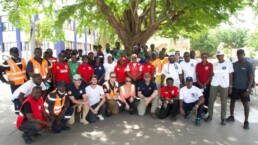
MSARC strengthens maritime mass rescue readiness through training and national live exercise off Dakar, Senegal
Joint MSARC–FHAS programme combines three days of SAR training with a national multi-agency live exercise The Maritime Search and Rescue Council ,…
Sogese report deliveries are still being delayed as container freight rates fluctuate
FOR IMPORTERS Spot rates into the Mediterranean are back at January levels, Far East to Europe reliability sits at pandemic lows, and nearly…
Glencore begins trading on Australian Securities Exchange
Glencore has begun trading on the Australian Securities Exchange under the ASX code GLC. Gary Nagle, Glencore’s CEO, said it was an exciting day for…
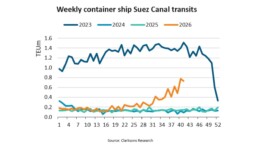
BIMCO Shipping Number of the Week
Suez Canal container ship transits exceed 50% of pre-disruption levels "During the first two weeks of October, weekly container ship capacity…
Subscribe to our newsletter!
if you dont want to swim alone in the ocean of news, sign up for the newsletter, and you will receive daily all the important news of world shipping!
