Vessel fire safety requires more than suppression systems, says ScanReach
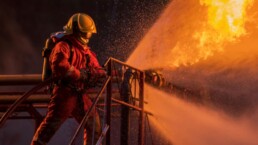

Vessel fires remain one of the industry’s most persistent and costly risks, and they are rising. Allianz’s 2025 Safety & Shipping Review reported a decade-high number of maritime fires in 2024, with 30% involving container, cargo, or ro-ro vessels. Large vessel fires, particularly on containerships, car carriers, and ro-ros, remain a top concern, driven by bigger ships, increasingly complex machinery spaces, and the operational challenges of firefighting and salvage.
Traditional fire safety frameworks rely heavily on manual roll calls, suppression systems, and fixed muster station assignments. In practice, these measures are vulnerable under stress — poor visibility, mismanaged hatches or ventilation, and limited crew familiarity with suppression protocols can compromise how effective they are in practice. Crews may also assume areas are secured while fires continue to spread unnoticed.
While suppression systems remain essential, ScanReach, a leading provider of wireless maritime technology solutions, argues that hardware alone cannot keep pace with modern operational complexity. The company is advocating a shift toward integrated safety frameworks that combine suppression, detection, and real-time personnel visibility.
“Suppression hardware saves lives, but it’s not enough,” says Sven Brooks, CEO at ScanReach. “In today’s electrified vessels, fire dynamics are changing, and knowing where your people are in real time is just as critical as knowing where the fire is.”

Wrongly declared cargo continues to be a major contributor to container and ro-ro fires. Despite regulatory oversight, many incidents result from shippers prioritising convenience over safety. New cargo types, including electric vehicles, batteries, and advanced energy systems, only amplify these risks. Machinery fires also remain common, with increased cargo turnover and trade pressures further challenging onboard safety processes.
ScanReach’s ConnectPOB system addresses the need for greater vigilance by combining real-time crew tracking with suppression and alarm systems. Wearable tags, linked through a wireless mesh network capable of functioning within steel structures, provide continuous visibility of personnel locations, muster progress, and missing individuals — even in zero-visibility conditions.
Through an open API, ConnectPOB integrates with existing detection and management systems, creating a unified data environment that enhances situational awareness and decision-making during emergencies. For operators, this translates into faster, more accurate mustering during drills and live events, instant accountability for crew and contractors, and data-driven insights for audits and post-incident analysis.
With regulators and insurers increasingly assessing measurable readiness, from muster times to procedural redundancy, ScanReach predicts connected systems like ConnectPOB will become a baseline requirement rather than a discretionary upgrade in future.
“Fire suppression is only half the equation,” Mr Brooks concludes. “An integrated approach to awareness is the only way to turn safety protocols from a reactionary into a real-time process.”



Related News.

Navigating the Multi-Orbit Era: In Conversation with Intellian’s Jon Harrison at SMM 2026
At SMM 2026 in Hamburg, the rapid evolution of maritime satellite communications took centre stage. Across the exhibition halls, discussions among…
Cyprus ports need joint energy and investment strategy, shipping agents chief says
Cyprus needs a coordinated strategy for shipping, energy and environmental protection to support port investment and modernisation, Cyprus shipping…

MASO Public Affairs introduces MASO Regulatory Intelligence
A new subscription service helping businesses understand what is changing and what it means for them MASO Public Affairs introduces MASO Regulatory…
Anglo-Eastern helps turn CMBTECH’s ammonia ambition into an operational reality
From early feasibility study and risk-based design to newbuilding supervision, crew readiness and technical management, Anglo-Eastern drew on its…

Escalation of attacks threatens to derail recovery in Middle East oil exports
World oil demand is forecast to fall by 2.5 mb/d y-o-y in 4Q26 and 2.6 mb/d on average in 2026. As the Iran war manifests itself through restricted…
New study finds shipping pays twice its share to EU ETS earmarked revenues should triple to help build market for sustainable fuels and technologies
Shipping is responsible for around 10% of EU ETS emissions but pays almost 20% of the ETS bill. Unlike other sectors, it has never received free…

MSARC strengthens maritime mass rescue readiness through training and national live exercise off Dakar, Senegal
Joint MSARC–FHAS programme combines three days of SAR training with a national multi-agency live exercise The Maritime Search and Rescue Council ,…
Sogese report deliveries are still being delayed as container freight rates fluctuate
FOR IMPORTERS Spot rates into the Mediterranean are back at January levels, Far East to Europe reliability sits at pandemic lows, and nearly…
Glencore begins trading on Australian Securities Exchange
Glencore has begun trading on the Australian Securities Exchange under the ASX code GLC. Gary Nagle, Glencore’s CEO, said it was an exciting day for…
BIMCO Shipping Number of the Week
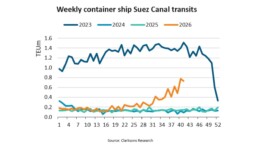
Suez Canal container ship transits exceed 50% of pre-disruption levels "During the first two weeks of October, weekly container ship capacity…
Subscribe to our newsletter!
if you dont want to swim alone in the ocean of news, sign up for the newsletter, and you will receive daily all the important news of world shipping!
