University of Alberta contracts SFL Missions to develop Small Satellite for Study of Space Radiation Impacts on Earth’s Climate
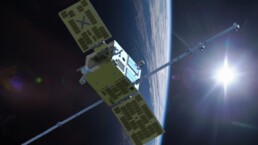

SFL Missions Inc. has been awarded a contract by the University of Alberta for development of the RADICALS small satellite to study the transport of space radiation into Earth’s atmosphere and its impact on climate. The RADiation Impacts on Climate and Atmospheric Loss Satellite (RADICALS) mission is being designed by a consortium of Canadian Universities and SFL Missions, led by the University of Alberta, and funded by the Canada Foundation for Innovation, the Government of Alberta, and the Canadian Space Agency.
Built on the space-proven SFL DEFIANT bus, RADICALS will leverage SFL’s flexibility in attitude control approaches and require the spacecraft to spin end-over-end as it travels in a near-polar orbit around Earth. This will enable its suite of multiple instruments to collect continuous measurements of the full angular distribution of the space radiation which rains down into the Earth’s atmosphere, these 360-degree directional measurements being essential for quantifying the energy input with unprecedented accuracy.
“RADICALS will be a voyage of discovery to understand the space weather impacts on the Earth’s climate system,” said Prof Ian Mann, the mission Principal Investigator from the University of Alberta.
RADICALS will carry three multi-sensor instrument suites – an X-ray Imager (XRI), High Energy Particle Telescope (HEPT), and Magnetometers (MAGS), with a total of 11 sensors.
The RADICALS science team will analyze the measurements collected by the small satellite mission to better characterise space weather, and to understand the effects that space radiation has on the atmosphere, and ultimately its role in the Earth’s climate system. Energetic particles are usually trapped by the Earth’s magnetic field, bouncing back and forth along the field lines. At times of heightened space weather activity, electromagnetic waves in the near-Earth space environment can scatter some of these trapped energetic particles into the atmosphere.
The RADICALS mission will discover the dominant processes which transport these energetic particles into the atmosphere, assess how and when this occurs, and establish their role in coupling the space environment and the Earth’s climate system. Energetic particles from the sun can also enter the Earth’s atmosphere and will be monitored by the RADICALS as it passes over the North and South Poles.
Overall, the RADICALS mission will deliver new physical understanding required to improve space weather forecasting, as well as better understanding of space radiation effects on technological systems, including space radiation warnings for aircraft flying over the poles.
“The primary design objective of RADICALS is creating a spacecraft that is spin stabilized and magnetically quiet,” said SFL Missions Director and CEO Dr. Robert E. Zee. “Mission specifications will also require us to accommodate and coordinate among 11 onboard sensors.”
The SFL Missions team pioneered development of the Attitude Determination and Control System (ADCS) technologies, including miniaturized magnetic torquers and reaction wheels, to keep low-mass spacecraft stable in orbit. For RADICALS, the team is developing a Quiet ADCS mode that does not use torquers and wheels, subsystems which emit electromagnetic energy that could interfere with the measurements being made by the sensitive instruments.
The need for RADICALS to spin while also remaining stable and electromagnetically quiet will require implementation of a spacecraft design called a Thomson Spinner, which will maintain spacecraft stability as it turns perpendicular to its orbital path at a steady rate of at least two rotations per minute. A benefit of the Thomson Spinner is that for extended periods it requires no active control that would create electromagnetic interference with payload sensors.
RADICALS will, however, include magnetic torquers and reaction wheels for activation periodically to correct the small satellite’s alignment to maintain the quality of the science measurements.
Data from the RADICALS satellite will also be used to study severe space weather, which can have significant effects on satellites, telecommunications networks, and space-based global communication and navigation systems.
Visit SFL Missions in Booth 38 at the 2025 International Astronautical Congress (IAC 2025) being held Sept. 29 to Oct. 3 in Sydney, Australia.
Source: BUSINESS WIRE



Related News.
Navigating the Multi-Orbit Era: In Conversation with Intellian’s Jon Harrison at SMM 2026
At SMM 2026 in Hamburg, the rapid evolution of maritime satellite communications took centre stage. Across the exhibition halls, discussions among…
Cyprus ports need joint energy and investment strategy, shipping agents chief says
Cyprus needs a coordinated strategy for shipping, energy and environmental protection to support port investment and modernisation, Cyprus shipping…

MASO Public Affairs introduces MASO Regulatory Intelligence
A new subscription service helping businesses understand what is changing and what it means for them MASO Public Affairs introduces MASO Regulatory…

Anglo-Eastern helps turn CMBTECH’s ammonia ambition into an operational reality
From early feasibility study and risk-based design to newbuilding supervision, crew readiness and technical management, Anglo-Eastern drew on its…

Escalation of attacks threatens to derail recovery in Middle East oil exports
World oil demand is forecast to fall by 2.5 mb/d y-o-y in 4Q26 and 2.6 mb/d on average in 2026. As the Iran war manifests itself through restricted…
New study finds shipping pays twice its share to EU ETS earmarked revenues should triple to help build market for sustainable fuels and technologies
Shipping is responsible for around 10% of EU ETS emissions but pays almost 20% of the ETS bill. Unlike other sectors, it has never received free…
MSARC strengthens maritime mass rescue readiness through training and national live exercise off Dakar, Senegal
Joint MSARC–FHAS programme combines three days of SAR training with a national multi-agency live exercise The Maritime Search and Rescue Council ,…
Sogese report deliveries are still being delayed as container freight rates fluctuate
FOR IMPORTERS Spot rates into the Mediterranean are back at January levels, Far East to Europe reliability sits at pandemic lows, and nearly…

Glencore begins trading on Australian Securities Exchange
Glencore has begun trading on the Australian Securities Exchange under the ASX code GLC. Gary Nagle, Glencore’s CEO, said it was an exciting day for…
BIMCO Shipping Number of the Week
Suez Canal container ship transits exceed 50% of pre-disruption levels "During the first two weeks of October, weekly container ship capacity…
Subscribe to our newsletter!
if you dont want to swim alone in the ocean of news, sign up for the newsletter, and you will receive daily all the important news of world shipping!
