Ontegos cloud survey freight forwarders optimistic about AI but poor data quality threatens early adoption


An August-September survey of over 800 forwarder and logistics industry professionals by Ontegos Cloud, a leading freight forwarder profitability solutions provider, found that three in four firms lack the data foundation to successfully adopt AI solutions.
Key survey findings:
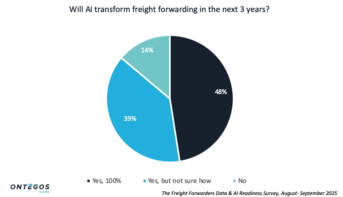
- 48% of freight professionals are confident AI will transform the industry in three years, but 39% are unsure how and 14% remain unconvinced.
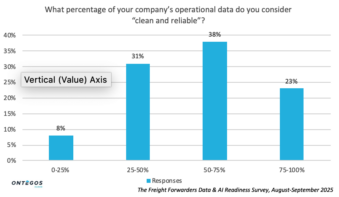
- Only 23% say their company’s data is 75-100% clean and reliable, leaving most unprepared for effective AI adoption.
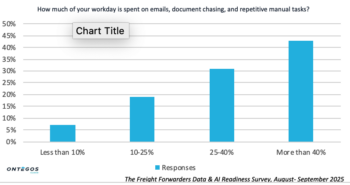
- Over 70% of professionals spend at least a quarter of their day on manual tasks like emails and document chasing, highlighting urgent need for automation.
A new survey of nearly 800 freight forwarding and logistics professionals by Ontegos Cloud has revealed a striking disconnect between industry optimism for artificial intelligence (AI) and the data readiness of companies to put it into practice.
The research shows that while almost half of logistics professionals expect AI to reshape freight forwarding within the next three years, most companies still lack the reliable data foundations required to adopt these solutions successfully. At the same time, manual work continues to dominate day-to-day operations, underscoring the urgent need for automation.
AI optimism, but uncertainty remains
48% of respondents are confident that AI will transform freight forwarding in the next three years. But enthusiasm is tempered by uncertainty.
More than a third (39%) say they believe AI will play a role but are unclear how it will impact operations. A further 14% remain unconvinced that AI will deliver meaningful change at all.
This mixed outlook suggests that while the hype around AI is strong, the pathway to practical adoption is far from clear for many operators.
Data quality poses a major roadblock
The survey also exposed a significant challenge: poor-quality data. Just 23% of respondents say that three-quarters or more of their company’s data is clean and reliable. A larger group, 38%, admit that only 50-75% of their data can be trusted, while nearly a third (31%) say less than half of their data is dependable.
For an industry built on precision, this data integrity gap is more than an inconvenience – it is a direct barrier to AI adoption. Without accurate, structured data, even the most advanced AI tools cannot perform effectively.
Oliver Gritz, Founder and Managing Director of Ontegos Cloud, commented:
“The optimism around AI is real. Almost half of freight professionals believe it will transform the industry within just three years. But what is missing is clarity on how this will actually happen. Too many assume today’s AI can turn messy, unstructured data into a masterpiece of accuracy, when in fact the opposite is true.
“At the core of every successful AI project is a structured company data model and a reliable system architecture. Without that discipline, the promises of AI will remain out of reach. This is why data quality matters so much. If the information feeding these systems cannot be trusted, AI will fail to deliver consistent, real-world results.”
Manual work still dominates daily operations
The survey further revealed how much time is still lost to repetitive, low-value tasks. More than 70% of professionals report spending at least a quarter of their working day on manual processes such as chasing documents and responding to emails. Within this group, 43% spend more than 40% of their time on these tasks, while 31% spend between 25% and 40%. Only a small minority – 7% of respondents – manage to keep such manual work below 10% of their workload.
This reliance on outdated, paper-driven processes not only erodes productivity but also prevents freight forwarders from scaling the automation required for effective AI adoption, according to Gritz.
He added:
“It is clear that logistics professionals spend far too much time on repetitive manual tasks. These inefficiencies are exactly what AI is meant to solve, yet the industry is not ready to let it. The reason is simple: the data foundations are not there. The industry’s real challenge is to put its house in order – to build data it can trust. Only then will AI be able to live up to its potential.”
Outlook
The survey findings point to both a challenge and an opportunity for the freight forwarding sector. Companies that act now to clean and structure their data, while reducing reliance on manual processes, will be best positioned to capture the benefits of AI.
Gritz concluded:
“The logistics industry is rightly excited about AI. But until organisations fix their data and tackle the heavy burden of manual work, AI’s full potential will remain out of reach. Those that invest now in automation and data reliability will lead the industry into its next decade of transformation.”



Related News.

Hong Kong Global Maritime Trade Summit to return for third edition
The International Chamber of Shipping, in collaboration with the Transport and Logistics Bureau of the Government of Hong Kong and the Hong Kong…

Appetite for US crude oil exports climbs despite high freight
South Korea tops US crude destinations at 568,600 b/d VLCC rates to Asia double, closing arbitrage window European refining margins…

Shipping stocks Rally as Hormuz Traffic plunges 75%
Ship traffic through the Strait of Hormuz — a critical chokepoint handling about 20% of global crude oil and liquefied natural gas shipments — has…

Diana Shipping announces Time Charter Contract for m/v G P Zafirakis with Classic Maritime
Diana Shipping, a global shipping company specializing in the ownership and bareboat charter-in of dry bulk vessels, announced that, through a…

New IMO ESP Code framework for Remote Inspection Techniques
The International Maritime Organisation, through Resolution MSC.584(111) , has adopted amendments to the International Code on the Enhanced…

ABS opens Offshore & Marine Support Center in Bergen
ABS has expanded its capabilities in the Norwegian maritime market with the opening of a cutting-edge support center in Bergen, bringing advanced…

MOL holds giant step memorial ceremony and beach cleanup at Kashima Coast
Memorial and Reflection 20 Years After the Accident: Learning from the Past to Foster an Even Stronger Safety Culture Mitsui O.S.K. Lines, announced…

KEZAD-based Arabian Gulf Steel Industries achieves lowest verified Carbon Footprint for Rebar
CARES UK verified Environmental Product Declaration confirms 139 kg CO₂e per tonne for rebar produced at AGSI’s KEZAD Abu Dhabi facility Arabian…

Indian Register of Shipping announces launch of first fleet support ship INS Surya
Indian Register of Shipping continues to strengthen its role in supporting the Indian Navy and India’s naval shipbuilding capabilities through the…

VLCCs Climbing the Record Charts
LR2 The TC1 75kt MEG/Japan index decreased by only a single point this week to WS928. The corresponding Baltic round-trip TCE fell by $2,000 to…
Subscribe to our newsletter!
if you dont want to swim alone in the ocean of news, sign up for the newsletter, and you will receive daily all the important news of world shipping!
