bound4blue secures LR validation for Pwind calculation methodology, supporting regulatory and financial gains for shipowners
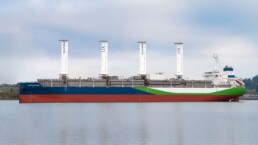

- Lloyd’s Register validates bound4blue’s ‘wind propulsion system force matrix’ methodology for calculating Pwind in line with IMO guidance.
- Critical step enabling shipowners to leverage wind-assisted propulsion for FuelEU, and EEXI/EEDI compliance and cost reductions.
- Validation builds trust and establishes efficient, regulation-ready framework for scaling wind propulsion.
bound4blue has taken another step forward in its mission to accelerate and simplify the adoption of wind power, with the validation of its ‘wind propulsion system force matrix calculation methodology’ by Lloyd’s Register . The validation gives shipowners a robust, credible and compliant means to calculate the Pwind value of installations, ensuring they unlock full regulatory (and cost) benefits under frameworks such as FuelEU Maritime, and EEDI/EEXI.
LR validated the approach, which utilizes advanced CFD-based (Computational Fluid Dynamics) calculations, validated with wind tunnel test results. The installation earlier this year of four bound4blue eSAILs® onboard juice carrier M.V. Atlantic Orchard, chartered by Louis Dreyfus Company (LDC) and owned by Wisby Tankers, is the first to benefit from this methodology validation.
Building confidence
With this validation, shipowners can now take advantage of a reliable tool to calculate the regulatory benefits of the unique suction sail technology without the need for full-scale testing, saving significant time and money. As Alberto Llopis, Head of Aerodynamics at bound4blue explains, this helps build trust and ease acceptance for the company’s systems as wind assisted propulsion “truly takes off” in the market.
“Validation by Lloyd’s Register is a key enabler for shipowners who want to realize the full value of wind propulsion,” comments Alberto. “By confirming our methodology aligns with all applicable international Rules and Standards, it ensures our clients can confidently calculate Pwind to simplify regulatory compliance and unlock substantial financial savings. It removes uncertainty and enables more informed decision-making, underlining the attractiveness of wind as a prime mover in maritime’s much-needed energy transition.”

A methodology that matters
Pwind is the calculated propulsive power available from a wind assisted propulsion system (WAPS), such as the eSAIL®, and plays a central role in environmental compliance.
Defined under IMO’s “2021 Guidance on treatment of innovative energy efficiency technologies” (MEPC.1/Circ.896), Pwind can be deducted from a ship’s required engine power under EEXI/EEDI calculations, reducing the vessel’s regulatory burden. It is also directly linked to the Wind Reward Factor in FuelEU Maritime, potentially relaxing GHG targets and lowering compliance-related expenses.
The force matrix – which represents the thrust characteristics of a WAPS under various wind conditions – must be installation-specific (considering both sail-to-sail and ship-to-sail aerodynamic interactions) and validated by an independent verifier. LR’s validation confirms that bound4blue’s methodology meets the standards set by IMO, ensuring consistency and transparency.
Speaking about the implications of the process, LR Advisory Ship Performance Manager, Dr Santiago Suarez de la Fuente said: “As the maritime industry works towards ambitious decarbonization targets, shipowners and technology developers need confidence that their investments align with both evolving regulatory expectations and their own objectives. At LR, we’re proud to support the safe and effective adoption of breakthrough technologies, such as bound4blue’s eSAILs®, by providing transparent, independent validation shipping companies can rely upon. We’d like to thank both bound4blue and LDC for their excellent collaboration on this project.”
Accelerating acceptance
LR’s validation is more than a standalone achievement. While force matrices must be calculated specifically for each ship and sail installation, the validated methodology is now transferable across future projects. This means that any new eSAIL® installation using the same CFD-based approach can efficiently obtain a verified Pwind – streamlining compliance, accelerating project timelines, and making the business case for wind propulsion even stronger.
“At LDC, we see validated wind power solutions as a clear win: one that supports our ambitious decarbonization goals, saves fuel costs and delivers strong regulatory advantages,” says Fabian Kowatsch, LDC’s Shipping Decarbonization Lead. “Thanks to the Pwind validation, we can now factor wind propulsion into our regulatory planning, accurately calculate the FuelEU Wind Reward Factor and significantly reduce our compliance costs.”
Mounting momentum
Demand for wind propulsion solutions, such as suction sails, is increasing since the advent of the FuelEU Maritime regulation. Wind is the only power source actively rewarded through the framework, with compliance targets for relevant vessels relaxed by up to 5%. eSAILs® also create energy efficiency benefits for EEDI and EEXI, reduce emissions and costs relating to EU ETS, and positively impact CII ratings.
bound4blue’s fully autonomous units are riding this wave of momentum, with recent orders placed by companies such as Maersk Tankers, Marflet Marine, Klaveness Combination Carriers, Eastern Pacific Shipping and other leading shipping companies. The mechanically simple, proven technology has a typical payback period of less than five years and is suitable for either newbuilds or retrofitting across a diverse array of vessel segments. This includes, but is not limited to, Tankers, Bulkers, Ro-Ros, Cruise vessels, Ferries, Gas Carriers and General Cargo vessels.



Related News.

Navigating the Multi-Orbit Era: In Conversation with Intellian’s Jon Harrison at SMM 2026
At SMM 2026 in Hamburg, the rapid evolution of maritime satellite communications took centre stage. Across the exhibition halls, discussions among…

Cyprus ports need joint energy and investment strategy, shipping agents chief says
Cyprus needs a coordinated strategy for shipping, energy and environmental protection to support port investment and modernisation, Cyprus shipping…

MASO Public Affairs introduces MASO Regulatory Intelligence
A new subscription service helping businesses understand what is changing and what it means for them MASO Public Affairs introduces MASO Regulatory…

Anglo-Eastern helps turn CMBTECH’s ammonia ambition into an operational reality
From early feasibility study and risk-based design to newbuilding supervision, crew readiness and technical management, Anglo-Eastern drew on its…

Escalation of attacks threatens to derail recovery in Middle East oil exports
World oil demand is forecast to fall by 2.5 mb/d y-o-y in 4Q26 and 2.6 mb/d on average in 2026. As the Iran war manifests itself through restricted…

New study finds shipping pays twice its share to EU ETS earmarked revenues should triple to help build market for sustainable fuels and technologies
Shipping is responsible for around 10% of EU ETS emissions but pays almost 20% of the ETS bill. Unlike other sectors, it has never received free…

MSARC strengthens maritime mass rescue readiness through training and national live exercise off Dakar, Senegal
Joint MSARC–FHAS programme combines three days of SAR training with a national multi-agency live exercise The Maritime Search and Rescue Council ,…

Sogese report deliveries are still being delayed as container freight rates fluctuate
FOR IMPORTERS Spot rates into the Mediterranean are back at January levels, Far East to Europe reliability sits at pandemic lows, and nearly…

Glencore begins trading on Australian Securities Exchange
Glencore has begun trading on the Australian Securities Exchange under the ASX code GLC. Gary Nagle, Glencore’s CEO, said it was an exciting day for…

BIMCO Shipping Number of the Week
Suez Canal container ship transits exceed 50% of pre-disruption levels "During the first two weeks of October, weekly container ship capacity…
Subscribe to our newsletter!
if you dont want to swim alone in the ocean of news, sign up for the newsletter, and you will receive daily all the important news of world shipping!
