
Chart of recent deficiencies in ballast water management, based on Paris Memorandum of Understanding (MoU) data.
Why record-keeping matters more than ever
Historically, most ballast water deficiencies flagged by inspectors haven’t come from failed systems, but from poor documentation. The Paris MoU’s latest figures show that well over half of recorded cases relate to record books – whether incomplete, inconsistent or missing entirely. DNV data from 2024–2025 confirms the same picture: administrative errors and inconsistent documentation are among the most frequent findings.
These aren’t minor oversights. A mismatch between what’s written in the logbook and what the BWMS shows in practice can lead to fines, detentions, or even delays in port entry. The problem is compounded by outdated reporting templates, fragmented digital records and the pressure crews face to keep up with a growing mountain of paperwork.
The new amendments adopted at MEPC 82 and 83 raise the bar further. Since February 2025, ballast water records must include more detailed information on maintenance, contingency actions during malfunctions, and crew familiarity with the system. MEPC 83 doubled down on this trajectory by reinforcing data reporting requirements across the board, from GHG emissions to ballast water handling, and creating a compliance landscape where paperwork and performance are increasingly inseparable. In this new era of regulations, shipowners need to reassess whether their current compliance solutions are fit for purpose , or if they’re the cause of errors and inefficiencies.
Traditional record-keeping simply cannot keep pace. Paper logs are easily lost or damaged, handwritten entries are prone to error and misinterpretation, and even standalone digital logs often fall short if they aren’t kept up to date, validated against live operational data or are evaluated in silos.
The operational challenge for crews
Crews already juggle voyage planning, safety drills, emission reporting, and inspections. Adding complex ballast water documentation to the mix can compound workload pressures, especially when records are still maintained manually or on disconnected systems. Mistakes creep in, entries get missed and compliance gaps appear.
This is not just an administrative issue. Each discrepancy carries risk: costly delays, failed inspections, or reputational damage for owners. Further, the stress of keeping up with compliance admin work can distract people from what matters most – running safe and efficient operations.
The answer is to move towards integrated digital platforms that take much of the manual burden away from crews while ensuring data accuracy and consistency.
A digital solution with a human touch
Modern digital logbooks are more than electronic replacements for paper logbooks but they remain tools, rather than replacements, for people. Both human intelligence and digital solutions need to work in harmony to avoid costly detentions or delays.
Developed for and with seafarers, electronic logbooks, like NAPA Logbook, help simplify ballast water record-keeping and support environmental reporting, in line with regulations like MARPOL, EU-MRV, EU ETS, and IMO-DCS, to enable teams onshore and onboard to confidently comply with regulations. These e-logbooks guide crew in inputting the right information, ensure potential mistakes are flagged, and fields are automatically populated with data from onboard systems. This level of automation and standardization reduces administrative burden, ensures vessels remain inspection-ready and that what’s written in the logbook actually matches what the BWMS has been doing.
When integrated with shoreside platforms such as NAPA Fleet Intelligence, digital tools connect ship and shore to create a single source of truth. BWMS data becomes part of a wider compliance and performance ecosystem, enabling real-time sharing with technical managers and independent verifiers like DNV’s Emission Connect. This eliminates redundant data entry, shortens reporting cycles, and establishes a centralized repository for compliance documentation, emissions accounting, and strategic decision-making.
For crews, the benefits are immediate: less time spent filling out forms, more confidence that records meet requirements and reduced stress during inspections. For ship owners and managers, the payoff is fewer compliance risks and stronger operational resilience.
More than compliance
The 2025 PSC CIC sheds light on an uncomfortable truth: ballast water noncompliance is preventable. Compliance is ultimately about accountability and preparedness, and shipowners who adopt digital tools are not only future-proofing their operations but are also reducing risk, freeing up resources and enabling crews to focus on what matters most: operating safe and efficient vessels. At its heart, this is also a people-focused story. Streamlined compliance eases workload pressures and helps create a more manageable, fulfilling workplace for seafarers.
Source: By Tommi Vihavainen, Director of Development, NAPA



Related News.

Navigating the Multi-Orbit Era: In Conversation with Intellian’s Jon Harrison at SMM 2026
At SMM 2026 in Hamburg, the rapid evolution of maritime satellite communications took centre stage. Across the exhibition halls, discussions among…

Cyprus ports need joint energy and investment strategy, shipping agents chief says
Cyprus needs a coordinated strategy for shipping, energy and environmental protection to support port investment and modernisation, Cyprus shipping…

MASO Public Affairs introduces MASO Regulatory Intelligence
A new subscription service helping businesses understand what is changing and what it means for them MASO Public Affairs introduces MASO Regulatory…
Anglo-Eastern helps turn CMBTECH’s ammonia ambition into an operational reality
From early feasibility study and risk-based design to newbuilding supervision, crew readiness and technical management, Anglo-Eastern drew on its…

Escalation of attacks threatens to derail recovery in Middle East oil exports
World oil demand is forecast to fall by 2.5 mb/d y-o-y in 4Q26 and 2.6 mb/d on average in 2026. As the Iran war manifests itself through restricted…
New study finds shipping pays twice its share to EU ETS earmarked revenues should triple to help build market for sustainable fuels and technologies
Shipping is responsible for around 10% of EU ETS emissions but pays almost 20% of the ETS bill. Unlike other sectors, it has never received free…

MSARC strengthens maritime mass rescue readiness through training and national live exercise off Dakar, Senegal
Joint MSARC–FHAS programme combines three days of SAR training with a national multi-agency live exercise The Maritime Search and Rescue Council ,…
Sogese report deliveries are still being delayed as container freight rates fluctuate
FOR IMPORTERS Spot rates into the Mediterranean are back at January levels, Far East to Europe reliability sits at pandemic lows, and nearly…

Glencore begins trading on Australian Securities Exchange
Glencore has begun trading on the Australian Securities Exchange under the ASX code GLC. Gary Nagle, Glencore’s CEO, said it was an exciting day for…
BIMCO Shipping Number of the Week
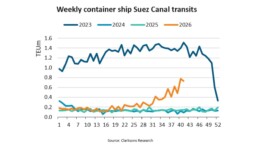
Suez Canal container ship transits exceed 50% of pre-disruption levels "During the first two weeks of October, weekly container ship capacity…
Subscribe to our newsletter!
if you dont want to swim alone in the ocean of news, sign up for the newsletter, and you will receive daily all the important news of world shipping!
