SES partners with Cailabs to test Next-Generation Laser Communication Technology


Leading space solutions company will use optical ground stations to deliver faster, more secure data from space
SES, a leading space solutions company, announced today it will test new optical ground stations built by France-based Cailabs to send data from space using laser beams instead of radio waves. By using optical communication, SES expects to be able to boost data transmission speeds, provide more secure links, and help alleviate congestion in increasingly crowded radio frequency bands.
The partnership marks a major step forward for optical communications, which use light beams to transmit data at speeds of up to 10 gigabits per second—about 100 times faster than typical home internet. Unlike traditional radio signals, laser beams are nearly impossible to intercept or jam, making them ideal for secure government and business communications.
The biggest challenge with optical communication to space has always been Earth’s atmosphere. Just as stars appear to twinkle due to atmospheric turbulence, laser beams wobble and break up as they pass through moving air. Cailabs solved this problem with technology called Multi-Plane Light Conversion (MPLC), which works like adaptive glasses that constantly adjust to keep the laser signal clear and strong.
“Our Optical Ground Station technology, already field-proven with a variety of satellites and terminals, offers top performance in mitigating atmospheric turbulence and maintaining resilient communications, while delivering features that are essential for secure communications in today’s most demanding environments,” said Jean-François Morizur, CEO of Cailabs.
The new ground stations, called TILBA-OGS L10, will enable SES to begin testing space-to-ground optical links ahead of integrating them into commercial services. Each station can handle two-way transmissions at 10 Gbps and can be operated remotely, making them practical for widespread deployment.
“Optical communication can provide much higher bandwidth, better data security, and less risk of spectrum congestion,” said Carmel Ortiz, SVP of MEO Programs at SES. “The Cailabs Optical Ground Stations can play a central role in our global network of gateways with access to high-throughput infrastructure.”
Since the 1960s, radio waves have dominated space communications, but the transition to optical systems is gaining momentum. The radio spectrum is becoming increasingly crowded as more satellites launch, leading to interference and limited bandwidth availability. Laser communication, which uses light rather than radio waves, opens up an entirely new spectrum and brings critical advantages such as low probability of intercept (LPI), low probability of detection (LPD), and low probability of exploitation (LPE).
Source: BUSINESS WIRE



Related News.

Navigating the Multi-Orbit Era: In Conversation with Intellian’s Jon Harrison at SMM 2026
At SMM 2026 in Hamburg, the rapid evolution of maritime satellite communications took centre stage. Across the exhibition halls, discussions among…
Cyprus ports need joint energy and investment strategy, shipping agents chief says
Cyprus needs a coordinated strategy for shipping, energy and environmental protection to support port investment and modernisation, Cyprus shipping…

MASO Public Affairs introduces MASO Regulatory Intelligence
A new subscription service helping businesses understand what is changing and what it means for them MASO Public Affairs introduces MASO Regulatory…

Anglo-Eastern helps turn CMBTECH’s ammonia ambition into an operational reality
From early feasibility study and risk-based design to newbuilding supervision, crew readiness and technical management, Anglo-Eastern drew on its…
Escalation of attacks threatens to derail recovery in Middle East oil exports
World oil demand is forecast to fall by 2.5 mb/d y-o-y in 4Q26 and 2.6 mb/d on average in 2026. As the Iran war manifests itself through restricted…
New study finds shipping pays twice its share to EU ETS earmarked revenues should triple to help build market for sustainable fuels and technologies
Shipping is responsible for around 10% of EU ETS emissions but pays almost 20% of the ETS bill. Unlike other sectors, it has never received free…
MSARC strengthens maritime mass rescue readiness through training and national live exercise off Dakar, Senegal
Joint MSARC–FHAS programme combines three days of SAR training with a national multi-agency live exercise The Maritime Search and Rescue Council ,…
Sogese report deliveries are still being delayed as container freight rates fluctuate
FOR IMPORTERS Spot rates into the Mediterranean are back at January levels, Far East to Europe reliability sits at pandemic lows, and nearly…
Glencore begins trading on Australian Securities Exchange
Glencore has begun trading on the Australian Securities Exchange under the ASX code GLC. Gary Nagle, Glencore’s CEO, said it was an exciting day for…
BIMCO Shipping Number of the Week
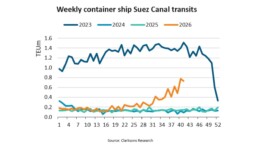
Suez Canal container ship transits exceed 50% of pre-disruption levels "During the first two weeks of October, weekly container ship capacity…
Subscribe to our newsletter!
if you dont want to swim alone in the ocean of news, sign up for the newsletter, and you will receive daily all the important news of world shipping!
