Tackling the hidden costs of reactive engine maintenance in maritime operations


In a market where margins are tightening and environmental regulations are intensifying, inconsistent engine monitoring is quietly eroding vessel performance. As decarbonisation pressures mount, precise control over engine efficiency and emissions is no longer optional. Unseen machinery inefficiencies contributes not only to higher OPEX but also to excess CO₂ output, now penalised under schemes like EU ETS.
“Shipowners understand that engine performance matters, but what they lack is visibility—where, when, and how performance starts to degrade,” says Pankaj Sharma, MD of OneLink. “What they need is a solution that gives them exactly that clarity, turning reactive fixes, lagging indicators or guesswork into proactive intelligence.”
In a recent study by OneLink, 13% of vessels across a European mixed cargo fleet with poor machinery routine maintenance practices showed progressive sludge accumulation over just 3–6 months. This buildup leads to rising operational inefficiencies like rising fuel consumption and exhaust temperature anomalies often culminating in emergency repairs and unscheduled maintenance costing between $5,000 and $15,000 per vessel. In worst-case scenarios, overheating can cause component failure, damage to liners or pistons, breakdown repairs that can exceed $50,000 on one vessel alone.
Deployed as part of the OneLink suite, EngineLink enables a smarter, condition-based maintenance strategy, extending engine life, optimising fuel use, and avoiding costly downtime. It does this by integrating real-time engine performance data, including pressure drops, fuel consumption anomalies and exhaust gas temperature spikes and engine load variations. It then uses AI-powered analytics to:
- Detect early signs of fouling, scaling, or sludge buildup
- Recommend optimal maintenance schedules based on real mechanical degradation, complementing planned maintenance cycles.
- Alert operators to potential mechanical stress before it leads to catastrophic failure
- Automatically generate audit-ready performance and condition logs for PMS, DNV, or flag-state compliance
“Our goal is to shift cleaning from a reactive to a pro-active monitoring service,” added Mr Sharma. “With EngineLink, shipowners get control, not just compliance.”
The solution integrates seamlessly with existing OneLink services, offering a unified view of performance degradation across machinery, hull, and propeller systems. This supports decision-making for both technical superintendents and crew onboard.
“Many operators are paying the price for ineffective cleaning without realising it, mainly through excess bunker consumption, higher emissions, or off-hire due to equipment failure,” added Mr Sharma. “With EngineLink, we’re giving them the data clarity and control to act before problems become costs.”
EngineLink capitalises on economies of scale and offers round-the-clock, Level 1 Support from experienced engineers who continuously monitor onboard systems. These experts evaluate performance data in real time and issue proactive alerts, whether to vessel crew, the technical team ashore, or directly to contracted maintenance providers.
This monitoring capability enables early intervention, often well before a machinery failure occurs, especially for components under ongoing maintenance and monitoring services. Offering a customised approach, OneLink delivers dedicated support from bow to stern, ensuring that every vessel system is actively protected and optimised for performance.
With growing pressure from charterers and regulators, including the EU ETS and CII frameworks, the stakes for engine efficiency have never been higher. A lack of performance visibility doesn’t just cost money, it increases CO₂ emissions, undermines sustainability goals, can push a vessel off-hire, and exposes operators to reputational and regulatory risks.
“EngineLink is part of a broader strategy to bring precision and predictability to onboard operations,” said Mr Sharma. “The difference between meeting your fuel budget or exceeding your emissions target often comes down to something as fundamental as real-time engine awareness.”



Related News.

Navigating the Multi-Orbit Era: In Conversation with Intellian’s Jon Harrison at SMM 2026
At SMM 2026 in Hamburg, the rapid evolution of maritime satellite communications took centre stage. Across the exhibition halls, discussions among…
Cyprus ports need joint energy and investment strategy, shipping agents chief says
Cyprus needs a coordinated strategy for shipping, energy and environmental protection to support port investment and modernisation, Cyprus shipping…

MASO Public Affairs introduces MASO Regulatory Intelligence
A new subscription service helping businesses understand what is changing and what it means for them MASO Public Affairs introduces MASO Regulatory…
Anglo-Eastern helps turn CMBTECH’s ammonia ambition into an operational reality
From early feasibility study and risk-based design to newbuilding supervision, crew readiness and technical management, Anglo-Eastern drew on its…

Escalation of attacks threatens to derail recovery in Middle East oil exports
World oil demand is forecast to fall by 2.5 mb/d y-o-y in 4Q26 and 2.6 mb/d on average in 2026. As the Iran war manifests itself through restricted…

New study finds shipping pays twice its share to EU ETS earmarked revenues should triple to help build market for sustainable fuels and technologies
Shipping is responsible for around 10% of EU ETS emissions but pays almost 20% of the ETS bill. Unlike other sectors, it has never received free…

MSARC strengthens maritime mass rescue readiness through training and national live exercise off Dakar, Senegal
Joint MSARC–FHAS programme combines three days of SAR training with a national multi-agency live exercise The Maritime Search and Rescue Council ,…
Sogese report deliveries are still being delayed as container freight rates fluctuate
FOR IMPORTERS Spot rates into the Mediterranean are back at January levels, Far East to Europe reliability sits at pandemic lows, and nearly…
Glencore begins trading on Australian Securities Exchange
Glencore has begun trading on the Australian Securities Exchange under the ASX code GLC. Gary Nagle, Glencore’s CEO, said it was an exciting day for…
BIMCO Shipping Number of the Week
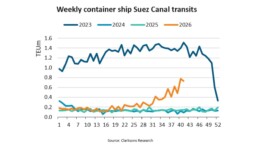
Suez Canal container ship transits exceed 50% of pre-disruption levels "During the first two weeks of October, weekly container ship capacity…
Subscribe to our newsletter!
if you dont want to swim alone in the ocean of news, sign up for the newsletter, and you will receive daily all the important news of world shipping!
