

The process and criteria in Cyprus and internationally
The Blue Flag program is one of the most recognized international symbols of quality for beaches and marinas. It is awarded exclusively to beaches and marinas that meet strict environmental, educational, organizational, and safety standards. The Blue Flag signifies a safe and clean beach, as evaluated on the basis of the program’s internationally established criteria.
The Blue Flag program is entirely voluntary. In Cyprus, it is coordinated by the not-for-profit organization CYMEPA (Cyprus Marine Environment Protection Association), in cooperation with the Foundation for Environmental Education (FEE), which makes the final award decision. Cyprus joined the program in 1994 following an initiative of the Cyprus Tourism Organization (now the Deputy Ministry of Tourism) and CYMEPA, which was founded in 1992.
As part of the Blue Flag initiative, water quality analyses in Cyprus began in 1995—well before the country joined the European Union. Results were submitted to the competent authorities, ensuring systematic monitoring. Since EU accession in 2004, the European Bathing Water Directive has been in force, and Cyprus has consistently ranked among the countries with the cleanest bathing waters in Europe.
Application and Inspection
Municipalities or communities that wish to include their beaches in the Blue Flag program must submit an application to CYMEPA. The application is then reviewed, and the National Jury convenes to evaluate and recommend to FEE which beaches and marinas may qualify.
The National Jury is composed of representatives of CYMEPA (National Operator), the Deputy Ministry of Tourism (National Coordinator), and the following institutions: State General Laboratory, Public Health Services, Ministry of Education, Sports and Youth, Union of Cyprus Municipalities, Union of Cyprus Communities, Cyprus Consumers Association, AKTI – Centre of Studies and Research, Cyprus Lifesaving Federation, Cyprus Institute of Maritime and Shipping, Deputy Ministry of Shipping, and Ministry of the Interior.
Blue Flag Criteria
We stress that the responsibility for the full implementation of criteria lies with the Local Authorities and the Marina Managers. CYMEPA conducts at least two inspections per season on all beaches awarded the Blue Flag to ensure continuous compliance with the criteria.. The Members of the National jury may also conduct control visits and frequently FEE sends external auditors.
- Water Quality
Sampling is carried out by experienced Health Inspectors of the Ministry of Health. Analyses are performed by the State General Laboratory (an accredited body), and results are managed by the Department of Environment. While the Directive requires monthly analyses during the bathing season, Blue Flag beaches undergo additional testing every two weeks to ensure water purity. Results are posted on information boards on each beach to guarantee transparency and inform bathers. - Environmental Management
The award also takes into account the cleanliness and maintenance of the beach and facilities, the presence of waste and recycling bins, and the protection of local ecosystems by the local authorities. - Environmental Education and Information
Beaches applying for or holding the Blue Flag must provide information boards near the Blue Flag mast. They are also required to carry out at least one environmental awareness activity each year. - Safety and Services
Lifeguard coverage must be ensured during designated hours, which are clearly posted on the information board, along with first aid equipment. Beaches must also have an emergency plan and safe access.
It is important to note that operating hours for lifeguards are determined by the local authority (municipality or community) in cooperation with the Ministry of the Interior and the Joint Rescue Coordination Center (JRCC). Lifeguard deployment is planned according to visitor numbers, Blue Flag status, risk levels, geographical conditions, and other relevant factors.
Managing Pollution Incidents
If pollution is detected, then the local authority:
- Immediately informs other competentauthorities.
- Posts Notices on beach information boards, and makes public announcements
- Lowers the Blue Flag temporarily until the incident is resolved.
- Takes measures to identify and address the source of pollution.
- Health Services carry out additional sampling until water quality is restored.
Marine pollution may occur occasionally due to natural phenomena or human activities. The Blue Flag program promotes transparency and accountability, empowering the local authorities to ensure that the public is informed promptly about the state of the beach and bathing waters.
The Blue Flag is not only a symbol of clean waters but also a comprehensive mechanism of response and communication in cases of environmental incidents—strengthening public trust and protecting both bathers and the marine environment.
By Dr. Michael Ierides, Secretary General of CYMEPA



Related News.

Navigating the Multi-Orbit Era: In Conversation with Intellian’s Jon Harrison at SMM 2026
At SMM 2026 in Hamburg, the rapid evolution of maritime satellite communications took centre stage. Across the exhibition halls, discussions among…
Cyprus ports need joint energy and investment strategy, shipping agents chief says
Cyprus needs a coordinated strategy for shipping, energy and environmental protection to support port investment and modernisation, Cyprus shipping…

MASO Public Affairs introduces MASO Regulatory Intelligence
A new subscription service helping businesses understand what is changing and what it means for them MASO Public Affairs introduces MASO Regulatory…
Anglo-Eastern helps turn CMBTECH’s ammonia ambition into an operational reality
From early feasibility study and risk-based design to newbuilding supervision, crew readiness and technical management, Anglo-Eastern drew on its…
Escalation of attacks threatens to derail recovery in Middle East oil exports
World oil demand is forecast to fall by 2.5 mb/d y-o-y in 4Q26 and 2.6 mb/d on average in 2026. As the Iran war manifests itself through restricted…
New study finds shipping pays twice its share to EU ETS earmarked revenues should triple to help build market for sustainable fuels and technologies
Shipping is responsible for around 10% of EU ETS emissions but pays almost 20% of the ETS bill. Unlike other sectors, it has never received free…
MSARC strengthens maritime mass rescue readiness through training and national live exercise off Dakar, Senegal
Joint MSARC–FHAS programme combines three days of SAR training with a national multi-agency live exercise The Maritime Search and Rescue Council ,…
Sogese report deliveries are still being delayed as container freight rates fluctuate
FOR IMPORTERS Spot rates into the Mediterranean are back at January levels, Far East to Europe reliability sits at pandemic lows, and nearly…
Glencore begins trading on Australian Securities Exchange
Glencore has begun trading on the Australian Securities Exchange under the ASX code GLC. Gary Nagle, Glencore’s CEO, said it was an exciting day for…
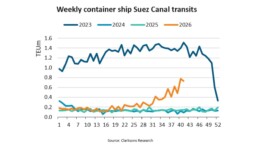
BIMCO Shipping Number of the Week
Suez Canal container ship transits exceed 50% of pre-disruption levels "During the first two weeks of October, weekly container ship capacity…
Subscribe to our newsletter!
if you dont want to swim alone in the ocean of news, sign up for the newsletter, and you will receive daily all the important news of world shipping!
