Successful launch of Metop-SGA1 to take Weather Forecasting to new heights
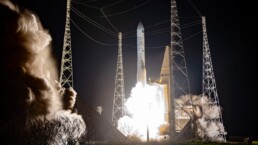

With a global audience watching in anticipation at launch events and online, Metop Second Generation A1 (Metop-SGA1) – also carrying the European Union’s Copernicus Sentinel-5 mission – lifted off on an Ariane-62 rocket from Europe’s Spaceport in Kourou, French Guiana, at 02:37 CEST on 13 August. As the first satellite in the EUMETSAT Polar System – Second Generation (EPS-SG) programme, the launch marks a major step toward delivering more precise forecasts and earlier warnings to help protect lives and property from extreme weather. EPS-SG will also support economies across Europe, with an expected return on investment of at least 20 to 1.
Now heading into a polar orbit around 800 kilometres above the Earth’s surface, Metop-SGA1 will soon begin transmitting a wealth of timely, high-resolution and high-quality observations from six complementary instruments. These data will continue the Metop series of satellites’ role as Europe’s most important source of meteorological observations for forecasts ranging from 12 hours to 10 days ahead. For example, Metop-SGA1 observations will help meteorologists improve short- and medium-term weather models that can save lives by enabling early warnings of storms, heatwaves, and other disasters, and help farmers to protect crops, grid operators to manage energy supply, and pilots and sailors to navigate safely.
Phil Evans, EUMETSAT Director-General, said: “Extreme weather has cost Europe hundreds of billions euros and tens of thousands of lives over the past 40 years – storms like Boris, Daniel and Hans, record heatwaves and fierce wildfires are just the latest reminders. The launch of Metop-SGA1 is a major step forward in giving national weather services in our member states sharper tools to save lives, protect property, and build resilience against the climate crisis. These positive impacts will be felt even beyond that and over the Atlantic, as Metop-SGA1 is Europe’s first contribution to the Joint Polar System with the United States’ National Oceanographic and Atmospheric Administration (NOAA). This milestone reflects years of teamwork across EUMETSAT, the European Space Agency (ESA), the European Union, the French Space Agency (CNES), the German Aerospace Centre (DLR), Airbus, Thales Alenia Space, and many others. This is the beginning of an exciting new chapter as we work to ensure the satellite settles into orbit and starts delivering the vital data it was built to provide.”
At the heart of better forecasts
More than 95% of the data used in numerical weather prediction comes from satellites –a share set to grow as Metop Second Generation satellites enter service. Unlike geostationary spacecraft fixed above the equator, polar-orbiting satellites like Metop-SGA1 travel north to south as Earth rotates beneath them, delivering global coverage and a rich variety of observations. Over the next two decades, three consecutive pairs of Metop-SG satellites will loop the planet 14 times daily, with advanced instruments collecting high-resolution data on the atmosphere, oceans, ice sheets, and land surfaces.
The Metop-SGA1 satellite hosts a total of six atmospheric sounding and imaging instrument missions. The payload includes the Infrared Atmospheric Sounding Interferometer – New Generation (IASI-NG), METimage (a visual and infrared imager), the Microwave Sounder (MWS), a Radio Occultation sounder, and the Multi-Viewing, Multi-Channel, Multi-Polarisation Imager (3MI) – the latter being an entirely new instrument designed to enhance the monitoring of aerosols and cloud properties. Metop-SGA1 also carries the European Union’s Copernicus Sentinel-5 mission, which will supply detailed data on atmospheric composition and trace gases that affect air quality, helping health authorities to monitor air pollution.
Christoph Kautz, Director for Space Policy, Earth Observation and Satellite Navigation at the European Commission, said: “The successful launch of Copernicus Sentinel-5 is a testimony to our close cooperation with EUMETSAT and is an outstanding achievement that will strengthen Europe’s capacity to monitor pollution and advance climate science. Thanks to the synergies with EUMETSAT’s meteorological mission, it was decided to embark Sentinel-5 on Metop-SGA1. This joint approach not only optimises the overall mission costs but also lowers the environmental impact by minimising the number of launches required.’’
Simonetta Cheli, Director of Earth Observation Programmes at ESA, said: “Metop-SGA1 and Copernicus Sentinel-5 show the power of European collaboration in building long-term missions that help us take the pulse of our planet. This successful launch will ultimately give us an unprecedented view of our atmosphere and climate. The data will allow us to monitor air quality, track greenhouse gases, and observe clouds, trace gases and ozone in more detail than ever. By feeding these insights into models and tools, we can strengthen climate action, improve public health, and deliver benefits for communities across Europe and beyond.”
For further updates on Metop-SGA1, visit EUMETSAT’s launch hub, which features news, interviews, and insights into the satellite’s journey.
Source: BUSINESS WIRE



Related News.

Navigating the Multi-Orbit Era: In Conversation with Intellian’s Jon Harrison at SMM 2026
At SMM 2026 in Hamburg, the rapid evolution of maritime satellite communications took centre stage. Across the exhibition halls, discussions among…

Cyprus ports need joint energy and investment strategy, shipping agents chief says
Cyprus needs a coordinated strategy for shipping, energy and environmental protection to support port investment and modernisation, Cyprus shipping…

MASO Public Affairs introduces MASO Regulatory Intelligence
A new subscription service helping businesses understand what is changing and what it means for them MASO Public Affairs introduces MASO Regulatory…

Anglo-Eastern helps turn CMBTECH’s ammonia ambition into an operational reality
From early feasibility study and risk-based design to newbuilding supervision, crew readiness and technical management, Anglo-Eastern drew on its…

Escalation of attacks threatens to derail recovery in Middle East oil exports
World oil demand is forecast to fall by 2.5 mb/d y-o-y in 4Q26 and 2.6 mb/d on average in 2026. As the Iran war manifests itself through restricted…

New study finds shipping pays twice its share to EU ETS earmarked revenues should triple to help build market for sustainable fuels and technologies
Shipping is responsible for around 10% of EU ETS emissions but pays almost 20% of the ETS bill. Unlike other sectors, it has never received free…

MSARC strengthens maritime mass rescue readiness through training and national live exercise off Dakar, Senegal
Joint MSARC–FHAS programme combines three days of SAR training with a national multi-agency live exercise The Maritime Search and Rescue Council ,…

Sogese report deliveries are still being delayed as container freight rates fluctuate
FOR IMPORTERS Spot rates into the Mediterranean are back at January levels, Far East to Europe reliability sits at pandemic lows, and nearly…

Glencore begins trading on Australian Securities Exchange
Glencore has begun trading on the Australian Securities Exchange under the ASX code GLC. Gary Nagle, Glencore’s CEO, said it was an exciting day for…

BIMCO Shipping Number of the Week
Suez Canal container ship transits exceed 50% of pre-disruption levels "During the first two weeks of October, weekly container ship capacity…
Subscribe to our newsletter!
if you dont want to swim alone in the ocean of news, sign up for the newsletter, and you will receive daily all the important news of world shipping!
