HD Korea Shipbuilding promoting construction of SMR-powered container ship
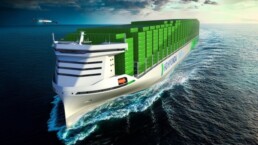

The domestic shipbuilding industry is accelerating the development of a nuclear-powered vessel. As “maritime nuclear power plants” emerge as a blue ocean globally, next-generation reactors such as small modular reactors and nuclear-powered ships utilizing them are gaining attention.
In this context, HD Korea Shipbuilding & Offshore Engineering (Hyundai Heavy Industries), the leading company in the domestic shipbuilding industry, is creating a new type of ship unprecedented in Korea. The ship uses a small modular reactor (SMR) as its main power source. The current development rate is about 50%, with the target completion date set for 2030.
SMR is a next-generation reactor designed by modularizing major components such as the reactor, steam generator, and coolant pump necessary for nuclear power generation. It is considered a carbon-free energy source capable of responding to the climate crisis.
Typically having an output capacity of 300 megawatts (MWe) or less, SMRs are manufactured in factories and assembled on-site. Thanks to these structural characteristics, construction time and costs can be reduced, and natural circulation cooling systems and passive safety systems allow cooling without external power. Compared to existing large power plant reactors, they have a relatively lower risk of accidents, and the shipping and shipbuilding industries are developing them for use as a major power source for future ships.
Although construction costs are higher, there are no fuel costs, and unlike existing marine fossil fuels, there are no carbon emissions. They can be used as a stable energy source for long periods, attracting attention as an eco-friendly ship propulsion technology. In particular, given the characteristics of the shipping industry with frequent long-distance voyages, the ability to operate for extended periods without refueling is a significant advantage.
HD Korea Shipbuilding & Offshore Engineering first unveiled its design model for a nuclear-powered container ship at the Houston Marine Nuclear Summit held at the Asia Society Texas Center in Houston, USA, in February.
The design model is for a 15,000 TEU (1 TEU = 1 20-foot container) container ship using SMR technology. It received concept approval from the American Bureau of Shipping (ABS). The company plans to invest half (3 billion won) of the 600 billion won raised through the issuance of exchangeable bonds (EB) in the development of SMR-powered ships.
The design model unveiled in February reflects actual equipment and safety design concepts. Unlike existing ships, nuclear-powered ships do not require engine exhaust systems or fuel tanks. This is because they use nuclear power instead of petroleum (heavy oil) as their power source.
Therefore, additional containers can be loaded in the existing engine room equipment space, increasing economic efficiency. Safety is ensured by applying a double tank system using stainless steel and light water for marine radiation shielding. Light water refers to water used as a coolant and neutron moderator in reactors.
Moreover, by applying a supercritical CO2-based propulsion system jointly developed with global energy technology company Baker Hughes, thermal efficiency has been improved by about 5% compared to existing steam-based propulsion systems. Supercritical CO2 power generation technology, which produces energy by heating supercritical carbon dioxide, is attracting attention as a next-generation power system as it enables high-efficiency power generation even at low temperatures and pressures.
In particular, this design model is being developed with a molten salt reactor (MSR) engine method, a type of SMR. MSR uses molten salt as both coolant and fuel medium at high temperatures.
MSRs operate at atmospheric pressure (1 bar), which means that even if an accident occurs due to pipe rupture, the explosion damage can be less compared to existing nuclear power plants. For instance, pressurized water reactors (PWRs), a type of reactor installed in many domestic and foreign nuclear power plants, operate at high pressure (150 bar), and in case of an explosion accident, the damage radius can reach 10-20 km. In contrast, the industry explains that the damage radius of MSRs is within 100 m. Recent research is also being conducted to prevent explosion effects from going outside the hull.
Additionally, MSRs can use various fuels such as uranium and plutonium. It is also possible to design for nuclear non-proliferation by diluting or converting nuclear materials in real-time to prevent weaponization in case of maritime theft.
Technology to prevent radioactive damage in case of sinking is also applied. According to industry experts, drain tanks installed inside the SMR quickly collect and isolate radioactive materials, allowing them to float on the surface in a solid state for recovery.
In addition, a shielding system has been developed to prevent radiation leakage from the reactor and protect the nuclear power plant from external attacks. According to HD Korea Shipbuilding & Offshore Engineering, the development of a shielding system suitable for civilian SMR ships is a world first.
However, there are technological barriers to overcome. The technology to adjust power (load-following operation) according to the required output as the ship’s speed changes is considered a high barrier. Nuclear power plants originally have high thermal inertia, making load-following operation difficult. Thermal inertia is the technological capability to react slowly to temperature changes. Nuclear power plants need high thermal inertia to suppress rapid temperature increases due to unexpected power increases and to secure time for the system to respond in case of accidents, as they generate enormous heat.
While this thermal inertia helps stable operation of nuclear power plants, it is not suitable for ships that need to frequently turn engines on and off due to waves, wind, and currents.
The reason HD Korea Shipbuilding & Offshore Engineering is pursuing the maritime nuclear power field as a core business is that SMRs are emerging as a clean energy source for realizing carbon neutrality and solving energy problems. In particular, if SMR-powered ships are successfully developed, it is expected that they will be able to gain an advantage in the future eco-friendly ship market.
Global interest and demand for SMRs are growing. According to the SMR market report by global market research firm MarketsandMarkets, the global SMR market is expected to grow from $5.7 billion in 2022 to $6.8 billion by 2030, with an average annual growth rate of 2.3%.
Source:Business Korea



Related News.
Navigating the Multi-Orbit Era: In Conversation with Intellian’s Jon Harrison at SMM 2026
At SMM 2026 in Hamburg, the rapid evolution of maritime satellite communications took centre stage. Across the exhibition halls, discussions among…
Cyprus ports need joint energy and investment strategy, shipping agents chief says
Cyprus needs a coordinated strategy for shipping, energy and environmental protection to support port investment and modernisation, Cyprus shipping…
MASO Public Affairs introduces MASO Regulatory Intelligence
A new subscription service helping businesses understand what is changing and what it means for them MASO Public Affairs introduces MASO Regulatory…
Anglo-Eastern helps turn CMBTECH’s ammonia ambition into an operational reality
From early feasibility study and risk-based design to newbuilding supervision, crew readiness and technical management, Anglo-Eastern drew on its…

Escalation of attacks threatens to derail recovery in Middle East oil exports
World oil demand is forecast to fall by 2.5 mb/d y-o-y in 4Q26 and 2.6 mb/d on average in 2026. As the Iran war manifests itself through restricted…
New study finds shipping pays twice its share to EU ETS earmarked revenues should triple to help build market for sustainable fuels and technologies
Shipping is responsible for around 10% of EU ETS emissions but pays almost 20% of the ETS bill. Unlike other sectors, it has never received free…

MSARC strengthens maritime mass rescue readiness through training and national live exercise off Dakar, Senegal
Joint MSARC–FHAS programme combines three days of SAR training with a national multi-agency live exercise The Maritime Search and Rescue Council ,…
Sogese report deliveries are still being delayed as container freight rates fluctuate
FOR IMPORTERS Spot rates into the Mediterranean are back at January levels, Far East to Europe reliability sits at pandemic lows, and nearly…
Glencore begins trading on Australian Securities Exchange
Glencore has begun trading on the Australian Securities Exchange under the ASX code GLC. Gary Nagle, Glencore’s CEO, said it was an exciting day for…
BIMCO Shipping Number of the Week
Suez Canal container ship transits exceed 50% of pre-disruption levels "During the first two weeks of October, weekly container ship capacity…
Subscribe to our newsletter!
if you dont want to swim alone in the ocean of news, sign up for the newsletter, and you will receive daily all the important news of world shipping!
