Ship operators invited to join “Stethoscope for cylinders” trial to prevent two stroke engine scuffing
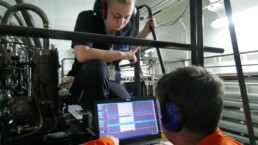

CM Technologies, a leader in advanced condition monitoring solutions, is calling on shipowners and managers to join collaborative trials designed to capture vital data on one of the shipping industry’s most costly problems: cylinder liner scuffing in two-stroke engines.
Scuffing, a form of sudden severe wear, can result in catastrophic engine damage and vessel downtime. And while it’s a well-known issue, typically affecting large two-stroke diesel engines found on bulkers, tankers, and large container ships, the root causes are difficult to pin down. Operators, OEMs, and service providers have long struggled to predict or prevent the phenomena.

Germany-based CMT, however, has developed a system that can alert operators to early onset cylinder damage, but see seeks trial partners for critical data gathering aimed at validating the sensor’s predictive capabilities and to prevent engine damage before it occurs.
“Scuffing is a silent killer. It can occur suddenly, and the damage can be extensive,” said Uwe Krüger, Managing Director at CM Technologies. “Despite the prevalence of this issue, even engine manufacturers don’t fully understand why it happens. What we do know is that it’s linked to a combination of factors, like lubrication failure, drastic load changes, recent overhauls, amongst other things. Our goal is to better understand the acoustic fingerprint of scuffing so we can prevent failures before they happen.”
CMT’s recently developed Scuffing Sensor system – a “stethoscope for cylinder liners” – uses high-frequency acoustic emission (AE) technology to detect the earliest signs of friction and wear from outside the cylinder.

Unlike other methods that rely on visual inspection or oil analysis performed weeks apart, this approach captures real-time acoustic data without interrupting engine operation. By identifying wear-related noise patterns, the system provides a potential early-warning signal before damage occurs.
Trial partners are invited to deploy the system onboard vessels equipped with two-stroke diesel engines. Ideally, these vessels will call at ports in Northern Europe, Germany, the Netherlands, Belgium or France, where CMT engineers can easily access them to install and retrieve data-logging equipment.
The system itself is unobtrusive, requires no modifications to engine internals, and is non-invasive. Mounted externally using magnetic brackets, the sensors require no disassembly, no drydock visit and no interruption to the ship’s voyage.
“There’s no need to open the engine or stop operations. The sensor system is magnetic, sits externally on the cylinder, and records data quietly in the background,” said Krüger “We’re looking for operators that will let us place this technology onboard for one to three months. The process is simple, and the benefits could be significant.”
By participating in the trials, ship operators and managers stand to gain early insight into the scuffing risks on their engines, while helping CMT further develop the breakthrough diagnostic tool for the wider industry.
“If we can collect enough data from a range of engines, we can build a reliable library of friction noise patterns,” Krüger said. “This will enable us to deliver early warnings when problems are brewing, long before current monitoring methods can detect them. The benefits will be lower maintenance costs, less downtime, and better protection of what is undoubtedly the most critical, high value asset onboard a ship, aside from the crew.”
CMT believes this collaborative approach is key to cracking one of shipping’s most persistent maintenance problems.
“We’re not asking shipowners to shoulder any risk, just to let us listen to their engines. Together, we can create something that protects engines, saves money, and sets a new benchmark for condition-based maintenance.”



Related News.

Navigating the Multi-Orbit Era: In Conversation with Intellian’s Jon Harrison at SMM 2026
At SMM 2026 in Hamburg, the rapid evolution of maritime satellite communications took centre stage. Across the exhibition halls, discussions among…

Cyprus ports need joint energy and investment strategy, shipping agents chief says
Cyprus needs a coordinated strategy for shipping, energy and environmental protection to support port investment and modernisation, Cyprus shipping…

MASO Public Affairs introduces MASO Regulatory Intelligence
A new subscription service helping businesses understand what is changing and what it means for them MASO Public Affairs introduces MASO Regulatory…

Anglo-Eastern helps turn CMBTECH’s ammonia ambition into an operational reality
From early feasibility study and risk-based design to newbuilding supervision, crew readiness and technical management, Anglo-Eastern drew on its…

Escalation of attacks threatens to derail recovery in Middle East oil exports
World oil demand is forecast to fall by 2.5 mb/d y-o-y in 4Q26 and 2.6 mb/d on average in 2026. As the Iran war manifests itself through restricted…

New study finds shipping pays twice its share to EU ETS earmarked revenues should triple to help build market for sustainable fuels and technologies
Shipping is responsible for around 10% of EU ETS emissions but pays almost 20% of the ETS bill. Unlike other sectors, it has never received free…

MSARC strengthens maritime mass rescue readiness through training and national live exercise off Dakar, Senegal
Joint MSARC–FHAS programme combines three days of SAR training with a national multi-agency live exercise The Maritime Search and Rescue Council ,…

Sogese report deliveries are still being delayed as container freight rates fluctuate
FOR IMPORTERS Spot rates into the Mediterranean are back at January levels, Far East to Europe reliability sits at pandemic lows, and nearly…

Glencore begins trading on Australian Securities Exchange
Glencore has begun trading on the Australian Securities Exchange under the ASX code GLC. Gary Nagle, Glencore’s CEO, said it was an exciting day for…

BIMCO Shipping Number of the Week
Suez Canal container ship transits exceed 50% of pre-disruption levels "During the first two weeks of October, weekly container ship capacity…
Subscribe to our newsletter!
if you dont want to swim alone in the ocean of news, sign up for the newsletter, and you will receive daily all the important news of world shipping!
