Liebherr ship-to-shore cranes assembled efficiently at port
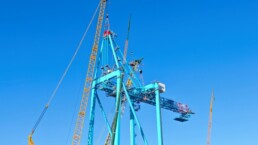

Disruption to operations minimized during assembly process.
Cargo ports handle thousands of ships every year. Efficiently offloading and loading vessels is essential for their smooth operation and maintaining global supply chains.
Many ports however face capacity constraints, with newer lifting equipment required to accommodate bigger ships and loads.
When it comes to container crane installations at ports, work must be carefully managed to minimize disruption and avoid interfering with operations.
The Port of Valencia took delivery of two Liebherr ship-to-shore container cranes in large, preassembled components, for integration on site.
Building these giants in one of the Mediterranean’s busiest seaports would require expert forward planning and efficient execution.
Building off-quay to minimize disruption
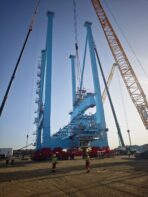
Both STS cranes were shipped from the Port of Fenit, Ireland, to the Port of Valencia, in Spain. Their components were offloaded onto SPMTs using the delivery vessel’s crane. The largest of these were the main beam and the derrick boom, which measured 69.6 and 76.3m meters, respectively.
Almost 90 axle lines of SPMTs were used on the project to move the components safely across the site.
Once the components were taken to the assembly area, Mammoet used crawler cranes, telescopic cranes, cherry pickers and forklifts to begin assembly of the first crane.
The working cranes had different capacities across the different stages of the project. The telescopic cranes had lifting capacities of between 80t to 250t; the two crawlers each had a capacity of 600t.
The telescopic crane worked with the crawlers to top and tail the main frame sections – performing a tandem lift to place them in the vertical upright position and onto bogies.
During the project, Mammoet, along with engineers from Liebherr, managed different teams of sub-contractors to make all the mechanical and electrical connections between the different components.
Once both cranes were assembled, they were driven to their final position on the quayside.
For this stage, SPMTs was used but fitted with two interfacing transport beams to help spread the load and connect the crane’s landside frame to its seaside frame for stability.
The STS cranes have a transport bracket on each of their four legs. The SPMTs were driven underneath the cranes, and the transport beams were connected to these brackets.
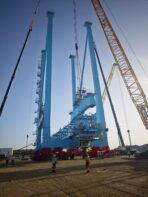
Once everything was securely fastened, the STS cranes were lifted using the on-board stroke of the SPMT. They were then driven 600 meters to the quayside and lowered into their longitudinal rails.
A full-service solution for project efficiency
“As soon as the components were delivered, they were immediately taken away from the quayside to allow operations to continue. The installation process was equally as quick, minimizing disruption” said Javier de Pablo Arenzana, Sales Manager at Mammoet.
We have worked with Liebherr for many years and across a number of different projects. Liebherr value our expertise and experience and are proud to be one of Liebherr’s key partners for this kind of work”.



Related News.

Navigating the Multi-Orbit Era: In Conversation with Intellian’s Jon Harrison at SMM 2026
At SMM 2026 in Hamburg, the rapid evolution of maritime satellite communications took centre stage. Across the exhibition halls, discussions among…
Cyprus ports need joint energy and investment strategy, shipping agents chief says
Cyprus needs a coordinated strategy for shipping, energy and environmental protection to support port investment and modernisation, Cyprus shipping…

MASO Public Affairs introduces MASO Regulatory Intelligence
A new subscription service helping businesses understand what is changing and what it means for them MASO Public Affairs introduces MASO Regulatory…
Anglo-Eastern helps turn CMBTECH’s ammonia ambition into an operational reality
From early feasibility study and risk-based design to newbuilding supervision, crew readiness and technical management, Anglo-Eastern drew on its…

Escalation of attacks threatens to derail recovery in Middle East oil exports
World oil demand is forecast to fall by 2.5 mb/d y-o-y in 4Q26 and 2.6 mb/d on average in 2026. As the Iran war manifests itself through restricted…

New study finds shipping pays twice its share to EU ETS earmarked revenues should triple to help build market for sustainable fuels and technologies
Shipping is responsible for around 10% of EU ETS emissions but pays almost 20% of the ETS bill. Unlike other sectors, it has never received free…

MSARC strengthens maritime mass rescue readiness through training and national live exercise off Dakar, Senegal
Joint MSARC–FHAS programme combines three days of SAR training with a national multi-agency live exercise The Maritime Search and Rescue Council ,…

Sogese report deliveries are still being delayed as container freight rates fluctuate
FOR IMPORTERS Spot rates into the Mediterranean are back at January levels, Far East to Europe reliability sits at pandemic lows, and nearly…

Glencore begins trading on Australian Securities Exchange
Glencore has begun trading on the Australian Securities Exchange under the ASX code GLC. Gary Nagle, Glencore’s CEO, said it was an exciting day for…
BIMCO Shipping Number of the Week
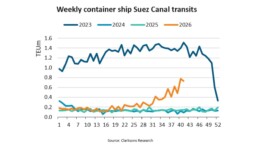
Suez Canal container ship transits exceed 50% of pre-disruption levels "During the first two weeks of October, weekly container ship capacity…
Subscribe to our newsletter!
if you dont want to swim alone in the ocean of news, sign up for the newsletter, and you will receive daily all the important news of world shipping!
