US port operators seek to mitigate hefty expected tariffs on China-built port cranes
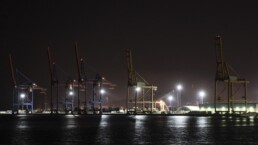

U.S. seaport operators are asking for extra time to implement pending tariffs on towering ship-to-shore cranes as they expect President Donald Trump’s administration to follow through on a promise to essentially ban that vital cargo-handling equipment.
The United States Trade Representative earlier this year proposed tariffs of up to 100% on those cranes after China devoured market share in its bid to dominate maritime manufacturing as well as commercial and military dominance on the seas. China, via state-owned Shanghai Zhenhua Heavy Industries , now commands the global market and has supplied some 80% of the ship-to-shore cranes in the United States. ZPMC has more than 200 cranes in operation across nearly two dozen U.S. ports, including Houston, Los Angeles and New York. Each of those cranes costs anywhere from $10 million to $20 million. Countering that trend is a priority for the Trump administration, whose officials stated in meetings they intended to put an end to such purchases, said Carl Bentzel, president of the National Association of Waterfront Employers , which represents terminal operators and other groups.
Asked whether he expected the tariff rate to land at around 100% when USTR issues its pending decision on the matter, Bentzel said, “I’ve been operating under the position that that’s the floor. This essentially is a ban on the use of Chinese manufactured cargo equipment.”
USTR and the White House did not immediately comment.
Trump is not the first U.S. President to push ports to buy higher-priced cranes from manufacturers with ties to U.S. allies, including Konecranes of Finland, Mitsui E&S of Japan and Swiss-headquartered Liebherr.
Joe Biden slapped 25% tariffs on ship-to-shore cranes from China in 2024 after the Cybersecurity and Infrastructure Security Agency, the Federal Bureau of Investigation and the National Security Agency publicly stated that China has sought to preposition cyber vulnerabilities in American critical infrastructure, including port equipment.
U.S. officials also warned that modems, software and other technology in that equipment could be a backdoor for spying on military operations or used as kill switches to hobble port operations.
Nevertheless, ports and terminal operators continued buying lower-cost Chinese cranes.
“The inaction and resistance from the port operator community is focused on short-term cost savings and massively underestimates the ultimate cost of inaction,” said William Henagan, a Council on Foreign Relations research fellow who was director for critical infrastructure at the National Security Council under Biden.
U.S. port operators and representatives for ZMPC in letters to USTR in May said security concerns linked to the cranes were out of proportion to the risk. Opponents also warned that the tariffs could heave billions of dollars of unexpected costs on the industry, stifling improvements meant to keep U.S. ports competitive.
These days NAWE, one of the industry organizations representing terminal operators, is working to mitigate the impact of the new tariffs by asking for exemptions for previously ordered cranes and a transition period for the implementation of new duties. “We’ve chosen to work with them,” Bentzel said.
Source: Reuters



Related News.

Hong Kong Global Maritime Trade Summit to return for third edition
The International Chamber of Shipping, in collaboration with the Transport and Logistics Bureau of the Government of Hong Kong and the Hong Kong…

Appetite for US crude oil exports climbs despite high freight
South Korea tops US crude destinations at 568,600 b/d VLCC rates to Asia double, closing arbitrage window European refining margins…

Shipping stocks Rally as Hormuz Traffic plunges 75%
Ship traffic through the Strait of Hormuz — a critical chokepoint handling about 20% of global crude oil and liquefied natural gas shipments — has…

Diana Shipping announces Time Charter Contract for m/v G P Zafirakis with Classic Maritime
Diana Shipping, a global shipping company specializing in the ownership and bareboat charter-in of dry bulk vessels, announced that, through a…

New IMO ESP Code framework for Remote Inspection Techniques
The International Maritime Organisation, through Resolution MSC.584(111) , has adopted amendments to the International Code on the Enhanced…

ABS opens Offshore & Marine Support Center in Bergen
ABS has expanded its capabilities in the Norwegian maritime market with the opening of a cutting-edge support center in Bergen, bringing advanced…

MOL holds giant step memorial ceremony and beach cleanup at Kashima Coast
Memorial and Reflection 20 Years After the Accident: Learning from the Past to Foster an Even Stronger Safety Culture Mitsui O.S.K. Lines, announced…

KEZAD-based Arabian Gulf Steel Industries achieves lowest verified Carbon Footprint for Rebar
CARES UK verified Environmental Product Declaration confirms 139 kg CO₂e per tonne for rebar produced at AGSI’s KEZAD Abu Dhabi facility Arabian…

Indian Register of Shipping announces launch of first fleet support ship INS Surya
Indian Register of Shipping continues to strengthen its role in supporting the Indian Navy and India’s naval shipbuilding capabilities through the…

VLCCs Climbing the Record Charts
LR2 The TC1 75kt MEG/Japan index decreased by only a single point this week to WS928. The corresponding Baltic round-trip TCE fell by $2,000 to…
Subscribe to our newsletter!
if you dont want to swim alone in the ocean of news, sign up for the newsletter, and you will receive daily all the important news of world shipping!
