Wattlab and HGK Shipping team up for world’s first hybrid solar-powered inland shipping vessel
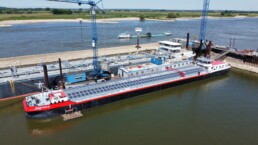

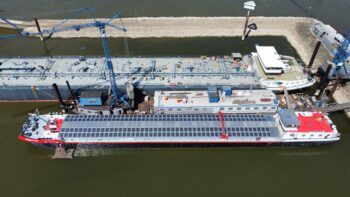
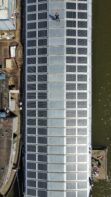
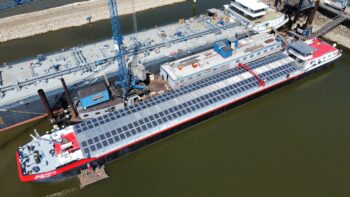
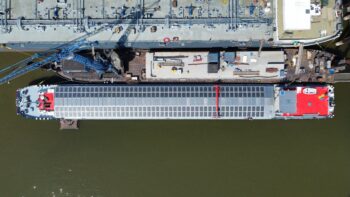
Dutch maritime solar innovator Wattlab has delivered a solar energy system for HGK Shipping’s inland shipping cargo vessel Blue Marlin. Representing a major technical milestone and step forward for sustainable inland shipping, the vessel’s 192 solar panels will provide power to both the onboard and propulsion systems, making the Blue Marlin the first inland shipping vessel in the world capable of hybrid sailing with solar power.
HGK Shipping is a European inland waterway shipping company operating a fleet of 350 vessels. With annual freight figures in the region of 43 million tonnes, HGK Shipping is considered to be a leading player in European dry bulk, gas and chemical transport. Wattlab, which is also active in the seagoing shipping industry, brings broad maritime experience to this pioneering project.
Wattlab has worked previously with HGK Shipping. In Q2 2024, HGK’s 135-metre long dry cargo vessel MS Helios made headlines – and entered The Guinness Book of Records – for having the world’s largest solar panel installation on an inland shipping vessel. The MS Helios is equipped with 312 solar panels.
Fully integrated system
The solar energy systems of the Helios and the Blue Marlin differ in one critical aspect. Unlike the Helios, where solar energy was used exclusively for low-voltage onboard (hotel) systems, the Blue Marlin features a more advanced, fully integrated system capable of contributing power directly to the ship’s high voltage electric propulsion.
This, says Wattlab co-founder and COO David Kester, is a technical milestone. “The Blue Marlin’s 192 solar panels are not only connected to the low-voltage onboard systems but also to the high-voltage propulsion network. This means that HGK Shipping can proudly state that they are the first inland shipping company to operate a vessel that uses solar power directly for propulsion.”
Automated energy management
Delivering up to 35 kilowatts under optimal conditions, the Blue Marlin’s solar power system will operate in conjunction with four diesel generators powering the electric propulsion system. This fully integrated setup enables ‘peak shaving’, where the combination of solar energy and batteries will prevent the need for activating an additional generator during high-demand periods. The system’s automated energy management will distribute electrical energy where and when it is required, increasing efficiency and reducing fuel consumption.
“Furthermore, in situations where the ship is lightly loaded and travelling downstream, we anticipate that it may even sail using only solar power for limited periods—an unprecedented achievement in the inland shipping sector,” continues Kester.
Proud to pioneer
“We have already reached a significant technical milestone with the construction of the Helios, which has had a noticeably positive impact. The Blue Marlin now goes one step further by also using solar energy for the power train. It makes another important contribution to making shipping, which is already a low-emission mode of transport, even more sustainable. We are excited to see how this innovative solution will prove itself in practical operation”, says Tim Gödde, Director Ship Management at HGK Ship Management Lux S.à r.l. “We are proud to pioneer the use of solar propulsion in inland shipping. The Blue Marlin demonstrates what’s possible when innovation meets engineering expertise.”
Installation of the Blue Marlin’s solar panels took place at De Gerlien van Tiem shipyard, with Wattlab cooperating closely with Blommaert Aluminium and Van Tiem Electro. “We have been working with these partners for some time now – on multiple vessels – so have managed to really optimise the processes. The Blue Marlin is a new-build vessel; it took about one week for installation followed by a few days for commissioning,” adds Kester. “Considering a similar-sized retrofit project, we estimate that a shipowner would be looking at a downtime of no more than one week.”
Scalable solar solutions for coastal and seagoing vessels
This project also marks a broader evolution in maritime decarbonization strategies. As regulatory pressure increases and fuel prices fluctuate, shipowners and operators are looking to diversify their energy mix. Wattlab’s scalable solar solutions are proving their viability not only on inland waterways, but also on coastal and seagoing vessels.



Related News.

Navigating the Multi-Orbit Era: In Conversation with Intellian’s Jon Harrison at SMM 2026
At SMM 2026 in Hamburg, the rapid evolution of maritime satellite communications took centre stage. Across the exhibition halls, discussions among…

Cyprus ports need joint energy and investment strategy, shipping agents chief says
Cyprus needs a coordinated strategy for shipping, energy and environmental protection to support port investment and modernisation, Cyprus shipping…

MASO Public Affairs introduces MASO Regulatory Intelligence
A new subscription service helping businesses understand what is changing and what it means for them MASO Public Affairs introduces MASO Regulatory…

Anglo-Eastern helps turn CMBTECH’s ammonia ambition into an operational reality
From early feasibility study and risk-based design to newbuilding supervision, crew readiness and technical management, Anglo-Eastern drew on its…

Escalation of attacks threatens to derail recovery in Middle East oil exports
World oil demand is forecast to fall by 2.5 mb/d y-o-y in 4Q26 and 2.6 mb/d on average in 2026. As the Iran war manifests itself through restricted…

New study finds shipping pays twice its share to EU ETS earmarked revenues should triple to help build market for sustainable fuels and technologies
Shipping is responsible for around 10% of EU ETS emissions but pays almost 20% of the ETS bill. Unlike other sectors, it has never received free…

MSARC strengthens maritime mass rescue readiness through training and national live exercise off Dakar, Senegal
Joint MSARC–FHAS programme combines three days of SAR training with a national multi-agency live exercise The Maritime Search and Rescue Council ,…

Sogese report deliveries are still being delayed as container freight rates fluctuate
FOR IMPORTERS Spot rates into the Mediterranean are back at January levels, Far East to Europe reliability sits at pandemic lows, and nearly…

Glencore begins trading on Australian Securities Exchange
Glencore has begun trading on the Australian Securities Exchange under the ASX code GLC. Gary Nagle, Glencore’s CEO, said it was an exciting day for…

BIMCO Shipping Number of the Week
Suez Canal container ship transits exceed 50% of pre-disruption levels "During the first two weeks of October, weekly container ship capacity…
Subscribe to our newsletter!
if you dont want to swim alone in the ocean of news, sign up for the newsletter, and you will receive daily all the important news of world shipping!
