HD Hyundai develop Fuel Cell Technology for Cruise Ships
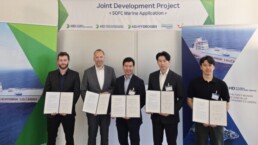

HD Korea Shipbuilding & Offshore Engineering, the intermediate holding company of HD Hyundai’s shipbuilding sector, is embarking on the development of fuel cell technology for cruise ships in response to the decarbonization era.
HD Hyundai announced on June 19 that HD Korea Shipbuilding & Offshore Engineering, HD Europe Research Center, and HD Hydrogen have recently initiated a joint development project with DNV and German cruise line TUI Cruises for the application of solid oxide fuel cell systems in cruise ships.
SOFC is a high-efficiency fuel cell that produces electricity by reacting hydrogen generated from natural gas, ammonia, and other sources with oxygen. It can significantly reduce carbon and pollutant emissions by generating electricity without combustion. It is also evaluated as a suitable power generation method for cruise ships with high power consumption due to its higher efficiency and lower noise and vibration compared to conventional power generation engines.
As the first step, HD Korea Shipbuilding & Offshore Engineering and HD Europe Research Center will establish safety design standards for applying SOFC systems to actual cruise ships from June this year to February next year. HD Hydrogen, HD Korea Shipbuilding & Offshore Engineering’s hydrogen fuel cell subsidiary, plans to analyze the performance of its independently developed SOFC system in various operating environments based on key data. It will also develop technology to recover and recycle waste heat generated due to the characteristics of SOFC operating at high temperatures between 600°C and 1000°C. Additionally, it will develop solutions to reduce carbon emissions partially generated from SOFC systems using Carbon Capture and Storage (CCS) technology.
Furthermore, DNV will ensure structural safety and regulatory compliance in line with class certification standards from the initial design stage, while TUI Cruises will share cruise ship data suitable for SOFC system application and installation requirements and operational requirements for actual ship application.
HD Hyundai plans to secure global competitiveness by developing SOFC technology applicable to cruise ships to target the European market, where environmental regulations are strict and demand for eco-friendly ships is high. According to global market research firm Grand View Research, the global SOFC market size is expected to grow at an average annual rate of 40.7% to reach approximately $7.124 billion (about 9.81 trillion won) by 2030.
An HD Hyundai official stated, “This international joint development project will be an important milestone in proving HD Hyundai’s world-class decarbonization ship technology in Europe,” adding, “We will lead the decarbonization of the sea with low-carbon, high-efficiency fuel cell technology.”
Source:BUsiness Korea



Related News.
Hong Kong Global Maritime Trade Summit to return for third edition
The International Chamber of Shipping, in collaboration with the Transport and Logistics Bureau of the Government of Hong Kong and the Hong Kong…
Appetite for US crude oil exports climbs despite high freight
South Korea tops US crude destinations at 568,600 b/d VLCC rates to Asia double, closing arbitrage window European refining margins…
Shipping stocks Rally as Hormuz Traffic plunges 75%
Ship traffic through the Strait of Hormuz — a critical chokepoint handling about 20% of global crude oil and liquefied natural gas shipments — has…
Diana Shipping announces Time Charter Contract for m/v G P Zafirakis with Classic Maritime
Diana Shipping, a global shipping company specializing in the ownership and bareboat charter-in of dry bulk vessels, announced that, through a…
New IMO ESP Code framework for Remote Inspection Techniques
The International Maritime Organisation, through Resolution MSC.584(111) , has adopted amendments to the International Code on the Enhanced…
ABS opens Offshore & Marine Support Center in Bergen
ABS has expanded its capabilities in the Norwegian maritime market with the opening of a cutting-edge support center in Bergen, bringing advanced…
MOL holds giant step memorial ceremony and beach cleanup at Kashima Coast
Memorial and Reflection 20 Years After the Accident: Learning from the Past to Foster an Even Stronger Safety Culture Mitsui O.S.K. Lines, announced…
KEZAD-based Arabian Gulf Steel Industries achieves lowest verified Carbon Footprint for Rebar
CARES UK verified Environmental Product Declaration confirms 139 kg CO₂e per tonne for rebar produced at AGSI’s KEZAD Abu Dhabi facility Arabian…
Indian Register of Shipping announces launch of first fleet support ship INS Surya
Indian Register of Shipping continues to strengthen its role in supporting the Indian Navy and India’s naval shipbuilding capabilities through the…
VLCCs Climbing the Record Charts
LR2 The TC1 75kt MEG/Japan index decreased by only a single point this week to WS928. The corresponding Baltic round-trip TCE fell by $2,000 to…
Subscribe to our newsletter!
if you dont want to swim alone in the ocean of news, sign up for the newsletter, and you will receive daily all the important news of world shipping!
