Arctic Council misses opportunity to cut climate warming super pollutants
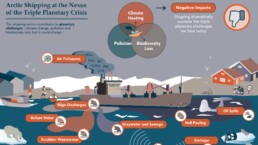

Responding to the publication of the Arctic Council’s Romssa-Tromsø Statement, published on May 12th, Dr Sian Prior, Lead Advisor to the Clean Arctic Alliance said:
“The Romssa-Tromsø Statement issued by the Arctic Council is a missed opportunity to acknowledge the impact that global climate heating is having on the Arctic, which is warming four times faster than anywhere else on earth, the consequences that the Arctic climate crisis is having for the rest of the planet, and on reducing the impact on the region from short-lived climate super pollutants like black carbon and methane”.
The Statement was approved during yesterday’s 14th meeting of the Arctic Council, where the Kingdom of Denmark chair, including Greenland and the Faroe Islands, took over the Arctic Council Chairship from Norway. Ahead of the meeting, the Clean Arctic Alliance called on government ministers and Senior Arctic Officials from Arctic Council member and observer states to commit to curbing the rise of black carbon and methane pollution from shipping in the Arctic.
“While the Clean Arctic Alliance recognises that efforts have been made by the Arctic Council to reduce black carbon emissions by 23% between 2017 and 2025, in recent years, black carbon emissions from Arctic shipping have more than doubled”, said Prior. “We urge the new Kingdom of Denmark Chairship of the Arctic Council to take a strong and ambitious lead on accelerating reductions of both black carbon and methane from all sectors before 2030”.
“More specifically the Clean Arctic Alliance is calling on the shipping sector to step forward and urgently reduce black carbon emissions by moving to polar fuels with lower black carbon emissions than traditional residual or heavy fuels still used by many ships operating in or near to the Arctic”, she added.
“While the Arctic Council’s modest efforts to reduce black carbon and methane are certainly welcome, we need more, and greater action from member states and the shipping sector to further reduce these super pollutants – and their impacts on Arctic communities and ecosystems”, said Andrew Dumbrille, Special Advisor to the Clean Arctic Alliance. “Delaying any discussion of a new black carbon emissions target until 2029 and staying silent on targets for methane, which should at minimum be in line with the Global Methane Pledge, is a missed opportunity to say the least.”
“While the outcome is disappointing, the Arctic Council and its Expert Group on Black Carbon and Methane did include specific reporting on black carbon shipping emissions and called out the need for action at the International Maritime Organization and in regional regulation to regulate and reduce emissions from shipping”, said Dumbrille. “This will set the foundation for concerted effort and action on Arctic black carbon pollution from shipping in the near future.”
About Black Carbon and Shipping
Black carbon is “shipping’s second largest cause of global warming” after carbon dioxide and makes up around one-fifth of international shipping’s already considerable climate impact. Black carbon is a solid particulate matter – soot – ejected by ship engines into their stacks and then into the atmosphere. This soot is a short-lived climate pollutant produced by the incomplete burning of fossil fuels in the engine combustion chambers, and has a climate warming impact more than three thousand times that of CO2 over a 20 year period.
Black carbon is widely recognised to be a “super pollutant” because of the outsize impact it has on both human health and on the climate. In its recent 6th Assessment Report, the UN Intergovernmental Panel on Climate Change (IPCC) doubled the estimate of the warming potential of black carbon on snow and ice due to a better understanding of its impact. Black carbon, along with other super pollutants – methane and ozone, are responsible for nearly half of global temperature increases to date and reducing emissions of ‘super pollutants’ would slam emergency brake on global warming. In its latest report, the Clean Air Fund recommends cutting black carbon emissions from shipping as quickly as possible and recognises cuts in emissions can unlock near-immediate climate gains.
Black carbon has been on the IMO’s agenda for more than a decade, but it has yet to take meaningful action. Addressing the impact of black carbon on the Arctic is one of the longest, unresolved issues running at the IMO and must be dealt with without any further delay. The Clean Arctic Alliance is urging Member States to collaborate in the development of a concrete proposal, for consideration by PPR 13 in early 2026.
- NSIDC: Arctic sea ice sets a record low maximum in 2025
- Explainer: Black Carbon and the Arctic: What is Happening, and What Comes Next?
- Infographic: How to regulate and control black carbon emissions from shipping
- Op-ed: Targeting Black Carbon and Methane at the Arctic Council
About Methane and Shipping
The Arctic Council’s Expert Group on Black Carbon and Methane (EGBCM)has a mandate to address both black carbon and methane; there is a huge urgency to address increasing methane emissions and their impacts in the Arctic.
When burned by ships, LNG releases methane and other pollutants into the atmosphere. Additionally, the process of extracting, processing, and transporting of LNG results in methane leakage. These activities can also cause significant environmental impacts including habitat destruction, water pollution, and climate heating. Methane based marine fuel use, mainly the operation of LNG gas tankers, has increased in the Arctic from zero in 2014 to vessels sailing 877.650 nautical miles in 2024. LNG bunkering (i.e. ports where ships can refuel) has also grown in the Arctic since 2010 to over 30 operational and proposed facilities.
Methane provides 30% of the global climate problem – and emissions are on the rise. Methane impacts are amplified in the Arctic due to melting glaciers exposing large deposits of leaking methane gas. Methane released from thawing permafrost and emitted by industrial sources have led some to describe the situation as a ticking methane bomb.
The Arctic Council must take more concrete action on methane and at the very least align with the Global Methane Pledge (backed by more than 150 countries), and given the accelerated climate impacts in the Arctic aim for a higher ambition striving for reductions of 40% by 2030 from 2020 levels.
Civil society has also initiated a new framework for action on methane which should be supported and championed by all Arctic Council members, theBeyond Methane Pledge focuses on rapidly phasing out methane based Liquefied Natural Gas (LNG) as a marine fuel.



Related News.

Navigating the Multi-Orbit Era: In Conversation with Intellian’s Jon Harrison at SMM 2026
At SMM 2026 in Hamburg, the rapid evolution of maritime satellite communications took centre stage. Across the exhibition halls, discussions among…
Cyprus ports need joint energy and investment strategy, shipping agents chief says
Cyprus needs a coordinated strategy for shipping, energy and environmental protection to support port investment and modernisation, Cyprus shipping…

MASO Public Affairs introduces MASO Regulatory Intelligence
A new subscription service helping businesses understand what is changing and what it means for them MASO Public Affairs introduces MASO Regulatory…
Anglo-Eastern helps turn CMBTECH’s ammonia ambition into an operational reality
From early feasibility study and risk-based design to newbuilding supervision, crew readiness and technical management, Anglo-Eastern drew on its…

Escalation of attacks threatens to derail recovery in Middle East oil exports
World oil demand is forecast to fall by 2.5 mb/d y-o-y in 4Q26 and 2.6 mb/d on average in 2026. As the Iran war manifests itself through restricted…
New study finds shipping pays twice its share to EU ETS earmarked revenues should triple to help build market for sustainable fuels and technologies
Shipping is responsible for around 10% of EU ETS emissions but pays almost 20% of the ETS bill. Unlike other sectors, it has never received free…

MSARC strengthens maritime mass rescue readiness through training and national live exercise off Dakar, Senegal
Joint MSARC–FHAS programme combines three days of SAR training with a national multi-agency live exercise The Maritime Search and Rescue Council ,…
Sogese report deliveries are still being delayed as container freight rates fluctuate
FOR IMPORTERS Spot rates into the Mediterranean are back at January levels, Far East to Europe reliability sits at pandemic lows, and nearly…
Glencore begins trading on Australian Securities Exchange
Glencore has begun trading on the Australian Securities Exchange under the ASX code GLC. Gary Nagle, Glencore’s CEO, said it was an exciting day for…
BIMCO Shipping Number of the Week
Suez Canal container ship transits exceed 50% of pre-disruption levels "During the first two weeks of October, weekly container ship capacity…
Subscribe to our newsletter!
if you dont want to swim alone in the ocean of news, sign up for the newsletter, and you will receive daily all the important news of world shipping!
