Space Flight Laboratory announced key milestone in development of Aspera Space Astronomy Microsatellite Mission
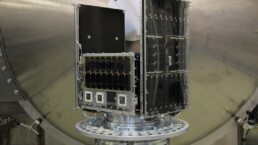

Space Flight Laboratory has completed assembly of the Aspera space astrophysics microsatellite bus. The spacecraft is ready for integration with the far-UV Aspera telescope being built by the University of Arizona. SFL will perform instrument-spacecraft integration and testing at its Toronto facility later this year with launch slated for early 2026.
Aspera is a bold NASA astrophysics mission that seeks to understand the formation and evolution of galaxies through far-UV observations of the matter surrounding those galaxies, known as the ‘circumgalactic medium’. The mission is managed by the University of Arizona’s Department of Astronomy & Steward Observatory with funding from the NASA Astrophysics Pioneers Program.
“SFL is proud to play a role in such a challenging space astrophysics mission that will enhance our understanding of how the universe formed,” said SFL Director Dr. Robert E. Zee. “We have developed Aspera on our 60-kg DEFIANT microsatellite platform.”
The Aspera mission derives its name from the Latin word for ‘difficulty’ or ‘hardship’ because astronomers have never been able to successfully observe the hot gasses that compose the circumgalactic medium. Aspera could be the first to do so.
“We know there must be some amount of matter in the universe…we’ve looked for it and still can’t find most of it. It’s likely in this circumgalactic medium,” said Prof. Carlos J. Vargas, University of Arizona Astronomer and Aspera Principal Investigator. “Why do we care about that? Because every star that has formed, every planet that’s formed, and all life on those planets must come from matter somewhere.”
A key aspect to the technical success of Aspera – and the reason SFL was selected for spacecraft development – is the importance of very precise pointing of the onboard telescope.
SFL is the acknowledged leader in the development of extremely stable small satellite platforms due to the advanced attitude control systems it has developed and refined for pointing of sensors on low-mass spacecraft. SFL has successfully leveraged this technology in missions for space astrophysics, Earth observation, RF signal detection, and atmospheric monitoring.
Vargas credits the small satellite revolution for making the Aspera mission possible. Just 10 years ago, he said, such a space astrophysics mission would not have been financially viable with traditional satellites.
“Big science can now be done on small platforms, and the University of Arizona and Steward Observatory are big players in the SmallSat revolution,” said Vargas. “Our partnership with SFL makes that possible.”
Established in 1998, SFL has developed 86 operationally successful smaller satellite missions totaling more than 370 cumulative years in orbit. Another 21 spacecraft are now under development by SFL, which offers a complete suite of nano-, micro- and small satellites – including high-performance, low-cost CubeSats – that satisfy the needs of a broad range of mission types from 3 to 500 kilograms. For a comprehensive list of SFL high-performance satellite platforms, please visit https://www.utias-sfl.net/satellite-platforms/overview/.
Source: BUSINESS WIRE



Related News.

Crewing After 2026: How AI Will Take Over the Routine in 2027
The crewing market of late 2026 is not the market of 2025. Artificial intelligence has moved from presentations into daily crewing work, while the…

Dualog launches secure maritime AI service amid surge in seafarer AI use
The new service, Sparks lets crew and shore teams search company emails, documents and conversations without exposing sensitive fleet information to…

Time Ticking: Two weeks for Governments to Green-Light Framework for Cutting Shipping Emissions
As a crucial fortnight of meetings opens at the International Maritime Organization opens in London, the Clean Shipping Coalition calls on member…

“K” LINE signs contract for construction of two LPG dual-fuel VLGCs
Kawasaki Kisen Kaisha, announces today that it has signed agreements with South Korea-based HD Hyundai Samho regarding the construction of two LPG…

Equinor and VNG sign 18-year gas sales agreement for supplies to Germany
Equinor will supply natural gas to the German energy company VNG until the end of 2044. The 18-year agreement is the longest gas sales agreement…

Open letter to MEPs to reject the motion for a resolution and support the inclusion of Indian ship recycling yards on the European List
Dear Members of the European Parliament, Ahead of this week’s plenary vote, European Shipowners | ECSA, BIMCO, the Cruise Lines International…

ShipVet appoints James Stairmand as Chief Executive Officer
Founder Captain Fintan Cullen moves to a non-executive role as the company builds on investment in its vetting team and technology. ShipVet, the…

USD ≈7bn lost per year the hidden cost of how shipping trades
New Torvald Klaveness study quantifies around USD 7bn a year in potentially avoidable costs in dry bulk and product tanker shipping, with a possible…

APM Terminals Maasvlakte II and Port of Rotterdam Authority take next step in terminal development
APM Terminals Maasvlakte II and the Port of Rotterdam Authority are moving forward in terminal’s development with preparations for a new phase of…

ABP inspiring the next generation
ABP host 500 young people to explore maritime and transport careers More than 500 young people from across Hampshire and the Solent explored career…
Subscribe to our newsletter!
if you dont want to swim alone in the ocean of news, sign up for the newsletter, and you will receive daily all the important news of world shipping!
