Jeju New Port to be transformed with cargo and cruise-centric vision
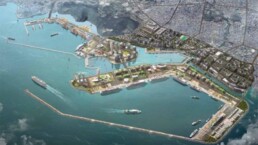

Jeju Province announced a significant shift in the development plan for Jeju New Port, marking a transition from its original focus on passenger and cruise functions to a more cargo-centric approach. This revised plan, unveiled by the Ministry of Oceans and Fisheries, involves a large-scale port development project valued at 3.8278 trillion won (approximately 2.6 billion), with an accelerated timeline targeting completion by 2035. The strategic move aims to enhance business viability and align with global maritime trends.
The Seogwipo Gangjeong Cruise Port, which opened in 2017, currently accommodates two cruise ships of 150,000-ton class or more simultaneously. However, the new development plan for Jeju New Port is set to expand this capacity significantly. According to Oh Sang-pil, Director of the Marine and Fisheries Bureau, “The cruise berths will be constructed to accommodate three 150,000-ton class cruise ships and one 220,000-ton class ship simultaneously, heralding a new era for Jeju marine tourism.”
The detailed infrastructure plan includes four cruise berths and four cargo berths—three general cargo berths of 20,000-ton class and one oil berth of the same class—alongside one management berth. Additionally, the rear area will span 809 thousand square meters, incorporating a redevelopment area within the inner port. The reclamation area is projected to reach approximately 1.26 million square meters.
Jeju Island’s geographical and economic significance as a hub for maritime trade and tourism underscores the importance of this development. The island’s strategic location in Northeast Asia makes it an ideal site for enhancing both tourism and cargo shipping capabilities. This aligns with broader trends in the global cruise industry that demand larger ships and diverse itineraries.
South Korea’s commitment to expanding its maritime infrastructure is evident in this project. It reflects national strategies aimed at improving port facilities and increasing capacity for passenger and cargo operations. The investment model involves substantial government funding alongside private sector participation—1.3025 trillion won from private investment—demonstrating a collaborative approach typical of large-scale infrastructure projects in South Korea.
The province plans to initiate preliminary feasibility study project applications in May this year. If selected as a target project, these studies will be conducted from the second half of this year through to the second half of 2026. Full-scale construction is targeted to commence in 2029.
This ambitious project not only increases its scale by approximately 961.6 billion won from its original estimate but also accelerates completion by five years ahead of schedule—from an initial target of 2040 now moved up to 2035. Such developments are crucial for maintaining Jeju Island’s competitive edge in tourism while bolstering its role in global shipping logistics.
Source:Business Korea



Related News.

Hong Kong Global Maritime Trade Summit to return for third edition
The International Chamber of Shipping, in collaboration with the Transport and Logistics Bureau of the Government of Hong Kong and the Hong Kong…

Appetite for US crude oil exports climbs despite high freight
South Korea tops US crude destinations at 568,600 b/d VLCC rates to Asia double, closing arbitrage window European refining margins…
Shipping stocks Rally as Hormuz Traffic plunges 75%
Ship traffic through the Strait of Hormuz — a critical chokepoint handling about 20% of global crude oil and liquefied natural gas shipments — has…
Diana Shipping announces Time Charter Contract for m/v G P Zafirakis with Classic Maritime
Diana Shipping, a global shipping company specializing in the ownership and bareboat charter-in of dry bulk vessels, announced that, through a…
New IMO ESP Code framework for Remote Inspection Techniques
The International Maritime Organisation, through Resolution MSC.584(111) , has adopted amendments to the International Code on the Enhanced…
ABS opens Offshore & Marine Support Center in Bergen
ABS has expanded its capabilities in the Norwegian maritime market with the opening of a cutting-edge support center in Bergen, bringing advanced…
MOL holds giant step memorial ceremony and beach cleanup at Kashima Coast
Memorial and Reflection 20 Years After the Accident: Learning from the Past to Foster an Even Stronger Safety Culture Mitsui O.S.K. Lines, announced…
KEZAD-based Arabian Gulf Steel Industries achieves lowest verified Carbon Footprint for Rebar
CARES UK verified Environmental Product Declaration confirms 139 kg CO₂e per tonne for rebar produced at AGSI’s KEZAD Abu Dhabi facility Arabian…
Indian Register of Shipping announces launch of first fleet support ship INS Surya
Indian Register of Shipping continues to strengthen its role in supporting the Indian Navy and India’s naval shipbuilding capabilities through the…

VLCCs Climbing the Record Charts
LR2 The TC1 75kt MEG/Japan index decreased by only a single point this week to WS928. The corresponding Baltic round-trip TCE fell by $2,000 to…
Subscribe to our newsletter!
if you dont want to swim alone in the ocean of news, sign up for the newsletter, and you will receive daily all the important news of world shipping!
