Advancing Ocean Tech for Marine Sustainability a dive into Marine Science Innovations

By Dr Nora von Xylander, Marine Biodiversity & Sustainability Scientist at Tunley Environmental

As the world aims to tackle the consequences of climate change and environmental degradation, the oceans, covering over 70% of our planet, are at the forefront of both the challenges and solutions we face. Sustainability science, with its interdisciplinary approach, is essential in addressing the complex interactions between human activities and marine ecosystems. Ocean technology plays a pivotal role in this effort, by transforming marine research and providing innovative tools and methodologies to help monitor, protect, and restore our oceans and overall planet.
This article explores how innovations in ocean tech supported key advancements in 2024 and examines new directions for 2025 in protecting and sustainably managing our oceans. Technological advancements, such as remote sensing satellite tools (e.g. NASA’s MODIS & NOAA) and autonomous underwater vehicles (AUVs), are being used to provide real-time data on ocean conditions such as sea surface temperature (SST), chlorophyll concentrations, and ocean currents. These tools empower scientists to predict events such as: harmful algal blooms, coral bleaching, and shifts in marine ecosystems. This leads to timely responses that help mitigate ecological and economic losses. Other innovations in ocean tech are currently being developed (e.g., SMRU Instrumentation and Arctic Seaweed) to ensure effective management and protection of our marine ecosystems. By addressing human impacts on our oceans, advancements in ocean tech continue to help illuminate the importance of marine ecosystems in climate regulation, biodiversity, and resources for humanity.
Harnessing the Power of the Sea & Implications for Marine Biodiversity
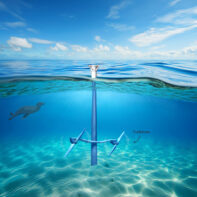
The push for marine renewable energy is vital for reducing reliance on fossil fuels and combating climate change. Ocean tech has made significant strides in harnessing marine renewable energy sources, such as tidal and offshore wind energy. Innovative designs, like floating wind farms6,7 and tidal turbines8, are being developed to reduce ecological disruption and maximise energy efficiency (Figure 1). By investing in these technologies, we can tap into the ocean’s vast energy potential while minimising marine environmental impacts and fostering sustainable coastal economies.
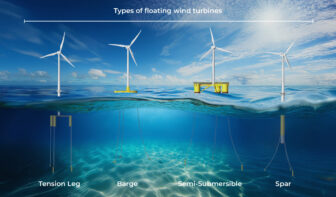
Figure 1. Illustration of the different types of floating wind turbines (A) and tidal turbines (B) as Innovative Ocean Tech Solutions for Sustainable Marine Renewable energy.
Ocean tech advancements are transforming marine renewable energy towards more sustainable practices essential for minimizing our carbon footprint whilst maintaining healthy ocean ecosystems. For instance, the ocean tech developed by the Sea Mammal Research Unit (SMRU) at the University of St. Andrews has been instrumental in advancing marine research to assess the impacts of renewable energy structures on marine mammals. This ensuring that the transition to cleaner energy remains aligned with marine conservation goals. SMRU Instrumentatio’s specialized tagging systems and open-source software for underwater sound monitoring known as Pamguard, are enabling real-time tracking of marine mammal movements and habitat needs. Consequently, providing essential insights into the potential impacts of marine renewable energy technologies.
The potential for collision between marine mammals and renewable energy infrastructure, like tidal turbines, has led SMRU to innovate multi-beam sonar systems10,11,12. This technology, along with the deployment of ultrasonic hydrophones arrays, has demonstrated the ability to detect and track marine mammals in three dimensions near tidal turbines13,14,15. These systems, designed to be used in conjunction with the UK government for conservation purposes, could be instrumental in reducing potential hazards from renewable energy structures and for informing policy development for renewable energy expansion. It is the hope of researchers that temporary shutdowns in operation could reduce negative impacts of offshore energy on marine mammals, similarly to how enforced vessel slowdowns in protected areas have reduced vessel collisions and harmful noise impacts to marine mammals.
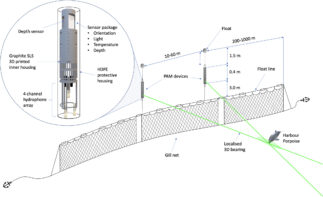
Due to its efficient underwater propagation, sound forms the primary sensory environment for marine mammals, who rely on vocalisations to communicate, navigate, and locate prey Starting with the development of the now globally used Pamguard software, in combination with passive acoustic monitoring (PAM) to detect marine mammals and record underwater sound, PAM research has expanded to new areas. This includes using artificial intelligence (AI) to identify species-specific acoustic signals, like those from bottlenose dolphins and killer whale. PAM technologies range from hydrophones towed behind boats and stationary recorders on the seafloor, to more recent advancements using distributed acoustic sensing (DAS) along existing underwater fibre optic cables to detect whales, shipping noise, or seismic activity. Ocean tech such as smart fishing gear and non-lethal acoustic deterrent devices for aquaculture are also being developed to support sustainable fishing practices by minimizing fisheries bycatch. With overfishing and bycatch continuing to impact marine life, sustainable fishing practices are becoming crucial to balancing economic needs with the needs for resilient marine ecosystems. As entanglement in fishing nets remains a leading cause of mortality for small cetaceans, smart fishing gear with the ability to track marine mammals using PAM technology is showing promise to minimise bycatch (Figure 2). Targeted Acoustic Startle Technology (TAST) is also emerging as potential alternative to traditional acoustic deterrent devices (ADD) currently used in aquaculture to prevent predation. Unlike, ADDs, which can harm to marine life and cause hearing damage in marine mammals, TAST offers a less harmful approach. PAM technology not only offers the opportunity to eavesdrop on vocalizing cetaceans, but also offers the opportunity monitor marine ecosystems by capturing the natural sounds of other marine life, alongside human-made noises from shipping and industrial activities. As we move into 2025, integrating AI-driven analysis and expanding PAM capabilities is marking a promising path forward for more sustainable marine practices that align with international goals for resilient ocean ecosystems.
Innovations in Blue Carbon Technologies and Insights into Algapelago’s Blue Forest
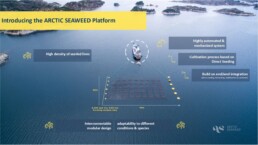
As international awareness of ocean sustainability grows, we anticipate increased efforts in developing scalable solutions that not only preserve but also regenerate ocean health. Coastal marine habitats such as kelp forests and seagrasses beds, playing key roles in carbon sequestration, provide substantial potential for reducing atmospheric CO₂ while contributing to nutrient cycling and supporting marine biodiversity25,26. As a natural solution to climate change, initiatives like regenerative seaweed farming are gaining traction globally, with new technologies showing promise for enhancing scalability and efficiency. As a platform for regenerative aquaculture research, Algapelago is working to harness these benefits as it plans to introduce a groundbreaking modular cultivation system, a product of the innovative design by the Norwegian company Arctic Seaweed (Figure 3). This system, set to be deployed in June 2025 in North Devon, England, has a production potential of up to 40 fresh tonnes of kelp. It is uniquely engineered for high energy conditions and offshore scaling, with automated seeding and harvesting capability. As part of Algapelago’s Blue Forest project, a pioneering scientific and content program designed to answer critical questions about the scalability, impacts, and natural capital value of regenerative ocean farming over four years, this rig will allow to explore the simultaneous cultivation of mussels and kelp at scale. As Algapelago’s co-founder and ocean adventurer Olly Hicks explains, “We are excited to deploy this new rig, as it will accelerate the development of the Blue Forest initiative. This effort will help establish strong future credit markets, promote ecological improvements, and create large-scale opportunities within the blue economy.” As we look ahead into 2025, regenerative seaweed farming projects like Algapelago’s are expected to expand, helping create resilient marine environments that contribute positively to the blue economy and global climate goals.
Conclusion: Charting a Sustainable Future with Ocean Tech
In 2024, there have been several innovative ocean tech advancements that support sustainability science and the management of marine ecosystems. The intersection of sustainability science and ocean technology has the potential to reshape marine conservation, providing innovative ways to address the pressing challenges facing our oceans. By investing in these technologies and fostering collaborative approaches, we can build resilient marine ecosystems that support biodiversity, climate stability, and sustainable resource use. The achievements of 2024 illustrate what is possible when interdisciplinary science meets visionary technology, setting the stage for an even more impactful 2025.



Related News.

Hong Kong Global Maritime Trade Summit to return for third edition
The International Chamber of Shipping, in collaboration with the Transport and Logistics Bureau of the Government of Hong Kong and the Hong Kong…

Appetite for US crude oil exports climbs despite high freight
South Korea tops US crude destinations at 568,600 b/d VLCC rates to Asia double, closing arbitrage window European refining margins…

Shipping stocks Rally as Hormuz Traffic plunges 75%
Ship traffic through the Strait of Hormuz — a critical chokepoint handling about 20% of global crude oil and liquefied natural gas shipments — has…

Diana Shipping announces Time Charter Contract for m/v G P Zafirakis with Classic Maritime
Diana Shipping, a global shipping company specializing in the ownership and bareboat charter-in of dry bulk vessels, announced that, through a…

New IMO ESP Code framework for Remote Inspection Techniques
The International Maritime Organisation, through Resolution MSC.584(111) , has adopted amendments to the International Code on the Enhanced…

ABS opens Offshore & Marine Support Center in Bergen
ABS has expanded its capabilities in the Norwegian maritime market with the opening of a cutting-edge support center in Bergen, bringing advanced…

MOL holds giant step memorial ceremony and beach cleanup at Kashima Coast
Memorial and Reflection 20 Years After the Accident: Learning from the Past to Foster an Even Stronger Safety Culture Mitsui O.S.K. Lines, announced…

KEZAD-based Arabian Gulf Steel Industries achieves lowest verified Carbon Footprint for Rebar
CARES UK verified Environmental Product Declaration confirms 139 kg CO₂e per tonne for rebar produced at AGSI’s KEZAD Abu Dhabi facility Arabian…

Indian Register of Shipping announces launch of first fleet support ship INS Surya
Indian Register of Shipping continues to strengthen its role in supporting the Indian Navy and India’s naval shipbuilding capabilities through the…

VLCCs Climbing the Record Charts
LR2 The TC1 75kt MEG/Japan index decreased by only a single point this week to WS928. The corresponding Baltic round-trip TCE fell by $2,000 to…
Subscribe to our newsletter!
if you dont want to swim alone in the ocean of news, sign up for the newsletter, and you will receive daily all the important news of world shipping!
