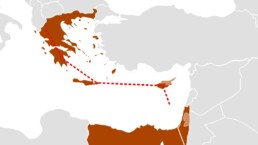

The Eastern Mediterranean (East Med) is a global gas hotspot, with Egypt, Israel and Cyprus at the heart of the action. Wood Mackenzie estimates the region holds some 80 tcf of advantaged remaining gas resources close to energy-hungry markets.
Despite having many of the ingredients for success, progress towards commercialisation has been stuttering. With Egypt experiencing a gas supply crunch, Israel looking for export growth and production in Cyprus yet to take off, accelerating development is a priority.
Gavin Thompson, Vice Chair EMEA, attended this week’s EGPYES event in Cairo and discusses five ways to deliver on the region’s gas potential.
First, strengthening collaboration between Egypt and Cyprus
Politically, the East Med is a tough neighbourhood. Competing national objectives too often hold back progress, while war in Gaza has curbed the pace of gas development. But the export deals announced this week between Egypt and Cyprus show an appetite for investment from both sellers and buyers of gas.
The energy crisis hit Egypt hard, with the country amassing multi-billion-dollar payment arrears to domestic gas producers that damaged credibility and curtailed much-needed upstream investment. A new Egyptian cabinet since June last year has set about restoring economic stability and investor confidence, paying down arrears with financial support from the IMF and key Gulf allies. But upstream producers still lament the unpredictable nature of ongoing receivables: on-time, consistent payments are essential to rebuilding investor confidence.
Progress is now being made in Cyprus more than a decade since the country’s first gas discovery. This week, Chevron reached an agreement for piped exports from its 3.5-tcf Aphrodite field to Egypt, while Eni signed a host government agreement with Cyprus and Egypt to develop the 2.5-tcf Cronos gas field and utilise Egypt’s Zohr infrastructure and Damietta LNG export terminal.
Second, revitalising Egyptian production
Egypt’s domestic gas production continues to decline steeply, with output down from 7 bcfd in 2022 to around 4.5 bcfd today. Zohr’s sharp decline, dwindling legacy production and lack of exploration success have led to an earlier-than-predicted gas deficit.
With payment arrears receding, exploration and development activity is slowly picking up. Development of key greenfield gas projects like Chevron’s Nargis and Shell’s near-field discoveries would go some way to meet growing gas demand, but much more is required. Last month’s play-opening multi-tcf Nefertari gas discovery on the offshore North Marakia block by ExxonMobil and partner Qatar Energy holds promise. But incentivising operators to develop new deepwater frontier acreage requires improved fiscal terms and higher domestic gas prices.
Third, diversifying Egyptian gas supply
With the era of mega-projects like Zohr and West Nile Delta largely over, Egypt must look more widely to source supply. More Israeli gas is an option. We assume Leviathan Phase 1B will leverage midstream expansion projects to meet increased regional demand, while Tamar gas exports to Egypt will also increase. Future gas imports from Cyprus now look more assured and further deals could follow.
Year-round Egyptian LNG imports seem set to be locked in. Egypt’s improved finances have helped with infrastructure deals, with two FSRUs secured and a third potentially in place this summer to meet peak demand. As a result, its LNG imports could rise by up to 6 Mt this year.
These moves underscore the permanence of Egypt’s gas deficit but don’t close the door on its regional gas hub ambitions. With massively under-utilised liquefaction infrastructure, Egypt could still attract more volumes, boosting hard currency inflows through re-exports into Europe.
Fourth, keeping the Majors engaged
The region is important to almost all the Majors and we estimate their remaining East Med NPV at US$19 billion. With the East Med set for significant growth through to the late 2020s, the Majors are its natural partners, attracted by stable cash flows from advantaged, low-emissions gas and potential access to European gas markets.
But this partnership shouldn’t be taken for granted. The region needs the Majors’ capital, technical expertise and execution. And while the East Med compares favourably to other regions in the Majors’ portfolios on some metrics, there is frustration at the more modest margins and domestic gas pricing, which doesn’t incentivise investment in higher risk/reward plays in deepwater and ultra-deepwater. Plus, it almost goes without saying, not getting paid doesn’t help, either.
Finally, attracting a wider range of investors
Newcomers are already starting to provide much-needed investment in Egypt’s gas sector. Arcius Energy, the ADNOC and BP gas-focused joint venture, is centred on Zohr, Atoll and exploration acreage in the Nile Delta and may also have designs on opportunities in Israel and Cyprus. The Carlyle Group’s acquisition of Energean’s Egyptian assets could boost its interest in local M&A, where opportunities are plentiful. We also expect Harbour Energy to keep its assets in Egypt, which ranks as the fifth-biggest country by NPV in a portfolio swelled by the Wintershall Dea merger.
Source: Wood Mackenzie



Related News.

Navigating the Multi-Orbit Era: In Conversation with Intellian’s Jon Harrison at SMM 2026
At SMM 2026 in Hamburg, the rapid evolution of maritime satellite communications took centre stage. Across the exhibition halls, discussions among…
Cyprus ports need joint energy and investment strategy, shipping agents chief says
Cyprus needs a coordinated strategy for shipping, energy and environmental protection to support port investment and modernisation, Cyprus shipping…
MASO Public Affairs introduces MASO Regulatory Intelligence
A new subscription service helping businesses understand what is changing and what it means for them MASO Public Affairs introduces MASO Regulatory…
Anglo-Eastern helps turn CMBTECH’s ammonia ambition into an operational reality
From early feasibility study and risk-based design to newbuilding supervision, crew readiness and technical management, Anglo-Eastern drew on its…
Escalation of attacks threatens to derail recovery in Middle East oil exports
World oil demand is forecast to fall by 2.5 mb/d y-o-y in 4Q26 and 2.6 mb/d on average in 2026. As the Iran war manifests itself through restricted…
New study finds shipping pays twice its share to EU ETS earmarked revenues should triple to help build market for sustainable fuels and technologies
Shipping is responsible for around 10% of EU ETS emissions but pays almost 20% of the ETS bill. Unlike other sectors, it has never received free…

MSARC strengthens maritime mass rescue readiness through training and national live exercise off Dakar, Senegal
Joint MSARC–FHAS programme combines three days of SAR training with a national multi-agency live exercise The Maritime Search and Rescue Council ,…
Sogese report deliveries are still being delayed as container freight rates fluctuate
FOR IMPORTERS Spot rates into the Mediterranean are back at January levels, Far East to Europe reliability sits at pandemic lows, and nearly…
Glencore begins trading on Australian Securities Exchange
Glencore has begun trading on the Australian Securities Exchange under the ASX code GLC. Gary Nagle, Glencore’s CEO, said it was an exciting day for…
BIMCO Shipping Number of the Week
Suez Canal container ship transits exceed 50% of pre-disruption levels "During the first two weeks of October, weekly container ship capacity…
Subscribe to our newsletter!
if you dont want to swim alone in the ocean of news, sign up for the newsletter, and you will receive daily all the important news of world shipping!
