
All eyes on China

December 4, 2024
Commentary summary:
• All told there is less temptation to be short crude with risks mounting against sanctioned crude barrels.
• Light sweet and medium-heavy crude still divergent; there is too much of the latter and presumably the two will converge at some stage.
• WTI may need to price higher globally with commercial stocks low and drawing.
• North Sea did correct a little but now may look balanced given risks ahead.
ICE Brent time-spreads trended a little weaker towards the end of last week while CFDs also began to cool.
Geopolitics holds increasing sway over the market with escalation in Ukraine and the global threat of US tariffs and sanctions continuing to escalate over the last week.
Asia
In the East, the big questions are around China and Iran. Independents have been scooping up Jan-loading ESPO and Sokol (i.e. short-haul discounted barrels), and are reportedly starting to avoid Iranian crude purchases.
New sanctions on tankers are also making the trade more expensive.
We might expect China to pick up more WAF and potentially spot MEG barrels in the February cycle, with players already snapping up overhang barrels from prior cycles.
Recent price moves may prove tempting: Angolan Girassol diffs dropped some $1/bbl late in the week; the Dubai market also appears to be weakening with Argus reporting Oman at a discount to Dubai swaps and Upper Zakum premiums also down substantially on Friday.
This is just the latest round in what has been a continual weakening cycle for a lot of the medium-heavy crude market globally. You have to wonder about both demand (runs) and supply (versus consensus/reported).
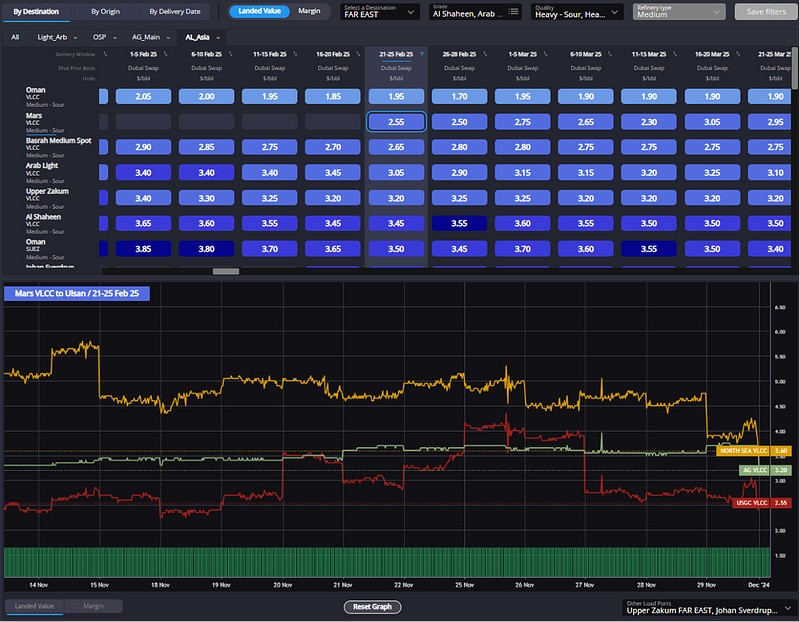
There might well be additional pressure on spot MEG at the moment from Western medium-heavy barrels, with Mars once again looking competitive in Asia and Johan Sverdrup – whose FOB premiums are extremely cheap – looking particularly cheap relative to normal.
Image
(Mars and Johan Sverdrup are cheap in the Far East)
Overall demand for Feb trading out of China, could still prove lacklustre due fewer calendar days, weak export margin incentives, and with some 2025 quotas having been pulled forward into end-24.
Independents are struggling from the margin perspective and presumably will increasingly do so if they are forced to take less discounted feedstock. One risk is that more escalation in the rhetoric pushes players to panic buy; such activity may be impacting the HSFO market already, which is very strong.
As such, while all told we don’t see the overall Feb Asian cycle coming out particularly strongly, similar to January, we see upside risk, particularly short-term.
This also depends a little on OPEC+ decisions and subsequent OSP releases (after which we should see a flurry of trading).
We think OPEC+ will kick the can down the road amid uncertainty over geopolitics and the US plan for Iran. There is a non-zero chance (we put it at some 25%) of OPEC+ cutting more, at least in official numbers.
On a different segment of the market, low sulphur, high flash crudes for blending into VLSFO have seen premiums dropping in line with falling VLSFO cracks.
Vincent in particular has dropped by 4$/bbl and face stiff competition with Niger’s Meleck crude for VLSFO blending.
Europe
We suggested last week that BFOET barrels looked a little overbought and we did start to see some correction late last week.
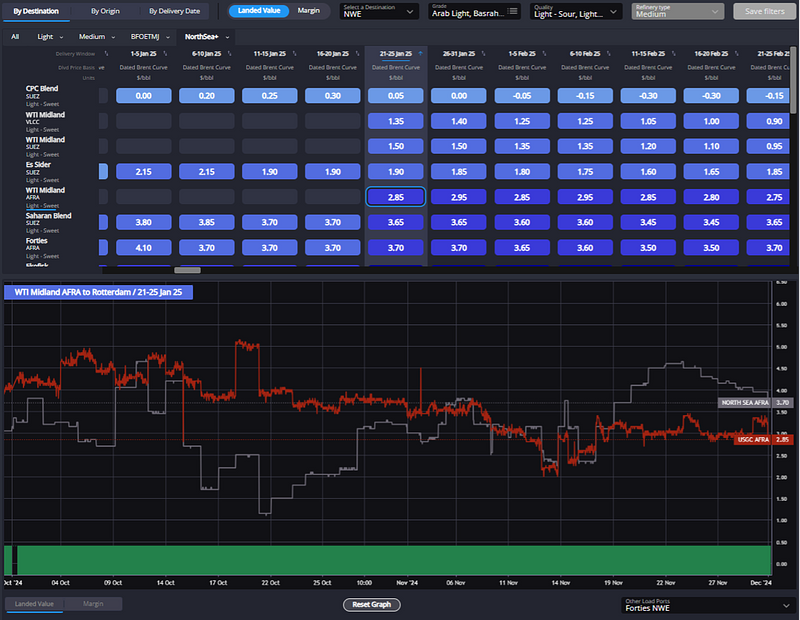
The Argus Forties FOB dropped back below $1/bbl, which still however lands an Afra into NWE at some 80c above landed WTI Afras, for late Jan.
Saharan Blend is still weakening and is landing cheaper than Forties in NWE, though gains in Black Sea have probably closed the arb to NWE now.
As such it is possible we still need to see physical Brent correct a little more, though we should recognise gradual gains in the rest of the European light sweet sphere (albeit in most cases still trending at the bottom of the post-Covid range), while the risk is towards stronger WTI (see Americas section).
Image
(WTI looks relatively cheap in NWE still)
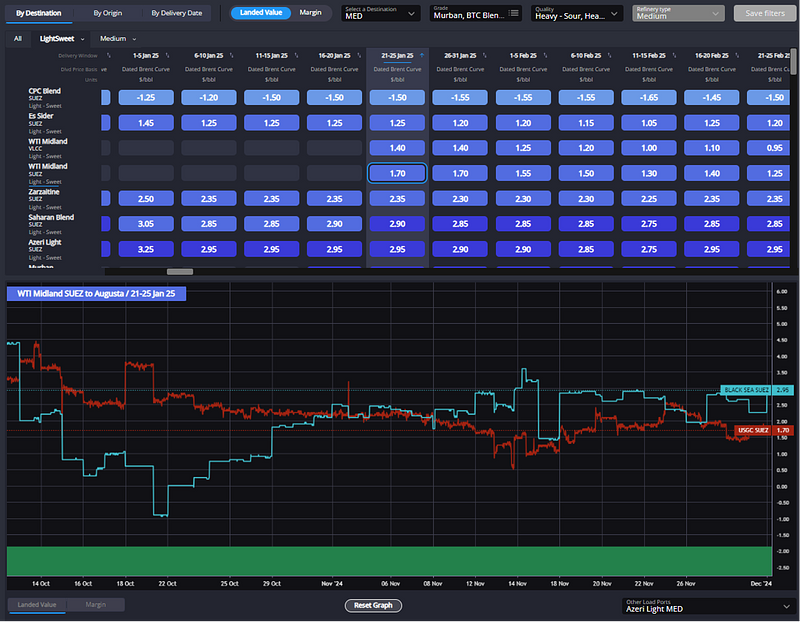
Black Sea diffs continue to rise slowly. Azeri Light has hit an eight-week high at Augusta; some strength is attributed to expectations of higher January demand, as well as cross-Med freight.
Reports suggest several BTC cargoes loading for NWE in Nov, presumably on workable econs earlier in the month. These econs look less workable now.
Light sweet European crude is not arbing well to the East currently, while WTI looks cheap still in NWE and the Med for now. All told from the arb perspective Europe probably still looks a little too strong, very short-term.
The risk remains for local refineries come out stronger for January landing crude amid decent margins, and for stronger WTI pricing in Dec.
Image
(WTI looks cheap in the Med for now)
Americas
For the most part Latin American heavy crudes continue to trend relatively weak which may reflect Asia’s (and PADD-5’s) new-found appetite for TMX barrels. It also reflects broader global weakness in heavier barrels.
The exception is in the US domestic system, where Mars and WCS have been dragged higher y-o-y, presumably on the mixture of high US runs and continuing impacts of the TMX expansion.
On light sweets, the question now is whether WTI can remain competitive. WTI is currently landing at relatively cheap levels in European destinations.
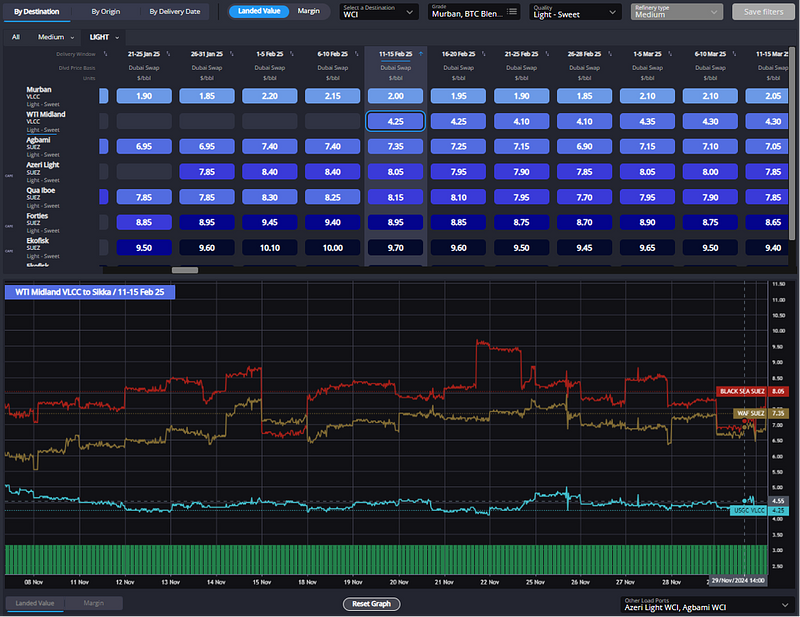
There has been reportedly strong demand in Asia for it over recent weeks and this may even get a further boost if discounted/sanctioned barrels continue to come under scrutiny and expectations are that Chinese buying of “legitimate” crude (as a proportion of overall buying) is set to rise, even if only for WAF and spot MEG. WTI also looks cheap in India against WAF and Black Sea.
Image
(WTI looks cheap in India against WAF and Black Sea)
What makes this interesting is that US commercial stocks are low, tend to draw seasonally until year-end, and Cushing is also becoming interesting again with stocks having drawn for several weeks.
If TD25 (and VLCC rates) continues to stay in the doldrums then WTI needs to price higher, as will TI/Brent.
******COMMENTARY ENDS******
About the Author
Neil Crosby is an experienced energy market and commodity analyst, specialising in crude oil, oil products, biofuels, and carbon. With roles at OilX and JBC Energy, he has extensive expertise in global oil industry analysis, forecasting tools, bespoke research, and client communication. His focus on refining and petrochemicals underscores his specialisation.
Source: Sparta Commodities

Related News.

Subscribe to our newsletter!

if you dont want to swim alone in the ocean of news, sign up for the newsletter, and you will receive daily all the important news of world shipping!

* indicates required
Consent *
By submitting this form you agree to receive Email Marketing

Design & Development by P.KAN.DESIGNER

Design & Development by P.KAN.DESIGNER

Privacy Preference Center