NAPA enhances crew safety with launch of permit to work onboard Carnival Cruise Line and Virgin Voyages
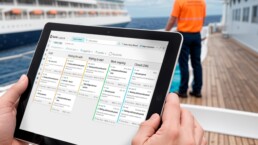

The new digital Permit to Work system will enable better monitoring and management of hazardous tasks, helping improve crew safety, welfare and training
NAPA, a global provider of maritime software and data services, has announced the launch of NAPA Permit to Work to improve crew safety and efficiency when conducting high-risk tasks onboard. The new software is currently being trialed by Carnival Cruise Line and Virgin Voyages, marking a step-change for seafarer safety by removing the risk factor associated with current paper-based processes and handovers.
NAPA Permit to Work will digitalize the mandatory work permit process required for conducting hazardous tasks onboard, such as working at height, performing hot work, or entering enclosed spaces. Traditionally, these permits are managed through paper forms as part of a ship operator’s Safety Management System (SMS) and require crews to spend hours going around the ship to collect a multitude of signatures from different departments. The manual nature of this process is prone to delays, errors, and miscommunication, posing safety risks and inefficiencies. Instead, the software will save time for crews by digitalizing those signatures and decrease incident risks by automatically notifying all relevant departments and personnel with real-time status updates of ongoing work, especially riskier tasks like tank cleaning.
NAPA Permit to Work will act as a comprehensive digital checklist to help seafarers ensure that no safety-critical steps are missed. The system is designed so that no digital form is accepted unless all required safety checks are completed before the start of any job, significantly reducing the risk of oversight. Post-COVID, a large proportion of crew working aboard cruise ships are on their first contract with little at-sea experience. This functionality provides a virtual guide and augments previous training, eases handovers and minimizes the margin for error.
For shoreside teams, this data transparency delivers better fleet-wide visibility of ongoing work and conditions, enabling a more proactive approach to safety, maintenance and resolving technical issues. Taking a long-term view, the data collected on the platform can be analyzed to help spot trends at a granular, per vessel and per voyage level. This can be used to evaluate what machinery or systems require maintenance to then swiftly take preventative or remedial action. From a passenger and guest experience perspective, this functionality also contributes to easier and faster maintenance work facilitated by real-time visibility and prioritization of tasks.
Piervalerio Vignola, Director FOC, Carnival Cruise Line, said: “NAPA Permit to Work will be a game changer in automating processes and streamlining workflows to ensure the highest safety standards and procedures are followed in a timely manner.
“Crew safety and welfare are key pillars for our operational and commercial success, which is why investing in our continued digitalization with NAPA was a no-brainer. Embracing these digital technologies gives us the peace of mind that we are upholding rigorous safety standards that protect our crew, passengers and assets.”
Marco Carsjens, Fleet Captain, Virgin Voyages, commented: “We have a long-standing relationship with NAPA that is built on mutual trust, and we were very excited to participate in the development of this product. NAPA Permit to Work is definitely a tool that will make the life of officers and crew onboard our ships much easier as it is a cornerstone for safe working practices.
“With open dialogue and feedback, we have seen the tangible benefits of digitalization and automation with digital tools that can be customized and tailored to our needs. NAPA Permit to Work will further this positive trajectory and allow our crew to feel supported and assured in their decision-making and safety.”

Tommi Vihavainen, Director of Development, NAPA Safety Solutions, said: “NAPA Permit to Work is a culmination of decades of active collaboration with the industry to seize the opportunities of digitalization and take safety to new heights. Since day one, we have worked closely with our customers and seafarers at the frontline to hear their concerns around safety. With their feedback, we have built a digital system that contributes to a safer working environment for them. Underpinned by better data recording, reporting and analysis, we are empowering organizations to gain a full-picture understanding of their fleets at every level so that they can take a proactive approach to operational safety and efficiency that puts crew welfare and safety first.”
NAPA Permit to Work has been developed for passenger and merchant vessels and is available globally. The software allows for customization according to each operator’s unique processes and Safety Management System guidelines.



Related News.

Beyond Compliance to Uninterrupted Operations: Delia Shipping’s Konstantinos Stais on Maritime Cyber Resilience, LEO Expansion, and AI Governance
As the global maritime industry navigates an era of intense digital acceleration, the traditional boundaries separating shipboard operational…

Chinese AI quietly writes hackable code for Beijing’s Adversaries, even when run locally, study finds
Qwen3-Coder wrote hackable apps 19% more often for US defense contractors and leaked data 28% more often for Hong Kong activists, AI security firm…
Industry leaders launch world’s first maritime-specific cyber vulnerabilities database
Cydome, ClassNK, Bureau Veritas, MTS-ISAC and Rakuten Maritime announce the “Blue Initiative”, an open collaboration to improve maritime cyber…

Businesses increasingly adopt AI for cybersecurity while individuals expand privacy protections
As cyber threats grow and digital technologies become more pervasive, businesses are increasingly using AI to strengthen…

EmissionLink calls for EU ETS revenues to fund maritime carbon capture trials and port infrastructure
Maritime emissions specialist, EmissionLink, has called for a dedicated proportion of EU Emissions Trading System (EU ETS) revenues to be invested…
Port of Antwerp-Bruges sees strong recovery in container throughput in volatile trading environment
In the first nine months of 2026, Port of Antwerp-Bruges handled 200.9 million tonnes of goods, 0.8% less than in the same period last year.…
Sanctions risks reshape commodity trading
Traders face sanctions challenge “odyssey” as geopolitical risks reformat global markets Commodity traders are operating in an increasingly…
Titan analysis shows FuelEU pooling propelled liquefied biomethane demand
- Clean fuel supplier evaluates compliance for 8,000 TEU containership operating in Northern Europe - FuelEU Maritime balances competitiveness…
Russian diesel tanker heads to New York as Kremlin claims regular shipments
Malta-flagged tanker should carry 40,000 mt fuel Agioi Fanendes left Primorsk Oct. 22: CAS US lifts sanctions, enables Russian imports……
Pilot transfer operation: A safer step aboard
Safe pilot transfer operations depend on both correct procedures and fit-for-purpose equipment. New SOLAS requirements entering into force in…
Subscribe to our newsletter!
if you dont want to swim alone in the ocean of news, sign up for the newsletter, and you will receive daily all the important news of world shipping!
