Cepsa commences supply of biofuels to Norwegian Cruise Line Holdings at the Port of Barcelona

-
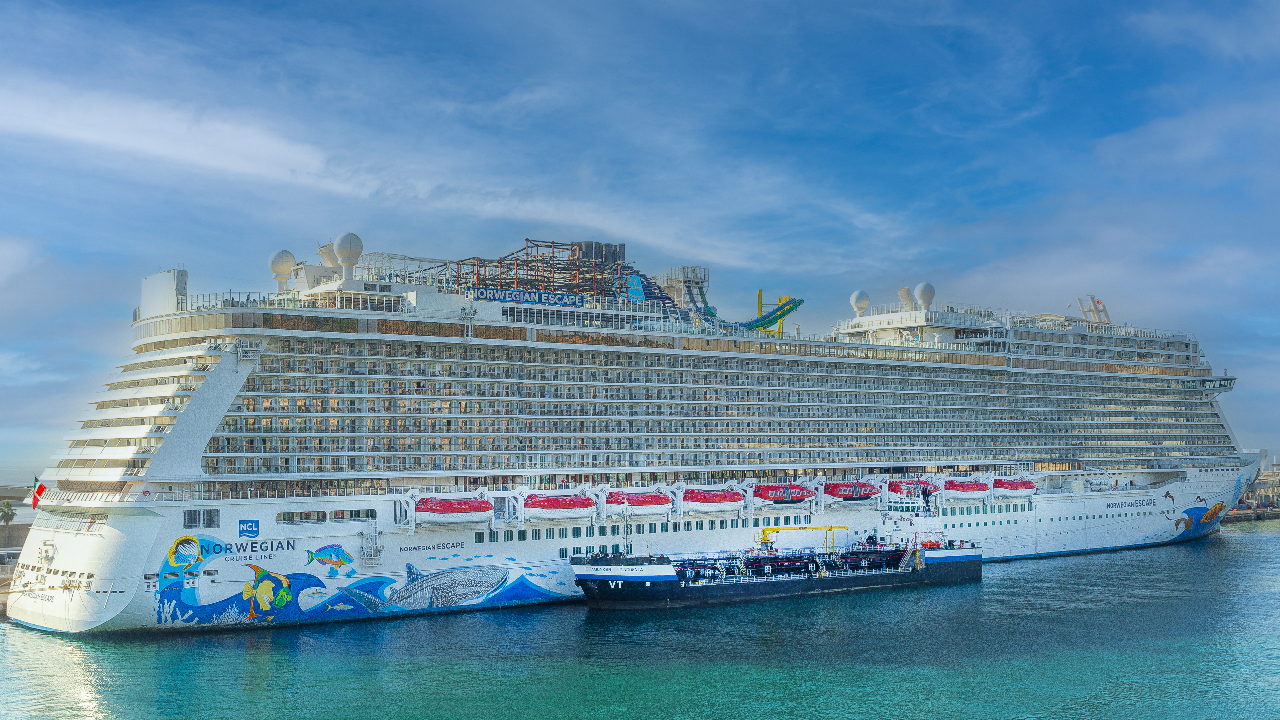
- Cepsa, a leading marine fuel supplier in Spain, begins supply of 2G biofuels to the Norwegian Escape, operated by Norwegian Cruise Line Holdings (NCLH) from the Port of Barcelona, with further supplies confirmed for coming months.
- Cepsa has the capacity to supply these sustainable fuels to the cruise industry on a regular basis at the Spanish ports where it operates.
- Since biofuels can reduce CO2 emissions by up to 90% compared to conventional fuels throughout their life cycle, they play a key role in decarbonization of hard-to-electrify sectors like maritime transport in addition to promoting the circular economy.
Cepsa, a leading supplier of energy for maritime transport in Spain, has undertaken its first direct supply of second-generation biofuels for the cruise industry at the Port of Barcelona. Further supplies have been confirmed for the coming months, with biofuels available on a regular basis from the Ports of Barcelona and Algeciras.
The supplied fuel contains a 24% sustainable component, which will prevent the emission of approximately 3,000 tons of CO2, equivalent to planting 200,000 trees. This biofuel has been produced from used cooking oils, promoting the circular economy.
Operated by Norwegian Cruise Line Holdings (NCLH), the Norwegian Escape, a 1,069-feet-long passenger vessel, received the first supply in late July and is scheduled to lift biofuel supply throughout the EU season. Cepsa also supplied biofuel for another two NCLH-operated vessels, the 734-feet-long Seven Seas Voyager and the 785-feet-long Oceania Riviera, in early August.
With this supply, Cepsa further solidifies its position as a benchmark in the energy transition and a leader in the supply of energy for maritime transportation. Cepsa has the capacity to supply these sustainable fuels to the cruise industry on a regular basis at the Spanish ports where it operates.
Samir Fernández, director of Marine Fuel Solutions at Cepsa, commented: “We are delighted that second-generation biofuels are now being harnessed by the cruise industry as they embark on their decarbonization journey. Marine fuels can be used in ships without the need for modifications to their engines, and they have a high potential for reducing CO2 emissions compared to conventional fossil fuels, achieving a reduction of up to 90% throughout their life cycle, which makes them an ideal immediate solution.”
This development comes at a time when the Cruise Lines International Association (CLIA) is turning its attention to ensure that the sector has sufficient access to low carbon fuels in pursuing net zero carbon cruising by 2050. According to CLIA’s latest State of the Cruise Industry Report, in 2023, over 31 million people globally chose to take a cruise, with over 8 million in Europe. With the sector rebounding significantly after COVID, enabling meaningful and rapid decarbonization is key. The International Energy Agency notes that, historically, oil-based fuels have met over 99% of the total energy demand for international shipping. In order to achieve net zero, the sector’s use of alternative fuels, including biofuels, hydrogen, ammonia, and electricity, will need to increase.
The use of biofuels enables shipping companies to meet the objectives of the European Union and the International Maritime Organization (IMO). Specifically, the European Commission’s Fit for 55 package includes the “Fuel EU Maritime” legislative initiative, which aims to reduce greenhouse gas emissions intensity in maritime transport by 2% in 2025, 6% in 2030 and 80% in 2050, compared to 2020 levels, through the use of sustainable fuels. Concurrently, the IMO has updated its strategy for reducing greenhouse gas emissions in maritime transportation, establishing ambitious targets that will incrementally rise from 20% in 2030 to achieving net-zero emissions by 2050, compared to 2008 levels.
Cepsa has a diversified portfolio of solutions to facilitate the decarbonization of maritime transport. In addition to biofuels, it includes products such as liquefied natural gas (LNG). Moreover, Cepsa expects to supply synthetic marine fuels, such as green ammonia or methanol, in the future, to be produced at the Andalusian Green Hydrogen Valley it is developing in southern Spain, one of the largest green hydrogen projects in Europe.
This initiative further underscores Cepsa’s unwavering commitment to second-generation biofuels as a catalyst for advancing the decarbonization of maritime transportation. Through its 2030 strategy, “Positive Motion,” Cepsa aims to lead sustainable mobility and promote the decarbonization of heavy transport (air, maritime and land) through the production of green molecules. The company aspires to be the leading biofuel producer in Spain and Portugal by 2030, with a production capacity of 2.5 million tons annually, and of green hydrogen with an annual production capacity equivalent to 2 GW.



Related News.

ISLAND OIL: Unveiling of the Sculpture “Cyprus’s Journey Through the Ages” in Protaras – A Tribute and Landmark to Cyprus’s Historical Memory and Cultural Heritage
In a modest ceremony marked by a moving atmosphere, the sculpture “Cyprus’s Journey Through the Ages”, created by acclaimed Cypriot sculptor…
World Maritime Day 2026 from Policy to Practice – powering Maritime Excellence
Global regulations will deliver safer, more resilient shipping when they are implemented worldwide. The international maritime community marks…

Diana Shipping announces Time Charter Contract for m/v DSI Polaris with Dai An Ocean Shipping
Diana Shipping , a global shipping company specializing in the ownership and bareboat charter-in of dry bulk vessels, announced that, through a…

Chief Economists Expect Global Economy to Stabilize, but Fiscal Constraints, Rising Living Costs and AI Investment Uncertainty Threaten Growth
The global economy is stabilizing, but the fiscal support that cushioned successive shocks since 2020 is unlikely to play the same role in the year…
V. welcomes its new graduate cohort as programme expands across the group
Twelve graduates from nine nationalities join 11th year of V.’s expanded international management programme. V., the global ship manager and marine…

From Policy to Practice: Why Seafarers Are the Key to Maritime Excellence
The shipping industry is no stranger to regulation. Seafarers and ship operators work within a vast framework of international conventions, national…

Intermodal Report – Week 38 2026
Please find below the Intermodal market report for week 38 2026. Intermodal Report Week 38 2026 Market Insight By Nikos Tagoulis, Head of…

Allied – Weekly Market Review – Week 38
Please find below the Allied Weekly Report for Week 38 | 2026 ALLIED - Weekly Market Report- Week 38

Record year on the Northeast Passage but Arctic shipping remains very limited
In 2025, a record 103 transit voyages were made via the Northeast Passage. However, this is still equivalent to only around a day and a half of…

[xclusiv] S&P Report 21th September 2026
Please find below the [xclusiv] latest Weekly S&P Report [xclusiv] 2026_09_21 Market Commentary: VLCCs: Freight Boom Reprices the Fleet The VLCC…
Subscribe to our newsletter!
if you dont want to swim alone in the ocean of news, sign up for the newsletter, and you will receive daily all the important news of world shipping!
