90 per cent fewer emissions – work on the Baltic Sea’s first green corridor culminates in an historic week
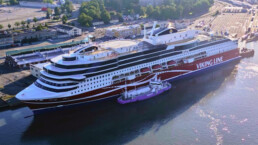

Viking Line’s vessels serving the Turku route will reduce their emissions by 90 per cent when the company runs those vessels for the first time for a whole week solely on biogas. During the week, which kicks off with Baltic Sea Day, Viking Glory and Viking Grace will demonstrate what the future looks like for the first green shipping corridor on the Baltic Sea.
Viking Line will celebrate Baltic Sea Day by introducing the first green corridor ever on the Baltic Sea, between Turku and Stockholm, for one week. The climate-smart Viking Glory and Viking Grace will only use liquefied biogas (LBG) as a fuel from August 29 to September 4, which will reduce the vessels’ carbon dioxide emissions by 90 per cent compared to liquefied natural gas (LNG), which is normally used.
During the week, a total of about 2,600 fewer tonnes of greenhouse gas emissions will be generated than normally. The reduction corresponds to the annual average carbon dioxide footprint for 270 Finns.
“This is an historic moment for us, the Baltic Sea and maritime transport. Scheduled service has never before been powered solely by biofuel. We have invested 450 million euros in our climate-smart vessels Viking Grace and Viking Glory, and one of their most important features is that they can run on LNG, biofuel and future synthetic fuels produced from renewable energy.
Such significant environmental measures are the result of our long-term work,” says Viking Line’s Sustainability Manager, Dani Lindberg.
For one year now, Viking Line has offered its passengers and its conference and cargo customers the option of purchasing biofuel corresponding to the amount of fuel used for their travel. This reduces emissions by 90 per cent per passenger or cargo unit.
“Both consumers and corporate customers expect responsible conduct from us, and they themselves are prepared to take part in protecting the vulnerable nature of the Baltic Sea’s archipelagos. The number of trips using biofuel increased 500 per cent immediately when we highlighted the option earlier in our booking system.”
Normally, liquefied natural gas (LNG) is used on the Turku route, and this fuel has significantly lower nitrogen oxide emissions than the heavy fuel oil traditionally used on vessels. Both LNG and LBG (liquefied biogas) generate virtually no harmful sulfur or particle emissions.
Viking Line’s biogas is supplied by Gasum, which makes the fuel from food and agricultural waste. The biogas is produced in Europe, and the origin of each gas consignment is clearly documented.
“We have already operated Viking Grace using biogas on our Turku route, and passengers and cargo customers on Viking Glory and Viking Grace also already have the option to purchase biogas when they book their trip to offset the fuel used for their own travel and thus reduce the emissions for their trip by up to 90 per cent. Now, for the first time, we are operating for a whole week using only biogas, which is unique. There is still limited access to renewable fuels, and the price for such fuels is at least twice as high compared to LNG. It is important to create demand in order for supply to rise and the price to fall,” says Dani Lindberg.
Viking Line is involved in efforts to develop a green sea corridor between Turku and Stockholm and between Helsinki and Tallinn. These green corridors are routes where the transport of both cargo and passengers is carbon-neutral. Emission reductions in maritime transport are regulated in part by the EU’s Fit for 55 programme for a green transition and the EU emissions trading system as well as the International Maritime Organization’s strategy for greenhouse gas emissions.
Viking Line’s environmental journey
1980s
- Viking Line stops using toxic paint for the bottoms of its vessels and starts using divers to clean vessel bottoms.
- Waste recycling begins on board the vessels.
- First land-based power supply is placed in service in Stockholm. Today a land-based power supply is also used in Helsinki, Mariehamn and Tallinn.
1990s
- The switch to fuel with a low sulfur content reduces sulfur emissions.
- Wastewater on board the vessels is transported ashore for treatment.
- Cold seawater starts being used to cool the air on board the vessels, and the vessels’ ventilation air is heated by recovering energy from flue gases.
2000s
- Viking Line is the first shipping company in the world to use Humid Air Motor technology to reduce nitrogen oxide emissions. Emissions are reduced by lowering the combustion temperature of the vessel’s engines using seawater.
- Viking Cinderella’s nitrogen oxide emissions are reduced following the installation of catalytic converters on the vessel.
- Recycling of biowaste starts on board Viking XPRS.
2010s
- The new Viking Grace uses 100% sulfur-free liquefied natural gas (LNG) as a fuel. The climate-smart vessel reduces nitrogen oxide emissions by 85% and greenhouse gas emissions by 15% compared to vessels that run on oil. With LNG, there are virtually no particle emissions.
- Viking Grace tests a rotor sail, making it the world’s first hybrid vessel to combine wind power with LNG. The vessel is also equipped with an energy recovery system that converts surplus heat into electricity.
2020s
- The new Viking Glory is placed in service in March 2022. The vessel’s engines enable optimal fuel utilization and do not produce any sulfur dioxide emissions.
- Thanks to Viking Glory’s Azipod steerable propeller-mounted propulsion system, the vessel is easy to manoeuvre in port, which saves time and fuel. The shape of the vessel’s hull also reduces the formation of waves as well as fuel consumption.
- Viking Glory is likewise a pioneer in utilizing waste cooling from LNG. The vessel’s energy recovery system generates up to 40 per cent of the vessel’s hotel department’s electricity.
- Viking Line starts offering passengers and cargo customers on Viking Glory and Viking Grace the option to purchase biogas equivalent to the amount used for their own travel and thus reduce emissions by up to 90 per cent.
- In honour of Baltic Sea Day, Viking Line will run on biofuel for one week on its Turku route.



Related News.

2 Weeks left for the 5th CSN Greece ICT Conference, Athens 19th November 2026 “Intelligent Skies, Secure Seas: The AI Impact on ICT” – Register Now
“Intelligent Skies, Secure Seas: The AI Impact on ICT” Register here Date: 19 November 2026 Time: 09:00-15:00 Venue: PLOES Floating Venue The…

BMA joins Bahamas Shipowners Association for AGM & Maritime Industry Forum
The Bahamas Maritime Authority (BMA) joined members of the Bahamas Shipowners Association (BSA) and representatives from across the maritime industry…

Marlow Navigation welcomes MPC Oceanic Group as strategic shareholder
MPC Oceanic Group to acquire a 41% minority stake in Marlow Navigation Group Long-standing partners combine complementary capabilities while…
VesselFront receives Bureau Veritas Type approval for its VesselFront.AI weather-routing software
VesselFront, a maritime software company based in Piraeus, announces that its Vesselfront.AI software has received Type Approval from the…

Trafigura provide over USD1 billion to support US refineries acquisition by CVR Energy
Trafigura US Holdings, has signed strategic agreements with CVR Energy, to support its intended acquisition of the Mandan refinery in North Dakota…
Maritime clusters urged to turn global cooperation into measurable action
Maritime clusters must turn international cooperation into practical projects that unlock investment, support innovation and strengthen the…
OneLearn Global and RINA unite technical training and seafarer wellbeing in new learning partnership
Collaboration brings technical competence, human performance and wellbeing together in an integrated maritime learning offering OneLearn Global ,a…

Almost half of all truck-driven containers are empty
Almost half of all container trucks in Sweden are being driven without a load. Researchers at Chalmers University of Technology in Sweden, have…
DP World expands free eyecare programme for 12,000 commercial drivers in India
Expanded partnership with VisionSpring Foundation builds on successful initiative in Gujarat, improving access to essential eye care, supporting…

India’s next-generation corvettes to address immediate priority of replacing aging fleet, says GlobalData
India’s defense ministry has signed contracts worth than more than INR 538.8 billion ($5.6 billion) with Garden Reach Shipbuilders & Engineers…
Subscribe to our newsletter!
if you dont want to swim alone in the ocean of news, sign up for the newsletter, and you will receive daily all the important news of world shipping!
