Efficiency given over 30% boost with quad lifts at APM Terminals Lazaro Cardenas
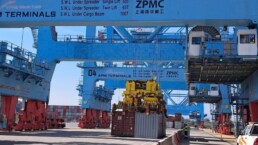

If a crane is ultimately a giant mechanical arm, the team at Lazaro Cardenas in Mexico have pumped their mechanical muscles to the extreme by perfecting a manoeuvre rarely achieved anywhere in the world – and scoring a first for Mexico: quad lifts with a ship-to-shore crane.
Pulling off quad lifts – the lifting of four containers at a time – is an uncommon and highly skilled accomplishment. It’s also not a task to be taken lightly. In port operations, where safety and speed are paramount, pushing the limits of efficiency necessitates careful calculation, intense planning and extraordinary teamwork.
Within the industry, in the late 1990s, health and safety legislative authorities approved the lifting of two freight containers under stringent conditions, but even today the lifting of two containers at a time is not commonplace. Gearing up to quad lifts is therefore a major step. It requires an innovative spirit, dedication to excellence and nerves – as well as mechanical arms – of steel.
High levels of expertise
To begin contemplating the manoeuvre, the primary constraints are the weight limitations of containers and the necessity to employ specialised equipment, such as double spreaders. Additionally, these moves demand a high level of expertise from ship-to-shore (STS) crane operators.
“These constraints make quad lifts particularly challenging,” explains Carlos Camino Darcourt, Waterside Execution Manager at APM Terminals Lazaro Cardenas. As the instigator of the quad lift idea at the terminal, Carlos was instrumental in broaching the topic, and it fell to him to convince others of the benefits, safety and feasibility. Beyond that, he had to inspire and lead the multi-disciplinary team required to pull it off.
[Text continues below film…]
A natural question might then be – faced with all the difficulties – why even try? Carlos smiles at the question, and answers as though his reasoning should be entirely obvious: “Because, constantly exploring, and pushing for innovative methods is how we reduce vessel port stay to increase efficiency. At APM Terminals, we are committed to improving our operations and making sure our customers are happy with our delivery.” He further explains: “Our main target is to reduce vessel port stay. By using quad mode, we improve Crane Moves Per Hour (CMPH) significantly.”
Timely goal
CMPH, Berth Moves Per Hour (BMPH), and overall Port Hours Saved (PHS) are the key metrics every terminal measures its performance by, and slashing those times is one of APM Terminals’ key objectives throughout its 60 terminals around the world. It’s a goal that Lazaro Cardenas has acted on decisively.
Remarkably, the transition from conceptualising quad lifts to implementation took just three months. This rapid progress underscores the proactivity and teamwork which was put in motion. To execute quad lifts, a second spreader is required – which is similar to tandem equipment, but with modifications.
Flávio Sousa, Head of Technical at Lazaro Cardenas, outlines the extent of these modifications, and the human factor initially encountered. “On the maintenance side, we had great challenges to break the paradigms of some colleagues who did not believe in this project, because our STS spreaders are not designed for this kind of operation. Our tandem spreader has one twin spreader (a maestro) and the other does not have a twin, so maintenance had to adapt another master spreader (with Twin) from another STS. As a result, the STS started to operate with two twin master spreaders, to enable the simultaneous operation of four 20-foot containers. But once they were on board, things really got moving.”
Safe steps
Safety in tricky operations – and in everyday work – is never in question, and therefore, quad lifts are currently utilised exclusively for loading processes, with empty containers, ensuring that risks are minimised. The team decided against using quad mode for discharge moves due to safety concerns related to twist lock removal, a decision backed by Carlos. “I am all for pushing the boundaries, but never past the limits of safety,” he says. “From the minute I broached the topic of quad lifts with my teammates and line managers, it was explicitly in the knowledge that any operation that we weren’t 100% secure in using would be discounted.”
To maintain safety standards, as well as requiring quay cranes to be equipped with alarm systems to detect overweight containers, and the presence of an additional signalman during operations, special training was put in place with experienced STS operators undergoing extensive practice to master tandem lifting before progressing to quad lifts. The knowledge gained was disseminated across the team using Training Within Industry (TWI) methods – a practice of skill-sharing which takes place in all APM Terminals locations to ensure learning is passed on efficiently.
Substantial benefits
And, after all that hard work and planning, the gains have proved substantial. Results in the region of 30-40% improvement in CMPH have been achieved when conditions allow their use. Such improvements not only enhance productivity, but reduce the consumption of electricity by the STS cranes, contributing to environmental sustainability – another of APM Terminals’ explicit goals.
“By reducing operating time, the electricity usage is consequentially also lower when quad lifting, since for every operation we are taking four times the usual load,” says Carlos. And, when it’s time to revert to standard practice, it takes less than five minutes, as part of a semi-automatic process, to switch back to a 2 x 40ft container spreader.
“We don’t use quad lifting for every vessel operation, but it’s used where we see an opportunity to improve our productivity. The operation is used only for empty containers loading under deck, and increase in usage is subject to the vessel operation loading plan.”
While the sole purpose in achieving quad lifts was always to benefit the customer, Carlos and the team are undeniably proud of what they have implemented. As the only terminal in Mexico capable of executing these manoeuvres, Carlos and the entire APM Terminals Lazaro Cardenas team have not only lifted standards of efficiency at the port, they have set a high standard for others to follow.



Related News.

Crewing After 2026: How AI Will Take Over the Routine in 2027
The crewing market of late 2026 is not the market of 2025. Artificial intelligence has moved from presentations into daily crewing work, while the…

Dualog launches secure maritime AI service amid surge in seafarer AI use
The new service, Sparks lets crew and shore teams search company emails, documents and conversations without exposing sensitive fleet information to…

Time Ticking: Two weeks for Governments to Green-Light Framework for Cutting Shipping Emissions
As a crucial fortnight of meetings opens at the International Maritime Organization opens in London, the Clean Shipping Coalition calls on member…

“K” LINE signs contract for construction of two LPG dual-fuel VLGCs
Kawasaki Kisen Kaisha, announces today that it has signed agreements with South Korea-based HD Hyundai Samho regarding the construction of two LPG…

Equinor and VNG sign 18-year gas sales agreement for supplies to Germany
Equinor will supply natural gas to the German energy company VNG until the end of 2044. The 18-year agreement is the longest gas sales agreement…

Open letter to MEPs to reject the motion for a resolution and support the inclusion of Indian ship recycling yards on the European List
Dear Members of the European Parliament, Ahead of this week’s plenary vote, European Shipowners | ECSA, BIMCO, the Cruise Lines International…

ShipVet appoints James Stairmand as Chief Executive Officer
Founder Captain Fintan Cullen moves to a non-executive role as the company builds on investment in its vetting team and technology. ShipVet, the…

USD ≈7bn lost per year the hidden cost of how shipping trades
New Torvald Klaveness study quantifies around USD 7bn a year in potentially avoidable costs in dry bulk and product tanker shipping, with a possible…

APM Terminals Maasvlakte II and Port of Rotterdam Authority take next step in terminal development
APM Terminals Maasvlakte II and the Port of Rotterdam Authority are moving forward in terminal’s development with preparations for a new phase of…

ABP inspiring the next generation
ABP host 500 young people to explore maritime and transport careers More than 500 young people from across Hampshire and the Solent explored career…
Subscribe to our newsletter!
if you dont want to swim alone in the ocean of news, sign up for the newsletter, and you will receive daily all the important news of world shipping!
