COSCO SHIPPING specialized carriers launches Maiden Voyage of 7,500 CEU LNG dual-fuel RoRo ships
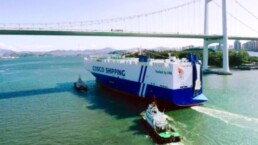

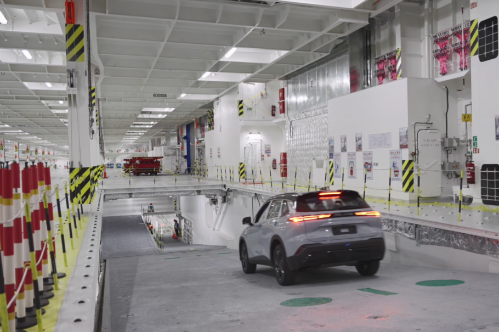
The initial pair of “LIAO HE KOU” and “MIN JIANG KOU” vessels delivered this time are both 7,500-space dual-fuel vehicle RoRo ship. Each ship measures 199.9 meters in total length and 38 meters in width, boasting an endurance of 12,000 nautical miles. The propulsion system of these ships is innovatively designed with a single engine and propeller configuration, employing an LNG dual-fuel main engine, a single-bow thruster, and an electric RoRo system—all of which are leading performance indicators in China. With 13 vehicle decks and 7,500 standard parking spots, including four rise-and-fall decks, these vessels can accommodate a variety of vehicles such as passenger cars, trucks, and engineering machinery vehicles.
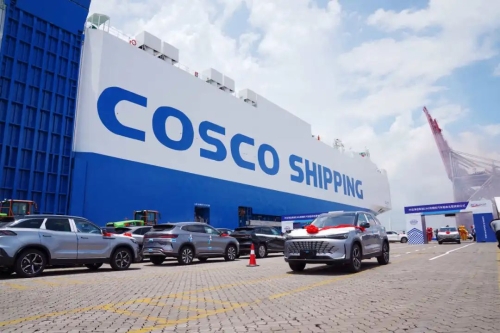
According to the delivery plan, the second half of this year will see the phased delivery and operation of 5 new ships; next year, 11 more ships are expected to be delivered, followed by an additional 6 ships by 2026. By then, a professional automobile fleet comprising approximately 30 ships will have been established, capable of handling an annual transportation volume of 700,000 vehicles, 80% of which will be powered by clean energy.
Charting a course toward the auto industry’s dual carbon goals
The automotive and shipping industries are increasingly focused on ESG (Environmental, Social, and Governance) initiatives. COSCO SHIPPING Specialized Carriers is at the forefront of this green transformation, with all newly constructed car carriers being LNG dual-fuel vessels. Additionally, photovoltaic systems and biofuels are being utilized across various ship types, and digitalization is employed to achieve energy efficiency throughout the entire operation process. The carbon emission intensity of the company’s fleet decreased by 5.79% year-on-year in 2023. By 2025, the launch of new LNG dual-fuel vessels is expected to further reduce carbon emission intensity by 35.25% compared to 2022.
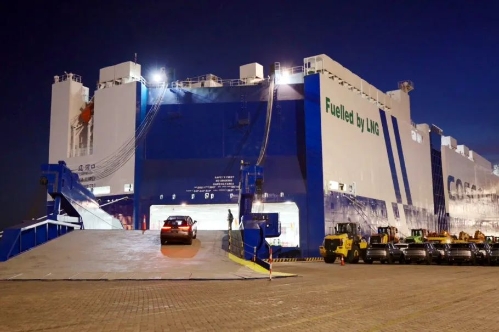
The innovative 7,500-space LNG dual-fuel RoRo vessels have been designed to meet the stringent International Maritime Organization’s TIER III emission standards. They incorporate numerous advanced green environmental protection technologies and will significantly conserve energy and reduce emissions during operation. Compared to traditional fuel oil vehicles and ships, they can save approximately 20% on energy consumption, cut about 27% of carbon emissions, 30% of nitrogen oxide emissions, 99% of sulfide emissions, and over 90% of PM particulate matter emissions. Upon entering service, the vessels are expected to achieve a decarburization rate of over 24%. Taking a typical round-trip voyage from China to Europe as an example, using LNG as an alternative fuel can reduce CO2 emissions by more than 2,100 tons per voyage. This development will undoubtedly contribute to the achievement of China’s automobile industry chain’s dual carbon goals.
Full-chain digitalization and visualization
COSCO SHIPPING Specialized Carriers is fully committed to digitally empowering the industrial chain, by building a comprehensive digital platform, and achieving full-chain “digitalization”. The company has developed an advanced system that includes visual cargo hold CCTV monitoring, power battery data surveillance, and a safety early warning mechanism. This state-of-the-art system can simultaneously monitor up to 5,000 new energy vehicles, effectively addressing the shipping industry’s need for large-scale power battery temperature monitoring. Leveraging the ship’s CCTV monitoring infrastructure, the company has seamlessly integrated the entire logistics supply chain process for commercial vehicles. This integration enables precise vehicle positioning during transportation (one vehicle, one code, one spot), offering customers an all-encompassing “visualized” experience of the automotive logistics supply chain. The company has also pioneered the use of the NFP algorithm in an intelligent ship stowage system, enabling rapid simultaneous stowage across multiple ships and tasks, as well as “one-click stowage” for the entire vessel. The functionality of this system is currently unmatched globally. As of April 2023, Yuanhai Automobile Shipping has successfully issued over 70 blockchain-based electronic bills of lading for automobile vessels, covering more than 15,000 commercial vehicles. This milestone significantly enhances document circulation efficiency throughout the entire chain, mitigates the risk of document loss, and elevates the customer service experience.
The new vessels also feature CCTV monitoring systems that offer complete coverage of the cargo hold areas, allowing for real-time end-to-end vehicle status monitoring. By employing infrared thermal imaging technology, image recognition algorithms, object monitoring algorithms, and edge computing, these systems provide continuous, real-time cabin temperature and vehicle condition monitoring, along with high-temperature warnings and ultra-high-temperature alarms to ensure the safe transport of automobiles.



Related News.

Crewing After 2026: How AI Will Take Over the Routine in 2027
The crewing market of late 2026 is not the market of 2025. Artificial intelligence has moved from presentations into daily crewing work, while the…

Dualog launches secure maritime AI service amid surge in seafarer AI use
The new service, Sparks lets crew and shore teams search company emails, documents and conversations without exposing sensitive fleet information to…

Time Ticking: Two weeks for Governments to Green-Light Framework for Cutting Shipping Emissions
As a crucial fortnight of meetings opens at the International Maritime Organization opens in London, the Clean Shipping Coalition calls on member…

“K” LINE signs contract for construction of two LPG dual-fuel VLGCs
Kawasaki Kisen Kaisha, announces today that it has signed agreements with South Korea-based HD Hyundai Samho regarding the construction of two LPG…

Equinor and VNG sign 18-year gas sales agreement for supplies to Germany
Equinor will supply natural gas to the German energy company VNG until the end of 2044. The 18-year agreement is the longest gas sales agreement…

Open letter to MEPs to reject the motion for a resolution and support the inclusion of Indian ship recycling yards on the European List
Dear Members of the European Parliament, Ahead of this week’s plenary vote, European Shipowners | ECSA, BIMCO, the Cruise Lines International…

ShipVet appoints James Stairmand as Chief Executive Officer
Founder Captain Fintan Cullen moves to a non-executive role as the company builds on investment in its vetting team and technology. ShipVet, the…

USD ≈7bn lost per year the hidden cost of how shipping trades
New Torvald Klaveness study quantifies around USD 7bn a year in potentially avoidable costs in dry bulk and product tanker shipping, with a possible…

APM Terminals Maasvlakte II and Port of Rotterdam Authority take next step in terminal development
APM Terminals Maasvlakte II and the Port of Rotterdam Authority are moving forward in terminal’s development with preparations for a new phase of…

ABP inspiring the next generation
ABP host 500 young people to explore maritime and transport careers More than 500 young people from across Hampshire and the Solent explored career…
Subscribe to our newsletter!
if you dont want to swim alone in the ocean of news, sign up for the newsletter, and you will receive daily all the important news of world shipping!
