Ariane 6 upper stage hot fire testing of a host of innovations
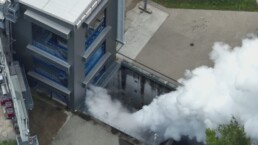

Hot-fire tests of the Ariane 6 stages: part 3
While the combined tests were being carried out Europe’s Spaceport in Kourou, French Guiana, the Ariane 6 upper stage was being tested in Germany. Although the Kourou launcher comprised an entirely functional upper stage, its Vinci engine could not be ignited because it was situated above the main stage. This is why the teams from ArianeGroup, the European Space Agency (ESA and the German space agency DLR hot-fire tested the stage in Lampoldshausen, in Baden-Württemberg.
The cryogenic upper stage is assembled on ArianeGroup’s Bremen site in Germany and is packed with innovations. It consists of two liquid hydrogen and liquid oxygen tanks which supply the new Vinci engine, which can be re-ignited up to four times, along with the innovative Auxiliary Propulsion Unit (APU). The APU is used to pressurise the stage’s tanks, and prepare for re-ignition of the Vinci engine in zero-gravity, by “compacting” the propellants towards the bottom of the tanks. It can also generate additional thrust on demand, a function which is particularly useful for separating “clusters” of satellites, or for improving the precision of final orbital injection. Finally, the APU can also be used to de-orbit the stage at the end of the mission, in compliance with space law. This architecture enables the launcher to perform the broadest possible spectrum of complex and combined launch missions, such as the deployment of constellations to low Earth orbit (LEO) or payloads of 4.5 to 12 tons to geostationary transfer orbit (GTO).

Designed to operate in the vacuum of space
The upper stage underwent hot-firing for the first time on October 5, 2022 on a dedicated test stand – called P5.2 – on the Lampoldshausen site of the German space agency (DLR). A second test was carried out on January 23, 2023. The aim was to run the main functions of the stage and the test stand, with filling of the tanks and activation of all the on-board systems with the Vinci engine and the APU.
The complexity lies in the preparation for and performance of the test on the ground, given that the stage is designed to operate in the vacuum of space and in weightless conditions. The tests must be carried out safely, preserving the stage and the test stand from the consequences of any unexpected event, by means of launch abort scenarios which can occur at any moment during the test. Preliminary analyses ensure optimal management of the possible risks: a first type of analysis of each subsystem to anticipate all its possible failures, and then stage system analysis and an analysis per phase in the life of the stage carried out on the test stand.

Test representative of the first flight
September 1, 2023 was a key moment in the Lampoldshausen campaign, with the teams carrying out a hot-fire test representative of the upper stage’s flight phase up to satellite separation during the first Ariane 6 flight. The Vinci engine operated for more than 11 minutes, with two boosts, including two parallel boosts by the APU, with management of the temperature and pressure of the propellants in the tanks during the ballistic phase. Altogether, the APU operated for a total of 30 minutes. This critical test was a means of ensuring that the Ariane 6 upper stage was ready for the first flight.
Finally, on December 7, a stage test was conducted in degraded conditions, demonstrating the reproducibility and reliability of the operations rehearsed and optimised during the previous tests. The fact that this test could not be completed owing to engine shutdown because of monitoring alert after two minutes of operation demonstrates the difficulties faced by the teams during these tests, as well as their ability to manage them. However, most of the results hoped for were in fact obtained. As a result of the technical investigations and the analysis carried out, ESA confirmed that the launch time-frame for the Ariane 6 first flight remains unchanged.
The last hot-firing test of the Ariane 6 upper stage was successfully completed on the DLR P5.2 test stand in Lampoldshausen on April 12, 2024.

A unique adventure
These campaigns in French Guiana and Germany means that the equipment, engines and the two complete stages of the launcher have been comprehensively tested, including in the full launch system environment in Kourou.
The teams from ESA, French space agency CNES, DLR and ArianeGroup have together faced and overcome all the difficulties in an adventure that few people get to experience: conducting the very first countdown operations of a brand-new rocket. The satisfactory results of these test campaigns are down to close cooperation between the parties involved and between the teams in the field. A new adventure is now underway, the launch campaign leading up to the inaugural flight.



Related News.
Predicting the Future or Preparing for It? Cyprus Marine Club Explores the Power of Adaptability with Natasa Pilides
In a world where uncertainty has become the new normal, is predicting the future really the best strategy, or is the ability to adapt the greater…

Greece and Egypt in talks to extend EEZ Eastwards towards Cyprus following Libya’s move on Turkish Maritime Pact
Athens and Cairo have agreed to advance bilateral consultations aimed at extending the geographical scope of their 2020 Exclusive Economic Zone (EEZ)…
Seafarers face widening competency gap as digital shipping accelerates, recent research finds
Eighty two per cent of maritime professionals surveyed say current training does not adequately prepare crews for the realities of modern,…
Wärtsilä and WinGD sign new Service Framework Agreement to ensure long-term continuity and support for the global fleet
Technology groups Wärtsilä and WinGD have entered into a new long-term Service Framework Agreement, reaffirming their shared commitment to supporting…
Seatrium and Karpowership sign contract for a series of whale class Powership Conversion and Integration Projects
Seatrium and its strategic partner, floating power leader Karpowership, have strengthened their longstanding collaboration with the award of a…
ClassNK releases Handbook Supporting Consideration of Onboard Carbon Capture “Onboard Carbon Capture Systems Implementation Framework”
Bringing together technical, infrastructure, regulatory and emissions assessment considerations across the OCCS value chain - ClassNK has released a…
HHLA lowers earnings forecast for the 2026 financial year
Based on the business development to date and updated estimates for the fourth quarter of 2026, the Executive Board of Hamburger Hafen und…
Port of Los Angeles reports lowest emissions per Container on Record
The Port of Los Angeles continued to make clean air gains in 2025, recording its lowest emissions per container on record, according to the Port's…
Drewry World Container Index – 22 Oct
WCI increased for the second consecutive week, the highest in 15 weeks. See detailed commentary below. Drewry World Container Index…
Mammoet, Port of Argentia and Argentia Capital Partner to Advance Floating Dry Dock and Marine Repair Facility
Partnership builds on Mammoet’s established presence at Port of Argentia and shared confidence in the growing market for ship repair and marine…
Subscribe to our newsletter!
if you dont want to swim alone in the ocean of news, sign up for the newsletter, and you will receive daily all the important news of world shipping!
