E-fuels offer long-term solution to key energy transition transport sectors, but journey needs to start now
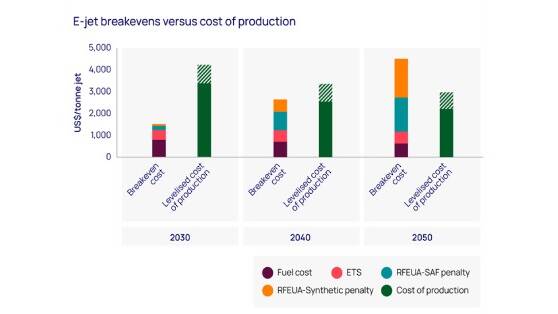

Wood Mackenzie report says competitive positions can be established in synthetic fuel production in the coming decades by early movers
The widespread development and use of synthetic fuels is still at least a decade away and depends on the successful deployment of other technologies, but companies that position themselves now are best positioned for success according to the latest Horizons report by data and analytics company Wood Mackenzie.
The report: ‘Adding fire to e-fuels’ states that e-fuels are a synthetic alternative to fossil fuels and can decarbonise difficult to electrify sectors without the need for the early scrapping of long-life equipment. This means e-fuels can offer a solution to power critical segments of transportation such as ships, long-haul aircraft and heavy-duty commercial vehicles.
The report states that e-fuels, which are also known as electrofuels, eFuels, synthetic fuels, Power-to-X (PtX), Power-to-Liquids (PtL) and renewable fuels of non-biological origin (RFNBOs), are produced by combining electrolytic (green) hydrogen, made by electrolysing water using renewable electricity, with captured carbon or nitrogen. An e-fuel can be considered carbon neutral if the emissions released into the atmosphere during its combustion are equal to (or less than) the captured CO₂ used to produce it.
“Identifying pathways from legacy fuels into low-carbon alternatives is a perennial challenge for incumbent energy players,” says Murray Douglas, Vice President of Hydrogen Research at Wood Mackenzie. “E-fuels offer companies an intriguing prospect at the intersection of electrons and molecules and the potential to capitalise on existing technical, commercial and marketing capabilities makes it an appealing, if challenging, opportunity for many.”
Challenges abound for large-scale deployment
The report also states that commercial viability is the key challenge in scaling up e-fuel production with green hydrogen production and CO₂ capture costs both high. The subsequent conversion process to the final e-fuel product is both energy and capital intensive – and delivery costs must also be considered.
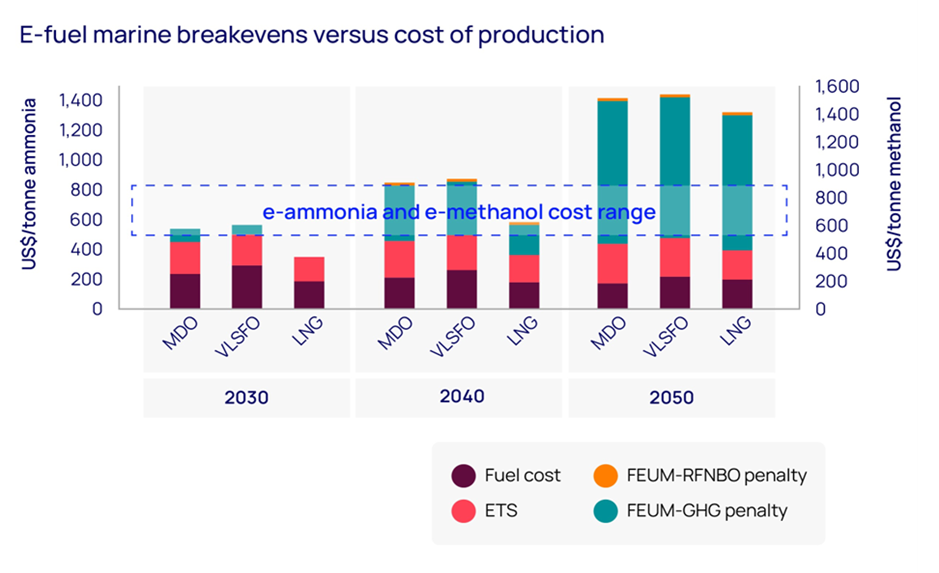
“There is no shortage of offtakers seeking low-carbon fuels, but the gap between cost of production and willingness to pay is sizeable,” Douglas says. “Each e-fuel has an incumbent fuel it aims to displace, all of which are much cheaper and this means their success will be dictated by policy to mandate volumes, place a cost on emissions and lower production costs.”
Douglas adds that current conversion technologies differ depending on the final e-fuel desired, but the key challenge for all of them is in integrating green hydrogen, carbon or nitrogen, and their subsequent conversion in a large-scale commercial e-fuel production facility.
Policy makers will need to wield both carrot and stickThe report states that currently most e-fuel proposals aim to source CO₂ from a variety of feedstocks with biogenic sources with a low cost of capture, such as biogas and ethanol plants, dominating. But as the production of e-fuels grows the available molecules from such facilities will become scarcer and more dispersed. Costs will rise as e-fuel producers scour for feedstock while looking to scale.
This means that in the long-term global policy makers will have to set the standards for where e-fuel producers source CO₂. In Europe, point-source CO₂ capture from fossil-fuel power generation will only be permitted until 2036 and from other fossil-fuel industries until 2041. Consequently, large volumes from net carbon dioxide removal (CDR) technologies – direct air capture (DAC) and bioenergy with carbon capture (BECC) – will be required.
“Globally, governments are going to have to take a holistic approach where incentives and penalties are introduced to ensure e-fuel production will be able to ramp up to a scale that will be required,” Douglas says.
The report concludes that producers who can pair low-cost renewables and biogenic CO₂ sources will have first mover advantage. However, putting this type of complex and technology-heavy production model in place is a lengthy process that must start now for large-scale production to be in place by the mid-2030’s.
“E-fuels are undoubtedly one of the longer-term plays in the energy transition,” says Douglas. “However, companies that set a strategic direction quickest can position themselves to capture the most attractive elements of the value chain and take those learnings forward.”
Source: Wood Mackenzie



Related News.

Global Flag State Ranking 2026 who is up, who is down
Lorrendraaier publishes Global Flag State Ranking 2026: 148 flags measured on objective data, Singapore leads, Pakistan falls 35 places, the Dutch…
Will Germany have enough gas this winter?
As of mid-September 2026, Germany had stored just about 141 terawatt-hours of gas, accounting for around 57% of the country’s total storage…

Record diesel prices put US policy options in focus
Record-high diesel prices and tight inventories have put US exports under scrutiny, but keeping more barrels at home may offer only temporary…
IUMI elects Sean M. Dalton as President and says farewell to Frédéric Denèfle
The International Union of Marine Insurance (IUMI) has elected Sean M. Dalton as its new President. The election took place today at a meeting of the…

F/V MISTRESS Shipwreck ‘Lost’ Near Block Island Located After Seven Years
Green Oceans’ Underwater Investigation Reveals a Shipwreck Presumed to be the F/V Mistress found at the Base of Block Island Turbine #1 - Asks…

OCEAN at 50 celebrating a proud past and Maritime Future
OCEAN, the European sub-committee of ISSA, celebrated half a century of service to Europe’s ship supply sector with a landmark anniversary conference…

DORIC MONTHLY BRAZIL BAROMETER SEPTEMBER 2026
Pls find below the DORIC MONTHLY - BRAZIL BAROMETER SEPTEMBER 2026 BRAZIL_BAROMETER_SEPTEMBER_2026

Steel flows face fresh challenges in the final quarter of 2026
Steel flows slip into negative growth in July 2026 Global steel flows fall 1% y/y in July 2026 to reach 22.2 Mt. China’s share of global steel…

Insurance must shift “from repair to prevention”, says IUMI
Marine insurers will need to place greater emphasis on loss prevention as risks become more complex and costly to insure, according to Pascal Dubois,…

BIMCO’s Container Shipping Market Overview & Outlook September 2026 is out
Container Shipping Market Overview & Outlook Supply pressure is mounting "Disruptions and strong growth in head-haul trades continue to support…
Subscribe to our newsletter!
if you dont want to swim alone in the ocean of news, sign up for the newsletter, and you will receive daily all the important news of world shipping!
