DNV New Power Systems report Global grid infrastructure to double by 2050 to meet surging electricity demand


Global electricity demand is set to double by 2050 as the world’s reliance on fossil fuels diminishes, according to DNV, the independent energy expert and assurance provider. Released today, DNV’s New Power Systems report finds that the pathway to a decarbonized energy system requires significant grid expansion, solutions for grid congestion, and new business models to accommodate rising electricity demand and generation from wind and solar. The report also concludes that grid expansion is affordable, thanks to growing efficiencies in grid technology and the increased electricity load, with DNV expecting global grid charges passed to consumers to remain stable or decline in the long term.
The growing demand for electricity and renewables
Global economic growth and the electrification of transportation, heating, and industry are primary drivers of the anticipated surge in global electricity demand. Additionally, the development of data centers, notably for AI applications, is also expected to contribute to this increase. At the same time, AI holds considerable potential to introduce efficiencies in both the provision and use of power.
By mid-century, electricity will constitute 37% of global final energy use, a substantial rise from 20% in 2023. This upswing is accompanied by a dramatic shift towards renewable energy, with wind and solar anticipated to generate half of the world’s electricity by 2040 and 70% by 2050. The decarbonization trajectory predicts that nearly 90% of electricity will be sourced from non-fossil sources by 2050.
Flexibility and demand-response
The growing share of renewable power requires flexibility and a robust system of demand-response: as variable renewable energy sources (VRES) expand ninefold, the need for short-term flexibility will double. Fluctuating demand from sectors like heat and transport calls for new ancillary services such as synthetic inertia products and fast frequency response and adapting market and regulatory frameworks to support these technologies is critical for a sustainable energy future.

Group President and CEO at DNV
In this new model, advanced technologies such as AI and automated activation of demand response will assist grid operations and market predictions: “Deep digitalization, including the application of AI, is crucial for managing the increased complexity of a renewable-dominated power system,” explains Remi Eriksen, Group President and CEO at DNV. “So there will be a rapid growth in both information technology and operational technology in the coming years which must be supported by a robust approach to risk management, particularly on cyber security, to reap the benefits of the new power systems.”
Energy storage is another core system component needed to address the intermittent nature of renewable energy sources, provide grid balancing, and manage load. Lithium-ion battery technology is set to play a dominant role in this segment, offering three times more storage capacity than hydropower and pumped storage by 2050. However, achieving the necessary level of flexibility will require innovative market designs and advanced tariff schemes to incentivize automated demand-response, vehicle-to-grid (V2G) and behind-the-meter storage systems. Power-to-hydrogen value chains are a critical market element for renewable generation, and need to be scaled through concerted investment efforts by all stakeholders.
Grid expansion is both necessary and affordable
A key bottleneck in the energy transition is the expansion of the electrical grid. Global grid capacity needs to grow 2.5 times its current size, with annual expenditure on grids more than doubling to USD 970 billion by 2050. While Grid Enhancing Technologies (GETs) offer potentially significant temporary relief, the long-term solution lies in accelerating the construction of new grid infrastructure and advanced controlling systems, which are currently hampered by permitting timelines, the scarcity of human and material resources, and financial constraints.
Despite a rise in global grid expenditures from 15% to over 25% of annual energy expenditure by 2050, efficiencies in grid technology and increased electricity distribution will likely keep consumer grid charges stable or declining in most regions. Only four out of ten regions might see an increase.
Predicting future unit electricity costs is challenging due to varying tax treatments and government incentives. However, the continuous decline in renewable power costs suggests that consumer prices are unlikely to rise. Electrifying end-use sectors like transport and heating will further enhance efficiencies and cost savings, leading to lower overall household energy bills in high- and middle-income regions. In low-income regions, while absolute household energy expenses may slightly increase, rapid GDP growth will offset this rise. This “green dividend” offers an opportunity for governments to accelerate the energy transition and maximize the benefits of green electricity.
A systemic approach to the energy transition

CEO for Energy Systems at DNV
“We believe in systems thinking, looking at the big picture, to consider how energy is generated, transmitted, consumed, and stored across all energy carriers,” comments Ditlev Engel, CEO for Energy Systems at DNV. “There will be no transition without transmission. The new energy system will require data-driven solutions and policies that address all interconnections, from permitting to the integration of AI and cyber-resilience. Planning for a new wind farm must include a strategy for grid connection; similarly, GETs and new wire integrations require IT upgrades at most control centers.”
He adds: “The pathway to a decarbonized power system is clear: renewables integration and grid expansion require significant investment, innovation, coordination, and commitment from all players, especially governments. As the world moves towards a greener future, addressing these challenges with a systemic and forward-thinking approach will be essential for a successful energy transition.”
DNV’s Energy Transition Outlook 2023 serves as the foundation for this report, with additional insights provided by experts in demand modeling, power grids, new market models, digitalization, and AI. The research delves into evolving market mechanisms, highlighting the importance of flexible and resilient grids. Insights include strategies for market design, addressing congestion, costs trajectories and expanding transmission and distribution networks.



Related News.

Predicting the Future or Preparing for It? Cyprus Marine Club Explores the Power of Adaptability with Natasa Pilides
In a world where uncertainty has become the new normal, is predicting the future really the best strategy, or is the ability to adapt the greater…

Greece and Egypt in talks to extend EEZ Eastwards towards Cyprus following Libya’s move on Turkish Maritime Pact
Athens and Cairo have agreed to advance bilateral consultations aimed at extending the geographical scope of their 2020 Exclusive Economic Zone (EEZ)…

Seafarers face widening competency gap as digital shipping accelerates, recent research finds
Eighty two per cent of maritime professionals surveyed say current training does not adequately prepare crews for the realities of modern,…

Wärtsilä and WinGD sign new Service Framework Agreement to ensure long-term continuity and support for the global fleet
Technology groups Wärtsilä and WinGD have entered into a new long-term Service Framework Agreement, reaffirming their shared commitment to supporting…

Seatrium and Karpowership sign contract for a series of whale class Powership Conversion and Integration Projects
Seatrium and its strategic partner, floating power leader Karpowership, have strengthened their longstanding collaboration with the award of a…

ClassNK releases Handbook Supporting Consideration of Onboard Carbon Capture “Onboard Carbon Capture Systems Implementation Framework”
Bringing together technical, infrastructure, regulatory and emissions assessment considerations across the OCCS value chain - ClassNK has released a…

HHLA lowers earnings forecast for the 2026 financial year
Based on the business development to date and updated estimates for the fourth quarter of 2026, the Executive Board of Hamburger Hafen und…
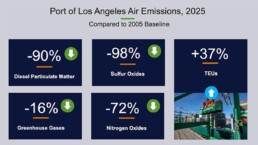
Port of Los Angeles reports lowest emissions per Container on Record
The Port of Los Angeles continued to make clean air gains in 2025, recording its lowest emissions per container on record, according to the Port's…

Drewry World Container Index – 22 Oct
WCI increased for the second consecutive week, the highest in 15 weeks. See detailed commentary below. Drewry World Container Index…

Mammoet, Port of Argentia and Argentia Capital Partner to Advance Floating Dry Dock and Marine Repair Facility
Partnership builds on Mammoet’s established presence at Port of Argentia and shared confidence in the growing market for ship repair and marine…
Subscribe to our newsletter!
if you dont want to swim alone in the ocean of news, sign up for the newsletter, and you will receive daily all the important news of world shipping!
