Baltimore’s busy port fully reopens after bridge collapse, and a return to normal is expected
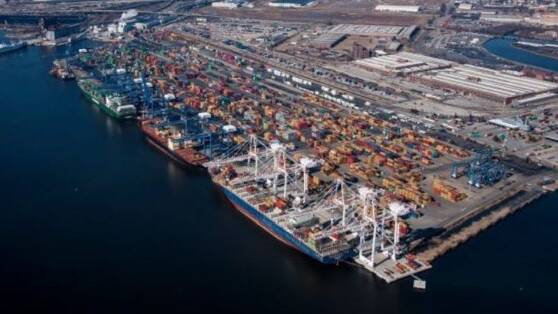

Commercial shipping traffic through the Port of Baltimore is expected to return to normal levels next month, officials said, after the channel fully reopened this week for the first time since the collapse of the Francis Scott Key Bridge in March.
“I’ve been waiting to say this for every day for the last 11 weeks: Maryland, the Fort McHenry Channel is fully cleared, and the Port of Baltimore is reopened for business,” Gov. Wes Moore said at a waterside news conference to highlight the milestone.
As the governor spoke, a passing ship blasted its horn.
“You hear that?” Moore said. “That’s a beautiful sound.”
Behind him, giant cranes lifted shipping containers from the deck of a docked cargo ship and deposited them on land.
Many shipping companies rerouted their cargo to other ports following the deadly collapse in March. The deadly disaster halted most maritime traffic through Baltimore’s busy port as crews worked around the clock to clear an estimated 50,000 tons of fallen steel and concrete from the Patapsco River.
The estimated cost for the entire salvage operation is $160 million, with federal, state and local agencies involved.
Companies that steered clear of Baltimore during the cleanup will likely come back now that the channel has been returned to its original depth and width, officials said. The port, which processes more cars and farm equipment than any other in the country, is expected to be operating at normal capacity by mid-July.
All that rerouted commercial traffic “belongs in Baltimore today,” U.S. Transportation Secretary Pete Buttigieg said during a news briefing earlier this week. “We have every indication that that is what is taking place, but we will be reinforcing that expectation as we speak with players up and down the supply chains.”
Crews were able to reopen portions of the deep-draft channel in phases, restoring some commercial traffic in recent weeks. Some cruise ships and large container ships have already passed through, officials said.
But thousands of longshoremen, truckers and small business owners have seen their jobs impacted by the collapse and its economic ripple effects, which extend well beyond the Baltimore region. State officials helped establish several relief programs to keep people employed and businesses afloat in the immediate aftermath.
“We were a wounded port,” said Scott Cowan, president of the International Longshoreman’s Association Local 333, which represents Baltimore port workers. In a competitive industry, he said, other ports were looking to take Baltimore’s cargo.
Reopening the channel means keeping thousands of longshoremen in their jobs, Cowan said.
Officials estimated that the salvage operations for the U.S. Army Corps of Engineers will cost up to $75 million, while the Coast Guard response has cost $24 million to date to open the main channel. Maryland used about $60 million in federal emergency funds to open three other smaller channels outside the main one.
Rebuilding the bridge could cost nearly $2 billion, officials have said. They hope it’s completed by 2028.
President Joe Biden has pledged that the federal government will cover the full cost of rebuilding, though officials said the funding is still awaiting approval from Congress.
In a statement Tuesday, Biden praised the work of everyone involved in the recovery effort.
“Baltimore can count on us to stick with them every step of the way, and we will continue to have your back until the bridge is rebuilt,” he said.
The cargo ship Dali lost power and crashed into a critical support column of the Francis Scott Key Bridge in the early hours of March 26, collapsing the span and sending six members of a roadwork crew plunging to their deaths.
A National Transportation Safety Board investigation found that the vessel experienced power outages before starting its voyage, but the exact causes of the electrical issues have yet to be determined. The FBI is also conducting a criminal investigation.
The Dali remained stuck amid the wreckage for almost two months, with a massive steel truss draped across its damaged bow, before being refloated and guided back to port May 20. That allowed officials to open a channel that was 50 feet (15 meters) deep and 400 feet (122 meters) wide, big enough for most of the largest commercial vessels.
The full federal shipping channel is 700 feet (213 meters) wide. Officials said two-way traffic can now resume, and additional safety requirements have also been lifted because of the increased width.
Source: AP



Related News.

Global Flag State Ranking 2026 who is up, who is down
Lorrendraaier publishes Global Flag State Ranking 2026: 148 flags measured on objective data, Singapore leads, Pakistan falls 35 places, the Dutch…

Will Germany have enough gas this winter?
As of mid-September 2026, Germany had stored just about 141 terawatt-hours of gas, accounting for around 57% of the country’s total storage…

Record diesel prices put US policy options in focus
Record-high diesel prices and tight inventories have put US exports under scrutiny, but keeping more barrels at home may offer only temporary…
IUMI elects Sean M. Dalton as President and says farewell to Frédéric Denèfle
The International Union of Marine Insurance (IUMI) has elected Sean M. Dalton as its new President. The election took place today at a meeting of the…
F/V MISTRESS Shipwreck ‘Lost’ Near Block Island Located After Seven Years
Green Oceans’ Underwater Investigation Reveals a Shipwreck Presumed to be the F/V Mistress found at the Base of Block Island Turbine #1 - Asks…
OCEAN at 50 celebrating a proud past and Maritime Future
OCEAN, the European sub-committee of ISSA, celebrated half a century of service to Europe’s ship supply sector with a landmark anniversary conference…

DORIC MONTHLY BRAZIL BAROMETER SEPTEMBER 2026
Pls find below the DORIC MONTHLY - BRAZIL BAROMETER SEPTEMBER 2026 BRAZIL_BAROMETER_SEPTEMBER_2026

Steel flows face fresh challenges in the final quarter of 2026
Steel flows slip into negative growth in July 2026 Global steel flows fall 1% y/y in July 2026 to reach 22.2 Mt. China’s share of global steel…

Insurance must shift “from repair to prevention”, says IUMI
Marine insurers will need to place greater emphasis on loss prevention as risks become more complex and costly to insure, according to Pascal Dubois,…

BIMCO’s Container Shipping Market Overview & Outlook September 2026 is out
Container Shipping Market Overview & Outlook Supply pressure is mounting "Disruptions and strong growth in head-haul trades continue to support…
Subscribe to our newsletter!
if you dont want to swim alone in the ocean of news, sign up for the newsletter, and you will receive daily all the important news of world shipping!
