First demonstration in Korea of marine ammonia engine combustion technology
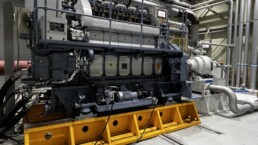

Reduce carbon dioxide emissions by 50%, a promising signal for a shipbuilding powerhous
MW-class marine engine combustion technology that uses ammonia, a future renewable energy source, as fuel will be applied on-site for the first time in Korea. The ship engine fueled by ammonia is expected to accelerate its competitiveness in the global market which aims to develop an environmentally friendly marine engine.
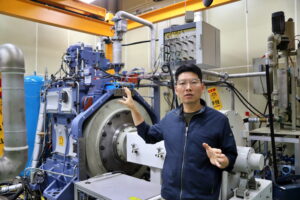
The joint research team led by the principal researcher Cheol-Woong Park of the Korea Institute of Machinery and Materials (President Seog-Hyeon Ryu, hereinafter referred to as KIMM), the Korean Register, HD Hyundai Heavy Industries, HD Korea Shipbuilding & Offshore Engineering, the Korea Research Institute of Ships and Ocean Engineering (KRISO), and Kunsan National University successfully demonstrated technology of using the LNG-ammonia dual-fuel engines at the KR Test & Certification Center (KR TCC). This research has been tested with the support of the Ministry of Oceans and Fishers’ currently ‘Development of 2,100 horsepower LNG-ammonia co-firing engine.’
The research team has demonstrated the test by injecting ammonia at high pressure into the combustion chamber of a marine engine and has maintained stable combustion of high power and thermal efficiency. Ammonia is a promising carbon-neutral fuel. However, it is a difficult material to manage as a fuel supply due to concerns such as corrosiveness and toxicity. Furthermore, problems result in a decrease in engine power and efficiency in an ammonia-fueled marine engine because it requires high ignition energy to ignite, and incomplete combustion increases due to a slow combustion speed.
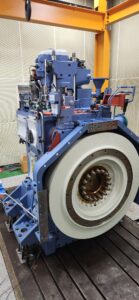
The technology demonstration testing ammonia as a fuel has been verified by changing the O-ring* material in the supply system in the ‘MW-class LNG-ammonia dual-fuel engine.’ The changing of the material has prevented corrosion and external leakage of ammonia and has reduced carbon dioxide emissions by more than 50%.
* O-ring: O-ring is a circular ring for sealing that is used in machinery.
The research team has satisfied the requirement of the ignition condition that requires high energy by optimizing the ammonia fuel injection timing and combustion speed. Additionally, the technology demonstration has solved both improving power output performance and reducing emissions at the same by injecting high-pressure ammonia fuel directly into the combustion chamber and maximizing thermal efficiency by mixing lean burn* with and air.
* Lean burn: Lean burn is the burning fuel with an excess air of the stoichiometric amount.
The senior researcher Cheol-Woong Park of the KIMM said, “MW-class ships, LNG-ammonia dual-fuel engine combustion technology is an exceptional technology that can satisfy greenhouse emission regulations and secure the forefront in the future of the shipbuilding industry.” He further noted, “The technology can be applied to a ship’s engines, it can also expand its application to various power sources that must reduce greenhouse emissions such as automobiles and generators.”



Related News.

Crewing After 2026: How AI Will Take Over the Routine in 2027
The crewing market of late 2026 is not the market of 2025. Artificial intelligence has moved from presentations into daily crewing work, while the…

Dualog launches secure maritime AI service amid surge in seafarer AI use
The new service, Sparks lets crew and shore teams search company emails, documents and conversations without exposing sensitive fleet information to…

Time Ticking: Two weeks for Governments to Green-Light Framework for Cutting Shipping Emissions
As a crucial fortnight of meetings opens at the International Maritime Organization opens in London, the Clean Shipping Coalition calls on member…

“K” LINE signs contract for construction of two LPG dual-fuel VLGCs
Kawasaki Kisen Kaisha, announces today that it has signed agreements with South Korea-based HD Hyundai Samho regarding the construction of two LPG…

Equinor and VNG sign 18-year gas sales agreement for supplies to Germany
Equinor will supply natural gas to the German energy company VNG until the end of 2044. The 18-year agreement is the longest gas sales agreement…

Open letter to MEPs to reject the motion for a resolution and support the inclusion of Indian ship recycling yards on the European List
Dear Members of the European Parliament, Ahead of this week’s plenary vote, European Shipowners | ECSA, BIMCO, the Cruise Lines International…

ShipVet appoints James Stairmand as Chief Executive Officer
Founder Captain Fintan Cullen moves to a non-executive role as the company builds on investment in its vetting team and technology. ShipVet, the…

USD ≈7bn lost per year the hidden cost of how shipping trades
New Torvald Klaveness study quantifies around USD 7bn a year in potentially avoidable costs in dry bulk and product tanker shipping, with a possible…

APM Terminals Maasvlakte II and Port of Rotterdam Authority take next step in terminal development
APM Terminals Maasvlakte II and the Port of Rotterdam Authority are moving forward in terminal’s development with preparations for a new phase of…

ABP inspiring the next generation
ABP host 500 young people to explore maritime and transport careers More than 500 young people from across Hampshire and the Solent explored career…
Subscribe to our newsletter!
if you dont want to swim alone in the ocean of news, sign up for the newsletter, and you will receive daily all the important news of world shipping!
