Onboard carbon capture technically feasible but commercial uptake relies on industry collaboration and regulatory acceptance, says DNV


Onboard carbon capture is attracting interest within the shipping industry, providing shipowners with the opportunity to continue operating on conventional fuels while reducing emissions. However, according to DNV’s latest whitepaper “The potential of onboard carbon capture in shipping”, its success depends on collaboration between regulators, policy makers, industry stakeholders, class, and suppliers.
With decarbonization targets rapidly approaching, demand for cost-efficient solutions for emission reduction is increasing. DNV’s latest whitepaper explores OCC as a decarbonization solution for shipping by looking at its technical, economic, operational, and regulatory challenges, as well as its integration into the carbon capture, utilization, and storage (CCUS) value chain.
CCUS is the process of capturing CO2 and recycling it for future use or permanently storing it in deep underground geological formations. The maritime industry is exploring its application onboard ships, which will require an onboard system to capture, process and store the CO2, and a network of offloading which is integrated into wider CCUS infrastructure.
Chara Georgopoulou, Head of Maritime R&D and Advisory Greece, said: “OCC is expected to be part of a range of future options which will help shipping achieve its decarbonization goals. However, further collaboration and testing is required to verify its performance. The commercial attractiveness of OCC will depend on the terms under which regulations can credit the removal of carbon emissions, and how smoothly it can be integrated into the growing CCUS value chain.”
For OCC to be relevant for wider application it must be economically viable and competitive with other decarbonization alternatives. If successfully deployed, OCC can become a key way for shipowners to comply with decarbonization regulations, while also helping to reduce the demand for alternative fuels.
The EU ETS is the only regulatory framework currently providing commercial incentives for OCC. To encourage shipowners to adopt the technology, future environmental and greenhouse gas (GHG) emissions regulations must also provide credit for captured CO2.
“If we are to achieve IMO decarbonization targets, we must leave no stone unturned in continuing to investigate OCC and other potential technologies that can accelerate shipping’s decarbonization journey,” Georgopoulou said.



Related News.

Predicting the Future or Preparing for It? Cyprus Marine Club Explores the Power of Adaptability with Natasa Pilides
In a world where uncertainty has become the new normal, is predicting the future really the best strategy, or is the ability to adapt the greater…

Greece and Egypt in talks to extend EEZ Eastwards towards Cyprus following Libya’s move on Turkish Maritime Pact
Athens and Cairo have agreed to advance bilateral consultations aimed at extending the geographical scope of their 2020 Exclusive Economic Zone (EEZ)…
Seafarers face widening competency gap as digital shipping accelerates, recent research finds
Eighty two per cent of maritime professionals surveyed say current training does not adequately prepare crews for the realities of modern,…

Wärtsilä and WinGD sign new Service Framework Agreement to ensure long-term continuity and support for the global fleet
Technology groups Wärtsilä and WinGD have entered into a new long-term Service Framework Agreement, reaffirming their shared commitment to supporting…
Seatrium and Karpowership sign contract for a series of whale class Powership Conversion and Integration Projects
Seatrium and its strategic partner, floating power leader Karpowership, have strengthened their longstanding collaboration with the award of a…
ClassNK releases Handbook Supporting Consideration of Onboard Carbon Capture “Onboard Carbon Capture Systems Implementation Framework”
Bringing together technical, infrastructure, regulatory and emissions assessment considerations across the OCCS value chain - ClassNK has released a…

HHLA lowers earnings forecast for the 2026 financial year
Based on the business development to date and updated estimates for the fourth quarter of 2026, the Executive Board of Hamburger Hafen und…
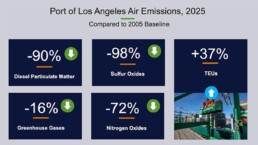
Port of Los Angeles reports lowest emissions per Container on Record
The Port of Los Angeles continued to make clean air gains in 2025, recording its lowest emissions per container on record, according to the Port's…
Drewry World Container Index – 22 Oct
WCI increased for the second consecutive week, the highest in 15 weeks. See detailed commentary below. Drewry World Container Index…
Mammoet, Port of Argentia and Argentia Capital Partner to Advance Floating Dry Dock and Marine Repair Facility
Partnership builds on Mammoet’s established presence at Port of Argentia and shared confidence in the growing market for ship repair and marine…
Subscribe to our newsletter!
if you dont want to swim alone in the ocean of news, sign up for the newsletter, and you will receive daily all the important news of world shipping!
