
For companies struggling to account for – and lower – the climate-warming emissions associated with their businesses, these rerouted journeys add to the challenge. Many companies had already revamped their supply chains as they navigated COVID-19 disruptions, extreme weather risks, trade protectionism that forced them to change suppliers, and rising freight costs.
“Whether it’s the Red Sea, or the war in Ukraine or COVID or Brexit before that, we’ve had so many discontinuities in the last decade,” said Archana Jagannathan, who leads sustainability in Europe for PepsiCo PEP.O. She said the company will need to double down on efforts to cut emissions if it hopes to meet its 2030 and 2040 climate pledges.
Reuters spoke to executives from five large consumer companies and analyzed data from 30 sustainability reports of major firms to show that third-party carbon emissions have broadly been on the rise in recent years amid supply chain disruptions.
Since the attacks by Yemen’s Houthi rebel forces began in the Suez Canal last year, hundreds of ships – powered by heavy fuel oil – have been diverted around the Cape of Good Hope, adding hundreds of kilometers (miles) to each journey. Those extra kilometers (miles) are resulting in higher emissions.
A large container ship’s journey from Shanghai to Hamburg, for example, emits 38% more CO2, or 4.32 million kilograms, if it goes around Africa instead of through the Suez Canal, according to data pulled for Reuters by LSEG.
The tracking platform ShipsGo estimates that more than 600 vessels have been rerouted since the attacks began in October.
It is not uncommon for vessels to take longer than expected even on routine days, according to ShipsGo. But delays and carbon emissions increased significantly after diversions due to the conflict in the Red Sea. In December, when ships started rerouting, average transit times increased by around 50%, leading to a similar increase in carbon emissions.
Delays and emissions started to normalise in following months, which ShipsGo says could be a result of the shipping industry adapting to the changed situations, such as choosing alternate shipping methods, or logged expected journey times more in line with longer routes.
The reroutings “are not planned,” International Maritime Organization chief Arsenio Dominguez told a news conference last month, and the additional CO2 release is “not emitted because we want to.”
The tracking data for the more than 6,000 containers originally loaded between Dec. 15, 2023, when the first service suspension started according to ShipsGo, and March 31, 2024, shows how the rerouting led to delays, as ships were further redirected with some shipments delayed for weeks.
Maersk MAERSKb.CO has said the delays and backlogs will likely continue into the second half of the year.
WHAT’S AT STAKE?
For companies that depend on receiving or distributing goods by sea, these longer shipping journeys pose a potential threat. While a company’s in-house operations and energy use make up what’s called Scope 1 and Scope 2 emissions tallies, its supply chain and distribution activities go into its Scope 3 emissions — a classification developed by non-profit thinktank the World Resources Institute.
Reuters examined the most recent sustainability reports for 30 of the world’s biggest companies, and found that 10 reported higher year-on-year Scope 3 emissions in 2022 or 2023, largely tied to shipping. The Red Sea delays could make that worse.
Speaking to Reuters, officials from some of those companies said failing to cut overall emissions could risk alienating consumers, losing investors, or jeopardising their ability to secure sustainable financing. They also could face shipping taxes, which may soon be approved.
The Denmark-based dairy company Arla Foods, which makes Lurpak butter, is already juggling higher costs. “Due to the conflict in the Red Sea, our emission has also gone up equally 1-1 with the cost” of shipping, said the company’s supply chain sustainability chief, Mia Høj Bredal.
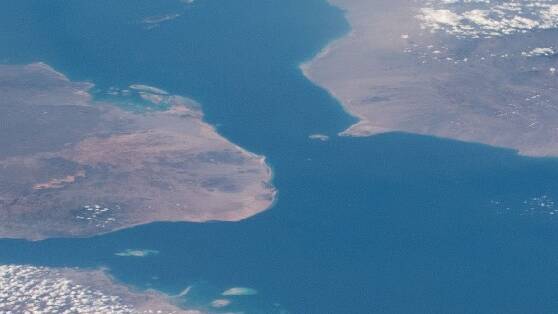
Reuters found many examples of detours in the tracking data, with the most common for ships to go around the entire African continent – adding weeks to the journey – rather than taking the Suez Canal shortcut between the Mediterranean and the Red Sea.
The Red Sea crisis has already pushed up the cost of European Union shipping emissions permits “by a third” as the typical 30-day voyage becomes a 40-day trip, said Chris Rogers, who manages the Supply Chain Research team within S&P Global.
Some vessels traveling from Asia to North America opted to avoid the Middle East and Red Sea completely, instead heading straight for the Cape of Good Hope and around the tip of Africa.
Other vessels coming from the north headed for the Suez Canal and made it halfway through the Red Sea, before turning back. This added even more time to those journeys.
COSTS AT SEA
Shipping, which accounts for 2.9% of global CO2 emissions, has largely escaped taxation because the high seas are not in the jurisdiction of any one government.
But for companies, the longer ship journeys translated to higher costs. Nestle NESN.S CEO Mark Schneider said in February that the world’s biggest food company was seeing “some stress” on its freight costs due to the detours.
Despite the higher shipping costs, the slower journey times led both San Francisco-based Levi Strauss & Co. LEVI.N clothing company and Britain’s multinational consumer goods company Reckitt RKT.L to transport some of their goods by air or by truck – both of which are significantly more climate polluting than shipping. Truck journeys are roughly 10 times more carbon intensive than shipping, while long-haul air freight generates 47 times the emissions as shipping per ton-mile, according to MIT research.
More than 20 countries and regional organisations are now backing proposals for an emissions levy on shippers, saying it could raise more than $80 billion a year in funds that can be put into developing low-carbon fuels. A levy on shipping could also lead to higher shipping costs for companies.
The harm from shipping emissions does not come from planet-warming CO2 alone, but also from the sulfates and black soot that billow out from a ship’s smokestack. Those airborne pollution particles allow shipping emissions to sometimes be seen from space. “Ship tracks” materialize as water vapor condenses around the particles.
The MODIS instrument aboard NASA’s Terra satellite captured this image on June 4, 2021. Some of the criss-crossing clouds stretch hundreds of kilometers from end to end.
With so many disruptions in the global supply chain, some companies told Reuters that they are looking to localize more of their operations by using suppliers closer to home, sometimes called “nearshoring.”
“It’s become much more apparent how urgent it is that as a collective we get emissions down,” said Thomas Lingard, who leads Dove soap maker Unilever’s global environmental policy and strategy. “The kinds of changes that you need are much more transformational.”
Multinational food company Kraft Heinz KHC.O, for instance, has been building capacity with local suppliers in Egypt and Eastern European operations in order to reduce its overall emissions, “a significant portion” of which comes from its transportation and distribution network.
This nearshoring also lowers the supply risk and leads to better prices, the Chicago-based company said in its 2023 sustainability report. This year, its Pudliszki factory will source nearly all of the tomato paste used in its products from dozens of small farms within 60 kilometers (40 miles) of the Polish town.
When Reuters examined the more than 6,000 delayed containers by destination, it became clear that the longest delays – as a percentage of the overall journey – were for ships heading to a port on the Mediterranean or in the Middle East, on either side of the Suez Canal. Containers on longer journeys between Asia and North America tended to have less significant delays.
INVESTMENT JEOPARDY
Several top investors told Reuters that they would challenge or engage with companies that say they missed their Scope 3 emissions targets because of supply chain troubles like the Red Sea crisis.
“Blaming transportation for missing Scope 3 targets sounds like a potential cop-out to me,” said Eric Pedersen, Nordea Asset Management’s head of responsible investments. Some portfolios with climate-focused investment strategies could consider letting stocks go after “successive disappointments.”
While experts agree there is a business threat from missing emissions targets, it is a threat that many companies are not yet concerned about.
Major global freight forwarder, Unique Logistics, said its hundreds of corporate clients were not asking about carbon emissions at all, but instead wanted to cut unexpected costs from their supply chains.
“We have not yet had major customers who specifically asked for certain vessel services or a certain choice of shipping lines based on environmental factors,” Unique Logistics CEO Sunandan Ray said. “The first priority for everyone still remains cost.”
Source: Reuters reported by Richa Naidu, Han Huang, Vijdan Mohammad Kawoosa, Sudev Kiyada, Adolfo Arranz and Simon Scarr. Additional reporting by Karl Plume, Gloria Dickie and Simon Jessop and edited by Claudia Parsons, Matt Scuffham and Katy Daigle



Related News.

Global Flag State Ranking 2026 who is up, who is down
Lorrendraaier publishes Global Flag State Ranking 2026: 148 flags measured on objective data, Singapore leads, Pakistan falls 35 places, the Dutch…

Will Germany have enough gas this winter?
As of mid-September 2026, Germany had stored just about 141 terawatt-hours of gas, accounting for around 57% of the country’s total storage…

Record diesel prices put US policy options in focus
Record-high diesel prices and tight inventories have put US exports under scrutiny, but keeping more barrels at home may offer only temporary…
IUMI elects Sean M. Dalton as President and says farewell to Frédéric Denèfle
The International Union of Marine Insurance (IUMI) has elected Sean M. Dalton as its new President. The election took place today at a meeting of the…
F/V MISTRESS Shipwreck ‘Lost’ Near Block Island Located After Seven Years
Green Oceans’ Underwater Investigation Reveals a Shipwreck Presumed to be the F/V Mistress found at the Base of Block Island Turbine #1 - Asks…
OCEAN at 50 celebrating a proud past and Maritime Future
OCEAN, the European sub-committee of ISSA, celebrated half a century of service to Europe’s ship supply sector with a landmark anniversary conference…

DORIC MONTHLY BRAZIL BAROMETER SEPTEMBER 2026
Pls find below the DORIC MONTHLY - BRAZIL BAROMETER SEPTEMBER 2026 BRAZIL_BAROMETER_SEPTEMBER_2026

Steel flows face fresh challenges in the final quarter of 2026
Steel flows slip into negative growth in July 2026 Global steel flows fall 1% y/y in July 2026 to reach 22.2 Mt. China’s share of global steel…

Insurance must shift “from repair to prevention”, says IUMI
Marine insurers will need to place greater emphasis on loss prevention as risks become more complex and costly to insure, according to Pascal Dubois,…

BIMCO’s Container Shipping Market Overview & Outlook September 2026 is out
Container Shipping Market Overview & Outlook Supply pressure is mounting "Disruptions and strong growth in head-haul trades continue to support…
Subscribe to our newsletter!
if you dont want to swim alone in the ocean of news, sign up for the newsletter, and you will receive daily all the important news of world shipping!
