
EU regulations on shoreside power are poised to introduce low-carbon electricity into marine energy mix with limited impact on the transition into sustainable fuels, assuming charging networks can be rolled out in time, industry analysts said.
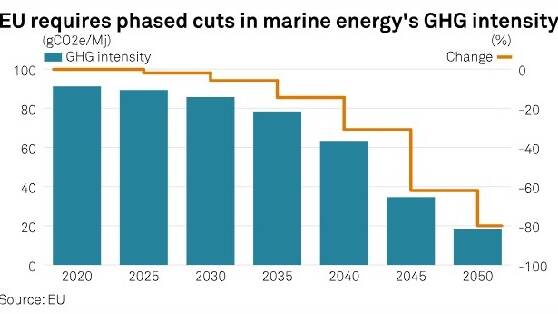
Brussels has allowed shipping companies to use onshore power supply to comply with FuelEU Maritime, which mandates reduction in the life-cycle greenhouse gas emissions intensity of marine energy for ships in EU-related trades of 2% against 2020 levels from 2025, 6% from 2030, and all the way to 80% from 2050 in phases.
The FuelEU Maritime rules separately require container and passenger ships to be connected to charging facilities by 2030 at main EU ports listed in the trans-European transport network, which in turn need to develop the infrastructure to meet 90% of ship operators’ demand, according to the EU’s alternative fuels infrastructure regulation.
While only small ships can be fully electrified due to limited space for on-board battery systems, large, ocean-going vessels could be designed or retrofitted to run on power at berth and turn off their auxiliary engines during “cold-ironing”, leading to lower bunker fuel use and CO2 emissions as well as less air pollution.
“Use of shore power when alongside is the no-brainer of maritime emission reduction,” Tristan Smith, co-founder of shipping consultancy UMAS, told S&P Global Commodity Insights, adding that mandating its use can create “certainty of demand” and promote infrastructure development.
More capacity
Based on an estimate by the nonprofit International Council on Clean Transportation, the EU needs to at least triple its installed show power capacity by 2030, from 309 MW at 51 ports in 15 coastal countries in October 2023, with demand expected to be driven by cruise traffic in Italy, France and Spain.
The EU’s impact assessment suggests containerships and passenger ships alone would require 5.6 GW of capacity to meet their mandates, which could come from new projects or better utilization of existing facilities.
With the regulatory requirements, major European ports like Rotterdam and Hamburg have started to develop onshore power supply networks, partnering with energy companies in some cases.
“Whilst today many ports across Europe do not yet have shore-side electricity installations in place, investment agreements are being signed and concrete plans being developed in order,” said Inesa Ulichina, sustainable shipping policy officer at think tank Transport & Environment, adding that using onshore power could halve energy use by ships at ports due to better efficiency.
Advantages
Analysts said shoreside power could emerge as a strong option for shipping firms to comply with FuelEU Maritime, with its cost expected to be lower than other low-carbon marine energy sources for some years at least.
Platts, part of Commodity Insights, assessed the delivered bunker price for 0.5% sulfur marine fuel at $570/mt in Hamburg May 28, or $13.9/Gigajoule. Industry estimates suggest sustainable marine fuels based on hydrogen generated from renewable energy could be five times more expensive.
The year-ahead contract for German electricity settled at Eur102/MWh on the same day, according to the European Energy Exchange. This was roughly equivalent to $30.7/Gj.
Taking into consideration better energy efficiency of electricity, Smith said shoreside power could be three to four times cheaper than using renewable hydrogen-based green fuels.
GHG factor
Furthermore, onshore power supply has a zero-emission factor by default regardless of the sources of electricity under FuelEU Maritime, while the GHG intensity of marine fuels are calculated based on their well-to-wake emissions.
The regulatory design could discourage procurement of renewable energy, but the impact would be largely mitigated by the EU’s decarbonization policies for its power sector, according to industry participants.
Nikita Pavlenko, a fuel researcher at the ICCT, estimated the EU’s grid electricity emissions factor at 250 grams CO2-equivalent/KWh — which can translate into a 60% GHG cut versus conventional, oil-based bunker fuels. This would be deeper than most biofuels, currently the most used low-carbon bunker fuels, according to Pavlenko.
With the EU targeting a 69% share of renewables in electricity by 2030 under the REPowerEU plan, Joe Bettles, a market analyst at Maersk Mc-Kinney Moller Center for Zero Carbon Shipping, suggested Brussels is aiming to drive the buildouts of shoreside charging facilities with the zero-emission factor.
“The EU’s approach has been that the grid is decarbonizing and will likely continue due to EU mandates,” Bettles said. “This is the right approach to scale a technology which currently has very low adoption.”
Future plans
For the long run, shipping companies would need both onshore power supply and low-carbon fuels to comply with FuelEU Maritime, according to analysts.
As shoreside electricity would typically amount to less than 5% of total energy used by a vessel, Smith said “a switch to clean fuel will be necessary” when FuelEU Maritime requirements become increasingly stringent in the next decade.
“The impact of this pathway on crowding out alternative fuels will be limited … [even as] using existing, grid average electricity is likely cheaper and easier [for meeting parts of the FuelEU Maritime requirements,” Pavlenko,said.
Based on the EU’s estimate, Eur7.4 billion would need to be spent on shoreside charging networks in 2025-2050, and analysts said it would take time for the capital expenditure programs to materialize across the bloc while shipowners enable their vessels to be connected to the grid.
“The challenge is to make sure that the fleet is compatible and can use shore power and that investment is made into supply,” Smith said.
Source: Platts



Related News.

Global Flag State Ranking 2026 who is up, who is down
Lorrendraaier publishes Global Flag State Ranking 2026: 148 flags measured on objective data, Singapore leads, Pakistan falls 35 places, the Dutch…
Will Germany have enough gas this winter?
As of mid-September 2026, Germany had stored just about 141 terawatt-hours of gas, accounting for around 57% of the country’s total storage…

Record diesel prices put US policy options in focus
Record-high diesel prices and tight inventories have put US exports under scrutiny, but keeping more barrels at home may offer only temporary…

IUMI elects Sean M. Dalton as President and says farewell to Frédéric Denèfle
The International Union of Marine Insurance (IUMI) has elected Sean M. Dalton as its new President. The election took place today at a meeting of the…

F/V MISTRESS Shipwreck ‘Lost’ Near Block Island Located After Seven Years
Green Oceans’ Underwater Investigation Reveals a Shipwreck Presumed to be the F/V Mistress found at the Base of Block Island Turbine #1 - Asks…

OCEAN at 50 celebrating a proud past and Maritime Future
OCEAN, the European sub-committee of ISSA, celebrated half a century of service to Europe’s ship supply sector with a landmark anniversary conference…

DORIC MONTHLY BRAZIL BAROMETER SEPTEMBER 2026
Pls find below the DORIC MONTHLY - BRAZIL BAROMETER SEPTEMBER 2026 BRAZIL_BAROMETER_SEPTEMBER_2026

Steel flows face fresh challenges in the final quarter of 2026
Steel flows slip into negative growth in July 2026 Global steel flows fall 1% y/y in July 2026 to reach 22.2 Mt. China’s share of global steel…

Insurance must shift “from repair to prevention”, says IUMI
Marine insurers will need to place greater emphasis on loss prevention as risks become more complex and costly to insure, according to Pascal Dubois,…

BIMCO’s Container Shipping Market Overview & Outlook September 2026 is out
Container Shipping Market Overview & Outlook Supply pressure is mounting "Disruptions and strong growth in head-haul trades continue to support…
Subscribe to our newsletter!
if you dont want to swim alone in the ocean of news, sign up for the newsletter, and you will receive daily all the important news of world shipping!
