A perfectly rehearsed countdown ahead of the Ariane 6 first flight
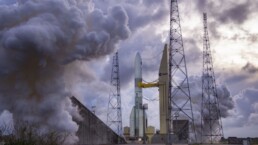

Hot-fire tests of the Ariane 6 stages: part 2
November 23, 2023 was a seminal date in the preparation for Ariane 6’s inaugural flight. At Europe’s Spaceport in French Guiana, the teams from the European Space Agency , ArianeGroup and the French space agency CNES successfully carried out a crucial test ahead of the first flight: the long-duration hot-fire test of the launcher’s main stage, following a complete launch countdown rehearsal.
This long-duration hot-fire test of the launcher’s main stage was a key moment in Ariane 6’s development and a crucial step in the combined test campaign at the spaceport in Kourou. It took place on November 23, 2023 and lasted about 30 hours, during which all the steps in a countdown leading to launch were rehearsed on the ground.

It began with switching on the launcher’s on-board avionics, followed by filling of the liquid helium subsystem, which is used to pressurize the main stage’s liquid oxygen tank. The dry air then had to be flushed from all the pipes and cavities in the launcher and replaced with neutral gases (helium or nitrogen). The aim was to ensure that there was not the slightest trace of humidity before cooling down the supply lines, first of all on the ground, then on-board the launcher, followed by chill-down of the tanks.
Thermal shock
Without these preliminary operations, in other words if any traces of humidity were to remain, the sudden arrival of the cryogenic propellants (liquid hydrogen and oxygen) could create ice in the supply lines or the tanks, and the thermal shock resulting from the extreme temperature difference could cause structural damage. Given that the average ambient temperature in French Guiana is 35°C, while liquid hydrogen (LH2) is at -253°C and liquid oxygen (LOx) is at -183°C. Once the tanks have been chilled down, propellant filling begins.

Although only the main stage and its Vulcain 2.1 engine were ignited for this test, both of the launcher’s liquid propulsion stages were actually filled. These operations represent one of the major risks in a launch: the flowrate and temperature need to be constantly adjusted to ensure adequate filling and avoid potential leaks, both on the launcher and the ground installations. This was an opportunity to test the cryogenic connections between the launcher and the launch pad.
180 tons of liquid hydrogen and oxygen
The main stage carries 150 tons of fuel: 25 tons of LH2 and 125 tons of LOx. For its part, the upper stage is filled with 30 tons of fuel: 5 tons of LH2 and 25 tons of LOx. In total, when filling is completed, the launcher carries 180 tons of propellant fuel. Chill-down then begins on the Vulcain 2.1 engine and its turbopumps through which these propellants will circulate at high speed.

Up to that point, the engineers in Kourou, in the CDL3 (Launch Center no. 3) control center, and back in Europe, notably at ArianeGroup’s concurrent engineering facility (Space Code) at the Les Mureaux site near Paris, closely monitor thousands of parameters on their screens. Then, automated verification of all the systems of the ground and launcher installations begins. They gradually switch to automatic mode, entirely controlled by the computers, with the screens in the control centers then showing the green “Prêt synchro” (ready for synchro) lights.
Synchronized sequence
Five minutes before main stage ignition, the system enters the “synchronized sequence”, which becomes irreversible 13 seconds before “H0” (the moment of lift off). All the controls and commands then switch from the ground control benches to the launcher’s on-board avionics, which become autonomous. During this sequence, the slightest parameter deviating from its tolerance range will lead to a red light, placing the launcher in a holding configuration. The teams will then have to identify the source of the problem, define the cause and find solutions to allow a completely safe restart of the sequence.

If everything is still green at the end of the synchronized sequence, the system automatically initiates ignition of the Vulcain 2.1 engine, using the burners located in the launch pad. The hydrogen and oxygen flood into the combustion chamber and ignite, generating a thrust of 135 tons almost instantaneously. In stabilized operation, the engine consumes 760 liters per second and its turbopump rotates at more than 33,000 rpm. For this test, the engine operated without interruption for more than seven minutes, covering the main stage’s entire flight phase. Gimbaling of the Vulcain 2.1 engine was tested several times during this phase, because this function plays the essential role of piloting the launcher in flight after separation of the boosters.

Configuration readiness
Cutting the engine did not mean the test was over. The teams still had to carry out a whole series of operations: depressurizing the fluids equipment and lines, draining and cleaning out the tanks, in particular those of the upper stage which were still full, switching off the on-board electronic and electrical equipment, returning the mobile gantry to the launch pad, and so on. All these operations performed after the tests enabled the launcher’s configuration to be readied for further tests.

When the combined tests campaign finished, the CTM test model launcher was removed from the launch pad and disassembled for storage, leaving the way clear for the actual first-flight launcher.
François Deneu, Ariane 6 Program Director.



Related News.

Predicting the Future or Preparing for It? Cyprus Marine Club Explores the Power of Adaptability with Natasa Pilides
In a world where uncertainty has become the new normal, is predicting the future really the best strategy, or is the ability to adapt the greater…

Greece and Egypt in talks to extend EEZ Eastwards towards Cyprus following Libya’s move on Turkish Maritime Pact
Athens and Cairo have agreed to advance bilateral consultations aimed at extending the geographical scope of their 2020 Exclusive Economic Zone (EEZ)…
Seafarers face widening competency gap as digital shipping accelerates, recent research finds
Eighty two per cent of maritime professionals surveyed say current training does not adequately prepare crews for the realities of modern,…
Wärtsilä and WinGD sign new Service Framework Agreement to ensure long-term continuity and support for the global fleet
Technology groups Wärtsilä and WinGD have entered into a new long-term Service Framework Agreement, reaffirming their shared commitment to supporting…
Seatrium and Karpowership sign contract for a series of whale class Powership Conversion and Integration Projects
Seatrium and its strategic partner, floating power leader Karpowership, have strengthened their longstanding collaboration with the award of a…
ClassNK releases Handbook Supporting Consideration of Onboard Carbon Capture “Onboard Carbon Capture Systems Implementation Framework”
Bringing together technical, infrastructure, regulatory and emissions assessment considerations across the OCCS value chain - ClassNK has released a…
HHLA lowers earnings forecast for the 2026 financial year
Based on the business development to date and updated estimates for the fourth quarter of 2026, the Executive Board of Hamburger Hafen und…
Port of Los Angeles reports lowest emissions per Container on Record
The Port of Los Angeles continued to make clean air gains in 2025, recording its lowest emissions per container on record, according to the Port's…
Drewry World Container Index – 22 Oct
WCI increased for the second consecutive week, the highest in 15 weeks. See detailed commentary below. Drewry World Container Index…
Mammoet, Port of Argentia and Argentia Capital Partner to Advance Floating Dry Dock and Marine Repair Facility
Partnership builds on Mammoet’s established presence at Port of Argentia and shared confidence in the growing market for ship repair and marine…
Subscribe to our newsletter!
if you dont want to swim alone in the ocean of news, sign up for the newsletter, and you will receive daily all the important news of world shipping!
