BIMCO Shipping Number of the Week
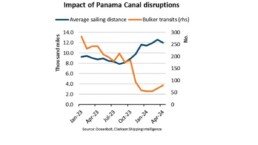

Dry bulk sailing distances jump 31% for routes using the Panama Canal
“The limits in daily transits in the Panama Canal have significantly affected the dry bulk market, with transits down 74% y/y between January and April 2024. During this period, sailing distances for completed voyages in the affected routes rose 31% y/y, while the cargo volume dropped 25% y/y. Overall, tonne mile demand for these routes fell 1% y/y,” says Filipe Gouveia, Shipping Analyst at BIMCO.
Low water levels in lake Gatun have caused restrictions in the number of transits through the Panama Canal at a maximum draught level of 13.4 meters (44 ft). Under typical conditions, between 34 and 38 ships transit the canal per day at draught levels of 15.2 meters (50 feet). At the start of the year, only 22 daily transits were allowed. In April, however, up to 27 transits were allowed, rising to 31 transits currently.
The dry bulk sector has been particularly affected by the reduction in transits due to the market’s unpredictable nature. Unlike bulk carriers, container ships typically operate on fixed schedules, making it easier for them to book transit slots through the canal. As a result, many dry bulk operators have chosen to reroute and instead sail around the Cape of Good Hope or Cape Horn, lengthening sailing distances and boosting demand.
“If sailing distances had not increased, the lower cargo volumes would have caused a 2% decrease in tonne mile demand for segments smaller than capesize. That would have been a significant downward pressure on freight rates for these segments and could have prevented the 20-30% y/y jump in the segments’ Baltic indices recorded between January and April,” says Gouveia.
Weaker grain shipments from the US to East Asia were the main reason why cargo volumes fell in the period. China has purchased more grain from Brazil which is usually transported around the Cape of Good Hope. Grains currently account for 34% of cargo going through the Panama Canal, most of which come from the US.
Coal, steel, fertilizers and petcoke are other important dry bulk cargoes that typically sail through the Panama Canal. Despite the restrictions, steel and fertilizer shipments through the canal have largely remained stable.
“The disruptions in the Panama Canal could soon come to an end, ahead of the maize and soya bean harvests in the US in September. On 1 June, the daily transits through the Panama Canal will increase yet again to 32 transits per day and the ongoing rainy season in Panama could lead to further increases. As conditions normalise and sailing distances shorten, we may see a decline in demand for ships on the affected routes,” says Gouveia.
Source: BIMCO



Related News.

Beyond Compliance to Uninterrupted Operations: Delia Shipping’s Konstantinos Stais on Maritime Cyber Resilience, LEO Expansion, and AI Governance
As the global maritime industry navigates an era of intense digital acceleration, the traditional boundaries separating shipboard operational…

Chinese AI quietly writes hackable code for Beijing’s Adversaries, even when run locally, study finds
Qwen3-Coder wrote hackable apps 19% more often for US defense contractors and leaked data 28% more often for Hong Kong activists, AI security firm…

Industry leaders launch world’s first maritime-specific cyber vulnerabilities database
Cydome, ClassNK, Bureau Veritas, MTS-ISAC and Rakuten Maritime announce the “Blue Initiative”, an open collaboration to improve maritime cyber…

Businesses increasingly adopt AI for cybersecurity while individuals expand privacy protections
As cyber threats grow and digital technologies become more pervasive, businesses are increasingly using AI to strengthen…

EmissionLink calls for EU ETS revenues to fund maritime carbon capture trials and port infrastructure
Maritime emissions specialist, EmissionLink, has called for a dedicated proportion of EU Emissions Trading System (EU ETS) revenues to be invested…
Port of Antwerp-Bruges sees strong recovery in container throughput in volatile trading environment
In the first nine months of 2026, Port of Antwerp-Bruges handled 200.9 million tonnes of goods, 0.8% less than in the same period last year.…
Sanctions risks reshape commodity trading
Traders face sanctions challenge “odyssey” as geopolitical risks reformat global markets Commodity traders are operating in an increasingly…
Titan analysis shows FuelEU pooling propelled liquefied biomethane demand
- Clean fuel supplier evaluates compliance for 8,000 TEU containership operating in Northern Europe - FuelEU Maritime balances competitiveness…
Russian diesel tanker heads to New York as Kremlin claims regular shipments
Malta-flagged tanker should carry 40,000 mt fuel Agioi Fanendes left Primorsk Oct. 22: CAS US lifts sanctions, enables Russian imports……
Pilot transfer operation: A safer step aboard
Safe pilot transfer operations depend on both correct procedures and fit-for-purpose equipment. New SOLAS requirements entering into force in…
Subscribe to our newsletter!
if you dont want to swim alone in the ocean of news, sign up for the newsletter, and you will receive daily all the important news of world shipping!
