CLARION project takes the lead in strengthening European Ports’ Resilience
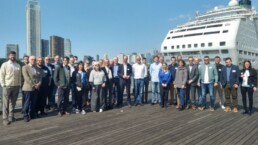

Together with the ports of Rotterdam and Hamburg, Port of Antwerp-Bruges is participating in the CLARION Project, funded by the Horizon Europe programme and coordinated by TU Delft, Faculty of Civil Engineering and Geosciences, the Geotechnical Engineering Section and a multidisciplinary team of 21 partners from 10 European countries. Aim of the project is to enhance the resilience and sustainability of European ports in the face of climate-related challenges. With an EU contribution of around 7 million euros, the project has a duration of 48 months, concluding in April 2028.
In line with the European Commission’s EU Strategy on Adaptation to Climate Change and the European Green Deal, CLARION sets ambitious objectives to increase the operational availability of port infrastructures during extreme events, to support modal shifts towards low-emission transport systems and reduce accidents caused by climate-related disruptions, to minimize environmental impact and ensure transferability of results.
Featuring the top-3 ports in Europe in terms of container throughput, namely Rotterdam, Antwerp-Bruges and Hamburg in the North Sea and the largest European port in the Black Sea, Constantza, during CLARION 10 pilots will be conducted to test and deploy advanced technologies and strategies aimed at enhancing port resilience and sustainability. These demonstrations will focus on smart quay walls, monitoring system for the corrosion of port infrastructure, dredged sediment reuse, flood impact control, extreme weather forecasting and more, pushing the boundaries of current practices to future-proof port infrastructure.
Jacques Vandermeiren, CEO Port of Antwerp-Bruges: “At Port of Antwerp-Bruges, we are committed to ensuring the future-proof and climate resilient nature of our infrastructure. As we are facing similar challenges as the ports of Rotterdam and Hamburg, we are delighted to collaborate with them through the Clarion European subsidy program on ‘Climate Resilient and Safe Maritime Ports’, taking our partnership to the next level. Additionally, we are thrilled to work alongside our local partners, Brabo and the Antwerp Maritime Academy, in developing two demo cases. We eagerly anticipate the exchange of insights and lessons learned with our fellow ports and partners.”
“The development strategy of the port of Constanta will take climate change into account as a major factor. In order to face its effects in the future, MPAC (National Company Maritime Ports Administration SA Constanta) commits to promote innovations and modern technologies, as a relevant instrument to increase port efficiency. In this sense, the CLARION project is first of all a tool for learning the latest trends in the field of innovation applications in sea and river ports, in order to be able to later promote and replicate them at the level of the entire port community, but also with potential effects at the level of the logistic chains influenced by the Port of Constanta. That is why the CLARION project, which analyzes the impact of climate changes and possible mitigation solutions, will contribute decisively to the identification of the best strategies and measures to ensure the stability and resilience of the port infrastructure. The use of innovative means (drones, sensors, AI, etc.) provided by CLARION through a pilot project implemented in the Port of Constanta, represents an important step in the port transformation and modernization”, declares Mihai Teodorescu, Port of Constanta CEO.
“One of the aims of forward-looking port planning is to ensure the best possible safe and reliable accessibility of the port. The ability to continuously adapt to changing environmental conditions, such as climate change or extreme weather conditions, is highly relevant in this context. The HPA is also meeting these challenges with new technologies such as artificial intelligence and digitalisation. We are therefore delighted to be part of the CLARION project to work on specific use cases together with our partners”, says Jens Meier, CEO of the Hamburg Port Authority (HPA).
“Physical risks from climate change are increasingly affecting our port infrastructure and assets, as well as those of our customers. The port of Rotterdam is largely situated outside the dykes, which means that dykes and barriers do not fully protect the port. This makes it more vulnerable to rising sea levels. Although the different sites in the port are built relatively high above sea level and are partly protected by storm surge barriers, we are continuously developing measures to ensure the port remains resilient to climate change in the future. As these adaptation challenges are equally relevant to our neighbouring ports Antwerp and Hamburg, as well as Danube-connected Constanta, we are glad to be a partner of the CLARION project. We have a long-standing relation with TU Delft in joint research and look forward to fruitful cooperation leading to results that ports can implement from the seaside to the hinterland” says Boudewijn Siemons, CEO of the Port of Rotterdam.



Related News.
Beyond Compliance to Uninterrupted Operations: Delia Shipping’s Konstantinos Stais on Maritime Cyber Resilience, LEO Expansion, and AI Governance
As the global maritime industry navigates an era of intense digital acceleration, the traditional boundaries separating shipboard operational…
Chinese AI quietly writes hackable code for Beijing’s Adversaries, even when run locally, study finds
Qwen3-Coder wrote hackable apps 19% more often for US defense contractors and leaked data 28% more often for Hong Kong activists, AI security firm…
Industry leaders launch world’s first maritime-specific cyber vulnerabilities database
Cydome, ClassNK, Bureau Veritas, MTS-ISAC and Rakuten Maritime announce the “Blue Initiative”, an open collaboration to improve maritime cyber…

Businesses increasingly adopt AI for cybersecurity while individuals expand privacy protections
As cyber threats grow and digital technologies become more pervasive, businesses are increasingly using AI to strengthen…
EmissionLink calls for EU ETS revenues to fund maritime carbon capture trials and port infrastructure
Maritime emissions specialist, EmissionLink, has called for a dedicated proportion of EU Emissions Trading System (EU ETS) revenues to be invested…
Port of Antwerp-Bruges sees strong recovery in container throughput in volatile trading environment
In the first nine months of 2026, Port of Antwerp-Bruges handled 200.9 million tonnes of goods, 0.8% less than in the same period last year.…
Sanctions risks reshape commodity trading
Traders face sanctions challenge “odyssey” as geopolitical risks reformat global markets Commodity traders are operating in an increasingly…
Titan analysis shows FuelEU pooling propelled liquefied biomethane demand
- Clean fuel supplier evaluates compliance for 8,000 TEU containership operating in Northern Europe - FuelEU Maritime balances competitiveness…
Russian diesel tanker heads to New York as Kremlin claims regular shipments
Malta-flagged tanker should carry 40,000 mt fuel Agioi Fanendes left Primorsk Oct. 22: CAS US lifts sanctions, enables Russian imports……
Pilot transfer operation: A safer step aboard
Safe pilot transfer operations depend on both correct procedures and fit-for-purpose equipment. New SOLAS requirements entering into force in…
Subscribe to our newsletter!
if you dont want to swim alone in the ocean of news, sign up for the newsletter, and you will receive daily all the important news of world shipping!
