Reimagining energy bp’s new ACE platform starts production
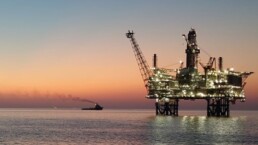

Our latest and most technologically advanced platform in the Caspian is applying new technology and the power of digital to manage safety risks, reduce operational emissions and raise efficiency
bp’s new Azeri Central East (ACE) platform in the Caspian Sea is “important, both for bp and beyond,” says Ruhali Imanov, the commissioning superintendent on bp’s latest platform in the Caspian Sea.
Off the coast of Baku, Azerbaijan, the platform is part of bp’s effort to help secure vital energy supplies for the region and Europe – and grow value for bp, too.
The platform is designed to produce up to 100,000 barrels of oil per day, and is expected to deliver up to 300 million barrels over its lifetime. It’s the latest piece in bp’s operations in the giant Azeri-Chirag-Gunashli (ACG) field, and in Azerbaijan, where bp’s portfolio also includes the giant Shah Deniz gas field, pipelines and the Sangachal oil and gas terminal.
“ACE is increasing Azerbaijan’s oil production and helping to make the most of a maturing field. It’s giving both bp and Azerbaijan the opportunity to get more value from existing fields and assets,” says Ruhali, who grew up in Azerbaijan, and has watched bp grow its operations there over the past 30-plus years.
bp’s Azeri-Chirag-Deepwater Gunashli platforms in the Caspian Sea
Controlling offshore onshore
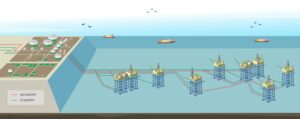
ACE is one of bp’s most technologically and digitally advanced platforms to date, and a model for future platforms, according to project operations engineering manager Phillippa Cook. One of its more exciting features, according to engineers, was the location of the control room onshore rather than on the platform – a first for both the region and for bp.
The control room sits at the massive Sangachal oil and gas terminal, about an hour’s drive south of Baku, and technicians there can control what’s happening 140 kilometres (87 miles) out at sea on the ACE platform.
“Having fewer personnel offshore is inherently safer as it reduces the risks associated with people travelling to and from the platform, being exposed to harsh weather conditions and potentially hazardous equipment and materials,” Phillippa explains.
To help the bp operations teams familiarize themselves with the new concept – both physically and mentally – Phillippa’s team set up the control room ahead of start-up to test it and get colleagues accustomed to a different way of working
“There was a three- or four-month period of rotating technicians through Sangachal terminal, verifying whether everything worked as it should. This is the future, and it was so important that everyone was on board with the changes,” says Phillippa. Digital tools, such as shared online white boards and integrated control safety systems, are also bridging the physical gap by helping teams to collaborate more effectively, without needing to be in a room together
Digital technology
Digital technology is helping ACE to stand out in other ways, too. A digital twin, or virtual replica of the platform and its systems, means that teams can look at its inner workings without leaving dry land.
“We call it a one-stop shop, where you can get all the information about ACE and its insides that anyone could need,” says Yekaterina Novruzlu, senior instrument and controls engineer for the ACE project. “Let’s say there was a maintenance issue with a part that is not readily accessible. In the past, it might have meant sending someone offshore, setting up scaffolding and taking photos as a first step. The digital twin allows us to understand what is involved and then decide on a course of action in just a few minutes or hours.”
As the digital twin was developed, bp teams relied on the experience of colleagues who had worked on similar projects in the US and UK. The ACE team has also shared their newly acquired digital twin expertise with other colleagues around the business, opening up the potential to introduce similar tools and designs across other assets.

Throughout ACE’s development, engineers looked at ways they could increase safety and efficiency – and reduce the need for maintenance. “A lot of work was done to engineer out single points of failure,” says Ruhali.
“We also looked at how, while maintaining and prioritizing safety, we could build in more time between maintenance shutdowns, known as turnarounds, when production has to be reduced or stopped,” he adds.
“The intention with ACE was that it would act as a pilot design for the platform of the future. When we started talking about this kind of automatization back in 2018, it seemed like we had a near-impossible task ahead of us. This start-up is a real milestone after years of conceptualizing, engineering, planning and execution.”



Related News.
Predicting the Future or Preparing for It? Cyprus Marine Club Explores the Power of Adaptability with Natasa Pilides
In a world where uncertainty has become the new normal, is predicting the future really the best strategy, or is the ability to adapt the greater…

Greece and Egypt in talks to extend EEZ Eastwards towards Cyprus following Libya’s move on Turkish Maritime Pact
Athens and Cairo have agreed to advance bilateral consultations aimed at extending the geographical scope of their 2020 Exclusive Economic Zone (EEZ)…
Seafarers face widening competency gap as digital shipping accelerates, recent research finds
Eighty two per cent of maritime professionals surveyed say current training does not adequately prepare crews for the realities of modern,…
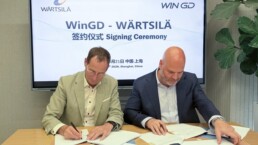
Wärtsilä and WinGD sign new Service Framework Agreement to ensure long-term continuity and support for the global fleet
Technology groups Wärtsilä and WinGD have entered into a new long-term Service Framework Agreement, reaffirming their shared commitment to supporting…
Seatrium and Karpowership sign contract for a series of whale class Powership Conversion and Integration Projects
Seatrium and its strategic partner, floating power leader Karpowership, have strengthened their longstanding collaboration with the award of a…
ClassNK releases Handbook Supporting Consideration of Onboard Carbon Capture “Onboard Carbon Capture Systems Implementation Framework”
Bringing together technical, infrastructure, regulatory and emissions assessment considerations across the OCCS value chain - ClassNK has released a…
HHLA lowers earnings forecast for the 2026 financial year
Based on the business development to date and updated estimates for the fourth quarter of 2026, the Executive Board of Hamburger Hafen und…
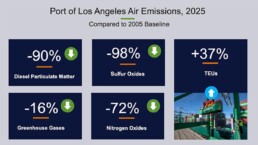
Port of Los Angeles reports lowest emissions per Container on Record
The Port of Los Angeles continued to make clean air gains in 2025, recording its lowest emissions per container on record, according to the Port's…
Drewry World Container Index – 22 Oct
WCI increased for the second consecutive week, the highest in 15 weeks. See detailed commentary below. Drewry World Container Index…
Mammoet, Port of Argentia and Argentia Capital Partner to Advance Floating Dry Dock and Marine Repair Facility
Partnership builds on Mammoet’s established presence at Port of Argentia and shared confidence in the growing market for ship repair and marine…
Subscribe to our newsletter!
if you dont want to swim alone in the ocean of news, sign up for the newsletter, and you will receive daily all the important news of world shipping!
