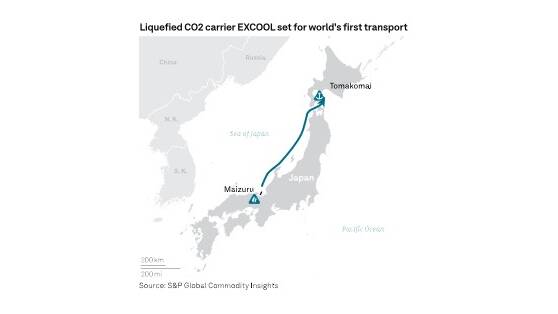

Within six months, Japan is set to start what will be the world’s first transport of carbon dioxide on a low-temperature and low-pressure liquefied CO2 carrier over 1,000 km in a series of trial voyages, which are expected to play a key role in the country achieving its carbon neutrality goal.
The trial voyage of the EXCOOL, a low-temperature and low-pressure liquefied CO2 carrier operated by Nippon Gas Line, is slated to start in early October between Kansai Electric’s 1.8 GW Maizuru coal-fired power plant in Kyoto prefecture and a Tomakomai terminal in Hokkaido. The trial is expected to last for about two-and-a-half years.
This is part of a pilot project commissioned by the state-owned New Energy and Industrial Technology Development Organization (NEDO). The project, which began in June 2021 and will end in March 2027, involves several Japanese companies and is expected to demonstrate capturing CO2 from the Maizuru power plant and liquefying it and transporting it on a newly built carrier.
The transport on the 996-gross-ton EXCOOL with a cargo tank capacity of 1,450 cu m will be a moment of truth for Japan to test the low-temperature and low-pressure liquefied CO2 transport technology, as the country aims to store 13 million mt/year of CO2 for carbon capture and storage in Japan and abroad by 2030 under its first seven CCS projects selected by the government.
The EXCOOL at Daikoku Pier in Yokohama Port Feb. 16, 2024. Source: Takeo Kumagai, S&P Global Commodity Insights
If this technology can be proven, it would eventually improve economics of CCS projects, allowing larger volumes of CO2 for transport and storage, compared with the current medium-temperature and medium-pressure technology, according to officials involved with the project.
Like other industrialized countries, Japan sees CCS as among key decarbonization solutions for industries, particularly those in hard-to-abate sectors, to trim greenhouse gas emissions.
“The pressure of CO2 will decrease by lowering temperatures, which would allow us to thin down the plate of tank, and we are aiming to upsize it,” said Keiji Iwagami, managing director and general manager of plant engineering department, at Japan CCS, which leads research and development of CO2 liquefaction and storage system.
LNG scale
This transport project is essentially about pursuing a scale of low-temperature and low-pressure liquefied CO2 storage tanks similar in scale to LNG carriers for Japan to be able to store around 120 million-240 million mt/year of CO2 by 2050 to achieve carbon neutrality, said Norihiko Saeki, director of CCS policy office, at the Ministry of Economy, Trade and Industry.
“The success or a failure of this research and development will be determined by how close we can enlarge [CO2] storage tanks to a level close to LNG carriers,” Saeki said.
Japan sees a need to launch its CCS business by 2030 and increase its CO2 storage volumes by 6 million-12 million mt/year thereafter to achieve 2050 carbon neutrality.
Considering Japan’s plan to store 120 million-240 million mt/year of CO2 at home and overseas by 2050, “this does not mean all of the volume will be transported overseas. However, the pursuit of [storing] 120 million mt [of CO2] would mean half of this would equate roughly [Japan’s] current LNG transport volumes,” Saeki said.
“This is why we believe this research and development, which could be decisive to Japan achieving carbon neutrality,” Saeki said. “In the absence of a low-temperature and low-pressure liquefied [CO2] carrier, we might not be able to achieve it.”
To achieve 2050 carbon neutrality, Japan might need a CO2 carrier fleet of “several hundred” ships, similar to the current level of LNG tankers used for importing around 70 million mt/year of LNG, Saeki added.
Project expansions
With the aim to store 120 million-240 million mt/year of CO2 by 2050, Japan has selected the first seven CCS projects — five in Japan and two in Malaysia and Oceania — with the ability to expand, Saeki said, adding that “expansion should not be as difficult” as the country needs to accelerate CCS storage volume growth after 2030.
Japan has found reservoirs in 11 locations suitable for storing a total of 16 billion mt of CO2 in the country’s earlier surveys.
To help support business developments in the country, the Japanese cabinet approved Feb. 13 a CCS business bill, which outlines domestic frameworks for drilling and storage rights as well as relevant business and safety regulations. The bill is currently being deliberated at the House of Councillors in the Diet after having passed by the House of Representatives on April 9.
The passage of the CCS business bill would mark Japan entering “the first year of CCS business,” Saeki said.
Transport project
In the upcoming CO2 trial transport using the EXCOOL, “we plan to transport a total of tens of thousands mt of CO2 from navigation records,” said Makoto Nunokawa, NEDO’s director of advanced thermal power and CCUS group at environment department.
“By the end of fiscal year 2026-27, we aim to have some idea about conditions for transporting a large volume of CO2 on suitable carriers, as well as specs for ground facilities and operational procedures for us, as well as for Japan,” Nunokawa said.
The project plans to eventually transport CO2 at low-temperature and low-pressure levels respectively of minus 50 C and 0.7 MPa on the EXCOOL, after starting at medium-temperature and medium-pressure levels respectively of minus 20 C and 2.0 MPa.
Lowering CO2 temperatures would require careful handling, as CO2 becomes dry ice at about minus 56.6 C with 0.52 MPa and changes in its content from mingling with impurities.
During trial voyages, the project will also examine sloshing of CO2, as in whether CO2 will become dry ice from sailing in different sea areas due to the difference in wave behaviors, said Iwagami of Japan CCS.
The size of CO2 storage tanks will also be a decisive factor for building CO2 receiving terminals feasibly in coastal areas in Japan, where it has limited space, Iwagami added.
The project involves capturing CO2 from exhaust gas emitted from the Maizuru coal-fired power plant, where a 3 mt/hour CO2 liquefaction facility and a 750 mt liquefied CO2 storage tank are being installed. A 1,200 mt liquefied CO2 storage tank — the largest in Japan — has also been installed at the Tomakomai terminal.
Source: Platts



Related News.
Cyprus Maritime Innovation takes Centre Stage at SMM Hamburg 2026
Underscoring its expanding role as a premier international hub for cutting-edge maritime technology and sustainable shipping, the Republic of Cyprus…

Trump seeks to refill US oil reserve with Venezuela deal but faces long delay
U.S. President Donald Trump said on the 30th (local time) that he would refill the U.S. Strategic Petroleum Reserve, which has been depleted with…
US Navy Official visits South Korean Shipyards in private
With U.S. President Donald Trump pushing a plan to allow overseas construction of U.S. warships, attention is focusing on whether the building of…
SES and De Boer Marine expand collaboration with FlexMaritime deployment across Global Markets
SES, a leading space solutions company, and De Boer Marine, a leading provider of top-quality marine equipment and maritime connectivity services,…

New ESG guidance to help maritime industry turn sustainability into commercial advantage
New framework helps shipowners and ports align ESG strategy with access to capital, charterer expectations and long-term asset value. Maritime…
Britannia P&I Club analysis finds four in five crew deaths linked to illness rather than accidents
New report highlights cardiovascular disease as leading cause of fatalities and raises concerns over mental health risks among younger seafarers.…

The Swedish Club launches new Loss Prevention podcast, Knot Another Lesson
The Swedish Club has launched Knot Another Lesson, a new podcast exploring the practical lessons, emerging risks and operational challenges shaping…

Lloyd’s Register appoints Jens Grunenberg as Senior Representative for Germany
Lloyd’s Register has appointed Jens Grunenberg as its Senior Representative for Germany, effective 1 September. Based in Hamburg, Grunenberg will…
Indian Register of Shipping sets sights on Hamburg for European Expansion
Indian Register of Shipping, a leading international classification society and full member of the International Association of Classification…
MOL completes Merger of 6 Ship Management Companies
Unifying Management of Over 200 Vessels and Strengthening Safety Mitsui O.S.K. Lines, announced that it has completed the integration of the MOL…
Subscribe to our newsletter!
if you dont want to swim alone in the ocean of news, sign up for the newsletter, and you will receive daily all the important news of world shipping!
