Government delegation highlights Belgium’s pioneering role and expertise in offshore wind during visit to impressive Caisson construction site for Princess Elisabeth island
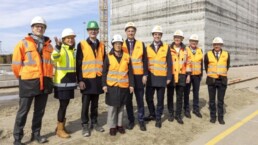

Belgian Prime Minister Alexander De Croo, Energy Minister Tinne Van der Straeten and State Secretary for Economic Recovery and Strategic Investments Thomas Dermine have visited the site in Vlissingen where caissons are being constructed for Princess Elisabeth Island. A Belgian consortium comprising DEME and Jan De Nul is building the foundations of the energy island on behalf of system operator Elia Transmission. The first of the 23 caissons is almost finished and will be immersed in the North Sea this summer. The Belgian energy island is a world first and will be the first building block in an integrated European high-voltage offshore grid.
Work began in Vlissingen in September 2023, with around 300 staff employed on site each day. As the first caisson nears completion, the scale of the project is becoming truly apparent for the first time. Each concrete block measures 57 m in length, 30 m in width and 30 m in height, and weighs 22,000 tonnes.
It takes approximately three months to build one caisson. The production process is split into five stages, each lasting 20 days. The caissons are between the different work sites using ‘runners’, which takes about six hours.
The most impressive construction phase is the second, in which slipforming is used to create the caisson walls (see video). Ten centimetres are added every hour over a period of around ten days.
23 caissons for one island
When the caissons are ready, a semi-submersible vessel will transport them further down the harbour, where they will be placed in the water and temporarily stored. They will then be moved to their final location in the North Sea this summer (weather permitting). The caissons will form the outer walls of the energy island. The island itself will be created using approximately 2.3 million m³ of sand, extracted locally. The island will be finished in late 2026, when the electrical equipment can start to be installed. Contracts for this will be tendered this year.
The energy island is being partly financed by the EU’s COVID-19 recovery fund, having been awarded a grant of around €100 million, in consultation with the Belgian government. Both Belgian and European support has also been pledged to implement a series of nature measures. In consultation with conservation and marine environment experts, a nature-inclusive design has been developed that will enhance biodiversity on and around the island.
A feat of innovation
Princess Elisabeth Island will be the first artificial energy island in the world to combine both direct current (HVDC) and alternating current (HVAC). The high-voltage infrastructure on the island will bundle together the electricity cables from the wind farms in the Princess Elisabeth Zone. The island will also become a hub for future interconnectors. In fact, these ‘hybrid’ interconnectors will have two functions, leading to enhanced efficiency. Not only will they handle power exchanges between countries, but they will also be connected to new offshore wind farms in the northern part of the North Sea that will eventually supply Belgium with large quantities of green electricity.
“The North Sea is set to become the powerhouse of our energy independence, and Princess Elisabeth Island will be a crucial part of this process. Belgium has long been a pioneer in offshore wind, and by continuing to innovate, we are further consolidating our position for the future. This gives our Belgian companies more opportunity to do groundbreaking work, both here and abroad, as well as guaranteeing sustainable, competitively priced energy for our citizens and businesses. Once again, we are putting Belgium on the map.”
Alexander De Croo, Prime Minister of Belgium
“Our offshore expertise is now world-renowned. As well as technical knowledge and expertise, Princess Elisabeth Island is also a fine example of participation. It is the first project of its size to take biodiversity into account from the outset, and to do so in consultation with experts in the field. Belgium has shown that renewable energy and biodiversity go hand in hand, and is thereby setting the standard for many future projects in the North Sea, the centre of Europe’s ambitions for offshore wind power.”
Tinne Van der Straeten, Federal Minister for Energy
“The energy island is a flagship project for the Recovery Plan and embodies three of its defining features: investment in infrastructure, deployment of innovative solutions and acceleration of the ecological transition. The project also illustrates the Recovery Plan’s dynamic approach: it will haven taken six years to get from the conceptual phase to full completion, which is quite an achievement for a project of this size.”
Thomas Dermine, State Secretary for Economic Recovery and Strategic Investments
“The energy island is of strategic importance for the energy transition in Belgium. As well as opening up the second offshore wind zone, the island concept also provides important options for the future. It will be the first energy hub in the North Sea that is connected via interconnectors to wind farms from other countries that have a surplus of renewable energy. Access to massive volumes of sustainable and cheap electricity is important for the competitiveness of our industry and the prosperity of our households.”
Catherine Vandenborre, Interim CEO, Elia Group
“The close collaboration between the TM Edison and Elia teams over the past few months has led to significant progress in realising the world’s first energy island. While construction of the caissons is in full swing, offshore work has also started to enable the installation of these caissons at sea. This unique project, which combines innovative technology with a nature-inclusive design, offers Belgian companies such as DEME another opportunity to demonstrate our pioneering role and expertise in building infrastructure that supports the energy transition.”
Luc Vandenbulcke, CEO, DEME Group
“As CEO of Jan De Nul Group, I am particularly proud of the construction of these caissons. They will soon be out at sea, forming the contours of the world’s very first artificial energy island. This is a powerful example of co-building the energy transition on water and land, and a big step towards a sustainable future. That is something that we at Jan De Nul Group and as a team at TM Edison and Elia are very passionate about.”



Related News.

Crewing After 2026: How AI Will Take Over the Routine in 2027
The crewing market of late 2026 is not the market of 2025. Artificial intelligence has moved from presentations into daily crewing work, while the…

Dualog launches secure maritime AI service amid surge in seafarer AI use
The new service, Sparks lets crew and shore teams search company emails, documents and conversations without exposing sensitive fleet information to…

Time Ticking: Two weeks for Governments to Green-Light Framework for Cutting Shipping Emissions
As a crucial fortnight of meetings opens at the International Maritime Organization opens in London, the Clean Shipping Coalition calls on member…

“K” LINE signs contract for construction of two LPG dual-fuel VLGCs
Kawasaki Kisen Kaisha, announces today that it has signed agreements with South Korea-based HD Hyundai Samho regarding the construction of two LPG…

Equinor and VNG sign 18-year gas sales agreement for supplies to Germany
Equinor will supply natural gas to the German energy company VNG until the end of 2044. The 18-year agreement is the longest gas sales agreement…

Open letter to MEPs to reject the motion for a resolution and support the inclusion of Indian ship recycling yards on the European List
Dear Members of the European Parliament, Ahead of this week’s plenary vote, European Shipowners | ECSA, BIMCO, the Cruise Lines International…

ShipVet appoints James Stairmand as Chief Executive Officer
Founder Captain Fintan Cullen moves to a non-executive role as the company builds on investment in its vetting team and technology. ShipVet, the…

USD ≈7bn lost per year the hidden cost of how shipping trades
New Torvald Klaveness study quantifies around USD 7bn a year in potentially avoidable costs in dry bulk and product tanker shipping, with a possible…

APM Terminals Maasvlakte II and Port of Rotterdam Authority take next step in terminal development
APM Terminals Maasvlakte II and the Port of Rotterdam Authority are moving forward in terminal’s development with preparations for a new phase of…

ABP inspiring the next generation
ABP host 500 young people to explore maritime and transport careers More than 500 young people from across Hampshire and the Solent explored career…
Subscribe to our newsletter!
if you dont want to swim alone in the ocean of news, sign up for the newsletter, and you will receive daily all the important news of world shipping!
